- Home
- India
- World
- Premium
- THE FEDERAL SPECIAL
- States
- Perspective
- Videos
- Sports
- Education
- Entertainment
- Elections
- Features
- Health
- Business
- Series
- In memoriam: Sheikh Mujibur Rahman
- Bishnoi's Men
- NEET TANGLE
- Economy Series
- Earth Day
- Kashmir’s Frozen Turbulence
- India@75
- The legend of Ramjanmabhoomi
- Liberalisation@30
- How to tame a dragon
- Celebrating biodiversity
- Farm Matters
- 50 days of solitude
- Bringing Migrants Home
- Budget 2020
- Jharkhand Votes
- The Federal Investigates
- The Federal Impact
- Vanishing Sand
- Gandhi @ 150
- Andhra Today
- Field report
- Operation Gulmarg
- Pandemic @1 Mn in India
- The Federal Year-End
- The Zero Year
- Science
- Brand studio
- Newsletter

Why Bengal BJP govt’s Rs 50 cr Ganga erosion budget has those living with devastation sceptical
In districts like Malda and neighbouring Murshidabad, the river has redrawn maps, erased villages and displaced generations. For families who have watched governments come and go while the river kept advancing, the question is whether a Rs 50 crore allocation can begin to address a disaster that has consumed lives and livelihoods for decades.

The Ganga did not just take away Abdullah Sheikh’s home. It swallowed the fields that sustained his family, along with the documents that had come to define his very identity in an age when a person's existence is increasingly established on paper.Over time, it also washed away much of his hope of a restart.Sitting outside a makeshift dwelling pieced together from broken bricks in Mothabari,...
The Ganga did not just take away Abdullah Sheikh’s home. It swallowed the fields that sustained his family, along with the documents that had come to define his very identity in an age when a person's existence is increasingly established on paper.
Over time, it also washed away much of his hope of a restart.
Sitting outside a makeshift dwelling pieced together from broken bricks in Mothabari, an erosion-ravaged village in Malda district, 67-year-old Sheikh struggles to recount all that he has lost.
"Everything went into the river," he says quietly. "I had farmland, I had a home. I received neither land nor a house afterwards. Whatever shelter I have today, I built myself."
When the river advanced, there was barely enough time to save the family. Most of his documents disappeared with the collapsing house.
The grief of losing his only son, then 19, in an accident soon after, only deepened the void.
His story is one among thousands that continue to unfold along the Ganga in Malda and neighbouring Murshidabad, where the river has redrawn maps, erased villages and displaced generations.
The new Bharatiya Janata Party government in West Bengal, in its first budget for the state, has allocated Rs 50 crore for Ganga erosion control in Murshidabad, reviving some hopes in the riverine belt.
But for families who have watched governments come and go while the river kept advancing, the bigger question is whether such a modest allocation can begin to address a disaster that has consumed villages, farmland, livelihoods and lives for decades.
Although riverbank erosion along the Ganga is a natural phenomenon, as with any major river, the crisis assumed far greater proportions after the Farakka Barrage became operational in 1975.
The first documented episode of catastrophic erosion predates the barrage and occurred around Dhulian in Murshidabad between 1952 and 1953, when the old town was almost entirely washed away after the Ganga shifted its course. Erosion continued until 1956, resumed in 1968, and from 1969-70 onwards became a recurring feature of life along the Ganga.
Also read: Why new BJP government in Bengal has brought both hope, apprehension to Bengali film industry
The scale of the devastation is difficult to comprehend until one stands on the riverbank at Panchanandapur in Malda.
Standing on the riverbank, local activist Torikul Islam, however, does not point towards villages. Instead, he points into the river.
"Janutola, Jagitola, Ujaltola, Hazaritola, Banutola..." he says, naming settlements that once stood where the Ganga now flows. There were markets, schools, temples, mosques, sugar mills and thriving agricultural settlements, he recalls. "Everything has gone under the river."
According to Islam, who has spent decades documenting erosion as part of the Ganga Bhangan Pratirodh Nagarik Action Committee (GBPNAC), the river has shifted nearly 17 kilometres eastward in parts of Malda since the 1960s.
"Sixty-three mouzas have been affected. Seven to eight lakh people have suffered over the decades. If you include everyone touched by erosion today, the number is close to ten lakh," he claims.
Those figures could not be independently verified by The Federal, but there is little dispute about the enormity of the problem.
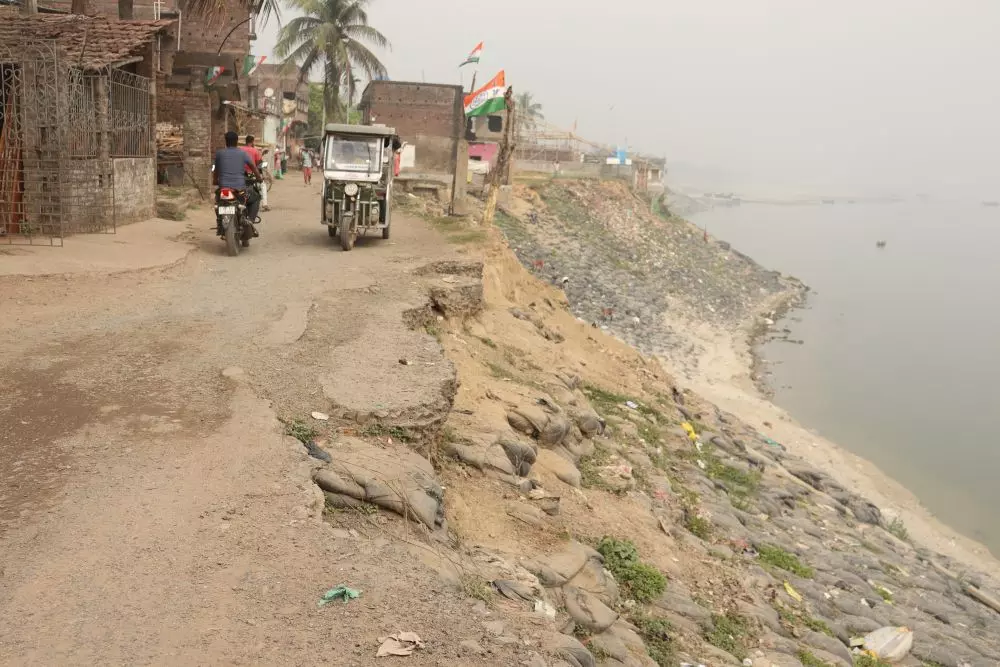
Life along the Ganga in Mahishasthali, Murshidabad. Photo: Abhishek Sharma
In villages across Malda and Murshidabad, stories of families rebuilding homes three, four or even six times have become commonplace. Entire neighbourhoods have disappeared, only for sandbars, or ‘chars’ as it is known in Bengali, to emerge years later on the opposite bank.
Ironically, many of those displaced have resettled on chars that surfaced on the opposite bank after the river changed course.
The river's changing course has created another extraordinary consequence. As the Ganga has drifted steadily eastwards, new chars have emerged on its western bank, across what is today Jharkhand.
Many of those who lost their homes in Malda eventually returned to these islands because the land that resurfaced often belonged to them or their ancestors.
But rebuilding there has meant living in administrative limbo. For years, families possessed West Bengal land records while depending on Jharkhand for ration cards, schools and other basic services.
"We cannot apply for government jobs because Jharkhand treats us as temporary residents, while West Bengal does not even recognise these settlements as its own," claims Ruhul Amin, a 47-year-old private tutor and resident of Piyarpur, one of the villages on the chars that surfaced on the western bank of the Ganga. "We are caught in between. That uncertainty has also made many Bengali-speaking Muslims vulnerable to being labelled as outsiders."
The shifting river has not merely erased villages. It has blurred state boundaries and created an identity crisis for thousands of displaced families.
"As the river shifted, many people moved to the chars that reappeared," Islam says.
"Around 2.5 lakh people live there today, but basic services remain scarce. There are hardly any health facilities, higher educational institutions or proper infrastructure. Every day, people cross the river by boat simply to visit a doctor or buy essentials."
For many victims, rehabilitation has remained incomplete even where government assistance reached them.
In Mahishasthali village in Murshidabad, repeated erosion in 2020 and 2021 displaced an estimated 150 families. The previous state government later distributed one-katha (a unit of land measurement) land pattas and financial assistance to help them rebuild.
Yet several years later, many families are still living in temporary shelters/camps that had been set up in schools and anganwadi centres or with relatives.
"It is difficult to construct a house with Rs 1.2 lakh or Rs 1.35 lakh," says resident Satyam Sarkar, who claims to be a local activist. "Some families have managed to move into their new homes, but many others are still unable to complete construction."
The contrast illustrates a challenge that extends beyond engineering.
Building embankments may stall erosion in some stretches. Rebuilding lives is a far more complicated task.
For decades, the debate over erosion in Malda and Murshidabad has revolved around the Farakka Barrage.
Conceived in the early 1950s, the barrage project aimed to divert Ganga water into the Bhagirathi-Hooghly river system and improve the navigability of the Kolkata port. Construction began in 1961 and the barrage and its 42-km feeder canal were completed in 1970. However, the project became fully operational only on April 21, 1975.
Over the decades since, the barrage has remained contentious.
Many river experts argue that changes in sediment flow and river hydraulics after the barrage accelerated bank erosion downstream and altered the river's course.
Others point to a combination of natural river dynamics, increasing sediment load and changing rainfall patterns linked to climate change.
Mosarekul Anwar, a river conservationist associated with the GBPNAC, argues that the Farakka Barrage fundamentally altered the river's behaviour.
"The barrage slowed the river, encouraged heavy silt deposition upstream and forced the Ganga to seek a new course," he says. "The result has been relentless bank erosion across large parts of Malda and Murshidabad."
The concerns are not new. Even before the barrage became operational in 1975, engineer and river expert Kapil Bhattacharya had warned that obstructing the Ganga's natural flow without adequately accounting for its sediment load could increase siltation upstream, intensify floods in Bihar, Malda and Murshidabad and accelerate erosion along vulnerable stretches of the river.
As the Ganga continues its eastward migration, the gap between it and the Fulahar (which flows through Bihar, running parallel to the Ganga, before merging with it in Manikchak, Malda) has narrowed sharply over the past decade. “A decade ago, the distance between the two rivers was about 10 kilometres. It has now shrunk to about 800 metres,” Anwar had told The Federal in 2024.
“If the two rivers eventually converge near Ratua, dozens of villages could face a fresh wave of erosion, placing thousands more families at risk of displacement,” said Sujapur MLA Sabina Yeasmin, who served as irrigation and waterways minister in the previous Trinamool Congress government.
The issue acquires fresh significance because the India-Bangladesh Ganga Water Treaty, signed in 1996, is due for renewal later this year. Much of the public debate has focused on sharing dry-season flows between the two countries. Less attention has been paid to how changing river behaviour continues to devastate communities on both sides of the border.
The Bangladesh Water Development Board has identified the Padma (the eastern distributary of the Ganga) as one of the country's most erosion-prone rivers, with recurring loss of farmland, homesteads and public infrastructure reported in districts such as Chapai Nawabganj, Rajshahi, Kushtia, Rajbari and Shariatpur, located along the Padma riverbanks.
According to the 2025 annual report of the Bangladesh River Research Institute, the Padma's constantly shifting main channel has consumed roads, schools, healthcare facilities, markets and vast stretches of farmland, making riverbank erosion one of the most persistent challenges for communities settled along the river.
Also read: Why Bengal’s oft-cited cultural supremacy might be on a decline
Meanwhile, for people in West Bengal living along the river, international diplomacy remains a distant concern. Their immediate struggle is survival.
Islam believes successive governments in the state and at the Centre have approached the crisis in fragments rather than as a long-term humanitarian challenge.
"If there is a flood, people receive compensation. If there is a cyclone, there is compensation. If there is a fire or an earthquake, there is compensation," he says. "But when the Ganga takes away everything except a person's life, there is no compensation."
He argues that responsibility should be shared.
"The Centre must prepare a permanent master plan because this is a national river," he says. "The state government, on its part, should ensure full rehabilitation and compensation for families who have lost their homes and land."
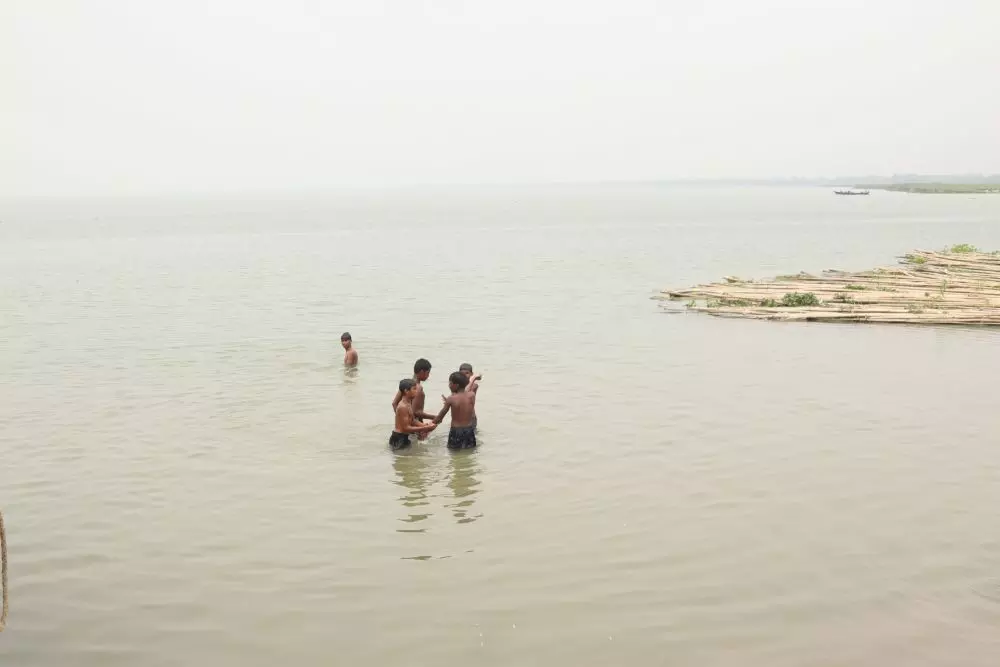
The river that sustains and swallows life in Panchanandapur, Malda. Photo: Abhishek Sharma
With the BJP now in power both at the Centre and in West Bengal, many in the erosion-hit belt believe the long-standing blame game between the two governments should finally give way to coordinated action.
Jangipur MP Khalilur Rahaman, who recently broke away from the Trinamool Congress and extended support to the Bharatiya Janata Party-led National Democratic Alliance, welcomed the latest budgetary allocation and said his decision to back the ruling alliance was driven in part by the belief that long-pending issues such as Ganga erosion and floods could now be addressed through closer coordination between the Centre and the state. Speaking to the media recently, Rahaman added that the region needed a permanent solution rather than piecemeal interventions.
The Federal also spoke to minister of state (MoS) for irrigation and waterways, Joyel Murmu, about the Rs 50 crore allocation. According to the MoS, the funds would be used for anti-erosion measures and rehabilitation in the Jangipur region. "Details and specifics are being worked out," he said.
Meanwhile, residents remain cautious after decades of promises that have outlasted successive administrations.
That scepticism runs across the erosion-hit belt, from Dhulian in Murshidabad to Panchanandapur in Malda.
"This was the second time the river took away our house [the first was in November 2023, the second in July 2024]," says Mohammad Nazim, a resident of Dhulian.
"You rebuild because you have no other choice. But every monsoon you wonder if the river will return for what is left."
In Dhulian, once a bustling river port known for trade, weaving and fishing, repeated displacement has steadily transformed the local economy.
Traditional occupations have faded, forcing many residents into bidi rolling or migrant labour.
Schools have shifted repeatedly to escape the advancing river. Young people leave in search of work, unsure whether the land they were born on will exist a decade later.
Nearly 100 km upstream in Panchanandapur, Mohammed Inamul Haque has little reason to believe that relief is finally at hand.
Having lost 33 acres of farmland in eight bouts of erosion, he says each monsoon still brings the same fear that the river could claim whatever remains.
As dark clouds gather over the river, families watch fresh cracks appear along the embankment.
Household belongings are packed in haste, ready to be moved at a moment's notice.
For those who have already rebuilt their homes several times, the budget announcement offers cautious optimism but little certainty.
"Rs 50 crore may strengthen some vulnerable stretches," says Murshidabad-based historian Faruque Abdullah. "But erosion here is also a humanitarian crisis built over decades. It requires rehabilitation, long-term river management and sustained coordination between the Centre and the state."
Along the banks of the Ganga, where maps have changed more often than governments, people are no longer waiting for promises.
They are waiting to see what rains on them this monsoon.