


- Home
- India
- World
- Premium
- THE FEDERAL SPECIAL
- States
- Perspective
- Videos
- Sports
- Education
- Entertainment
- Elections
- Features
- Health
- Business
- Series
- In memoriam: Sheikh Mujibur Rahman
- Bishnoi's Men
- NEET TANGLE
- Economy Series
- Earth Day
- Kashmir’s Frozen Turbulence
- India@75
- The legend of Ramjanmabhoomi
- Liberalisation@30
- How to tame a dragon
- Celebrating biodiversity
- Farm Matters
- 50 days of solitude
- Bringing Migrants Home
- Budget 2020
- Jharkhand Votes
- The Federal Investigates
- The Federal Impact
- Vanishing Sand
- Gandhi @ 150
- Andhra Today
- Field report
- Operation Gulmarg
- Pandemic @1 Mn in India
- The Federal Year-End
- The Zero Year
- Science
- Brand studio
- Newsletter

Why West Bengal appears to be witnessing a more unidimensional political messaging this Durga Puja
Political messaging through Durga Puja celebration is hardly a new concept in West Bengal, where themed decors or bookstalls set up near Puja venues have traditionally pushed party narratives. This year, the first Durga Puja celebration since the BJP's assembly election victory in West Bengal, invocations of Ram Rajya and Vande Mataram, along with a 'Slaying the Left' slogan, are among prominent political statements. And the messaging seems to be more one-sided than before, say experts.

A Durga Puja pandal near Kolkata’s Ruby Crossing traces Chief Minister Suvendu Adhikari’s journey from Nandigram to Nabanna (the state secretariat) this year. At another pandal, organisers celebrate Syama Prasad Mookerjee, founder of the Bharatiya Jana Sangh (the predecessor of the Bharatiya Janata Party, or BJP). Invocations of Ram Rajya and Vande Mataram, along with a ‘Slaying the...
A Durga Puja pandal near Kolkata’s Ruby Crossing traces Chief Minister Suvendu Adhikari’s journey from Nandigram to Nabanna (the state secretariat) this year. At another pandal, organisers celebrate Syama Prasad Mookerjee, founder of the Bharatiya Jana Sangh (the predecessor of the Bharatiya Janata Party, or BJP). Invocations of Ram Rajya and Vande Mataram, along with a ‘Slaying the Left’ slogan, are among the other prominent political statements this year, suggesting the manifestation of a more uniform ideological narrative in the state’s first Durga Puja festival — being celebrated between October 16 and 21 — since the BJP came to power in West Bengal earlier this year.
The push for ideological uniformity is also evident in the dispute over the setting up of Communist Party of India (Marxist) bookstalls near Puja venues, even as the BJP plans to set up “5,000 stalls” near Puja pandals to promote the party ideology. The issue has now reached the Kolkata high court.
The ruling party’s book stalls, according to party sources, will offer publications on Prime Minister Narendra Modi’s tenure, Mookerjee’s life and ideology, the history of the BJP and the Rashtriya Swayamsevak Sangh (RSS, the ideological fountainhead of the BJP), and the achievements of the central and state governments among others.
Also read: How women are claiming their place in both the spiritual and celebratory aspects of Durga Puja
Political messaging through Durga Puja celebrations is hardly a new phenomenon in West Bengal, whether through pandal artwork or bookstalls set up near Puja venues.
Even during the previous Trinamool Congress’s 15-year governance, pandal presentations often reflected the ruling party’s political priorities, with some Puja organising committees highlighting the state government’s welfare schemes and others criticising the Centre over issues such as demonetisation, the controversial National Register of Citizens (NRC) and its handling of the 2021 farmers’ protests (against three disputed farm laws that have since been repealed).
A few committees went further, depicting Mamata Banerjee as Goddess Durga in their pandal presentations — Bhawanipore Durgotsav Samity in Kolkata and Prantik Club in Chakdah, Nadia, in 2016, and Nazrul Park Unnayan Samity in Baguiati, in 2021.
“Although the messaging often favoured the ruling party disproportionately, it had never appeared as one-sided as it does this year,” claims political commentator and Commonwealth Fellow Debasish Chakrabarti.
At Suruchi Sangha in New Alipore, a south Kolkata Puja once associated with TMC leader Aroop Biswas, the theme this year centres on Syama Prasad Mookerjee. Photo: Debosree Chatterjee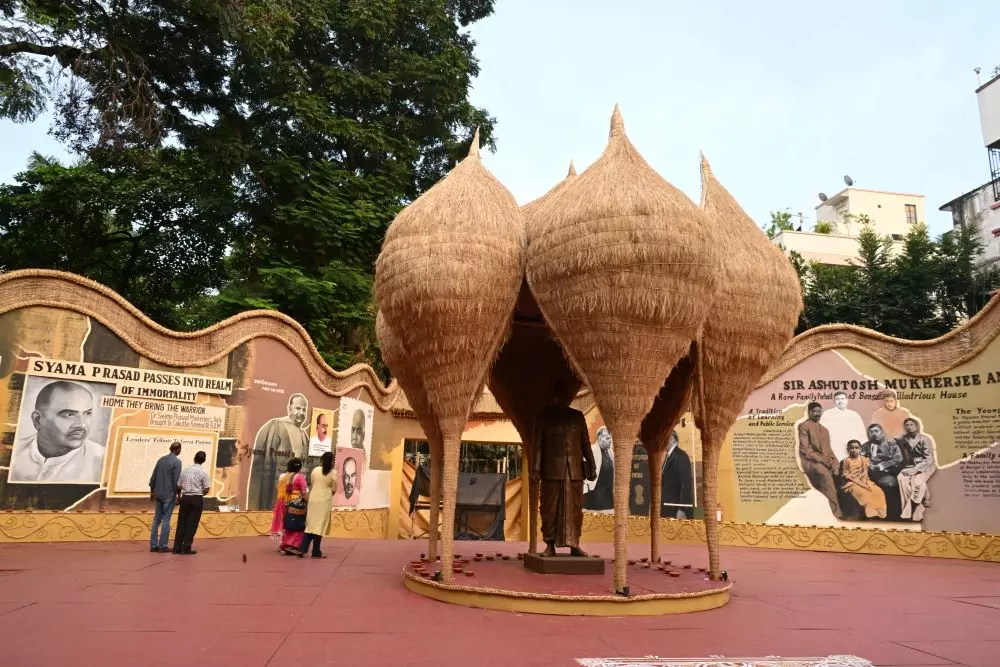
BJP-aligned organisers, too, got the opportunity to use the festival to promote their politics and set up book stalls in the past. In 2019, a Kolkata pandal recreated the 2019 Balakot airstrikes, while themes centred around space missions such as Chandrayaan (a series of lunar missions launched between 2008 and 2023) provided another avenue for showcasing India’s technological achievements under Narendra Modi.
In 2022, a Durga Puja organised by the Akhil Bharatiya Hindu Mahasabha depicted an asura resembling Mahatma Gandhi, triggering a controversy. Santosh Mitra Square’s Ram temple presentation in 2023 and its Operation Sindoor display in 2025 (depicting the Indian military campaign following last year’s Pehalgam terror strike) further illustrate how the BJP’s political messaging did find space, albeit on a much smaller scale, when the party was in opposition in the state.
“Not that the TMC government was entirely accommodating of opposing viewpoints, but with the BJP in power at the Centre and the TMC in the state, the political balance may have left the then opposition in the state more room for expression during Mamata Banerjee’s tenure as chief minister,” Chakrabarti added.
However, Kartik Roy of Kestopur Prafulla Kanan Paschim Adhibasi Brinda club, which is celebrating the 100-year-old legacy of Chhattisgarh’s Ramnami Samaj (members of the community have the word ‘Ram’ tattooed on their bodies) through its pandal themed “Jahate Mono Romi” (Where the Mind Finds Devotion), says the club had planned a similar theme two years ago but dropped it, apprehending that it might not go down well with the then ruling dispensation. Roy’s admission points to another hard reality of Durga Puja politics, with committees often keen to stay on the right side of the ruling dispensation, both to avoid confrontation and to secure government grants.
This tendency appears to have become more pronounced this year, with the BJP in power both at the Centre and in the state — a “double-engine sarkar”, which may help explain the more uniform political messaging.
At Ruby Crossing, the Akhil Bharat Hindu Mahasabha has chosen “Nandigram theke Nabanna, Bubaiyer Jayajatra (From Nandigram to Nabanna, Bubai’s Triumphant Journey”, tracing Adhikari’s political rise from the Nandigram agitation (against the then Left government’s drive to acquire agricultural land to set up a special economic zone; Adhikari was then a member of the TMC) to the chief minister’s office. Bubai is Suvendu Adhikari’s nickname.
The pandal, however, was still unfinished by Thursday evening, at the time of filing this report, just a day ahead of the formal beginning of the Durga Puja celebrations.
Explaining the choice of theme, Hindu Mahasabha state president Chandrachur Goswami said the organisation identified with Adhikari’s religious beliefs and wanted to honour him by depicting his political journey. (It is the same organisation that had depicted a Mahishasura figure resembling Mahatma Gandhi in 2022.)
Photographs, murals, models and a documentary, along with a bust of Adhikari outside the pandal, will be used to depict the chief minister’s political journey, which another committee member said helped free Bengal from TMC rule and contributed to the end of Communist rule in the state.
Kestopur Prafulla Kanan Paschim Adhibasi Brinda club is celebrating the legacy of Chhattisgarh’s Ramnami Samaj (members of the community have the word ‘Ram’ tattooed on their bodies) through its pandal themed “Jahate Mono Romi” (Where the Mind Finds Devotion). Photo: Debosree Chatterjee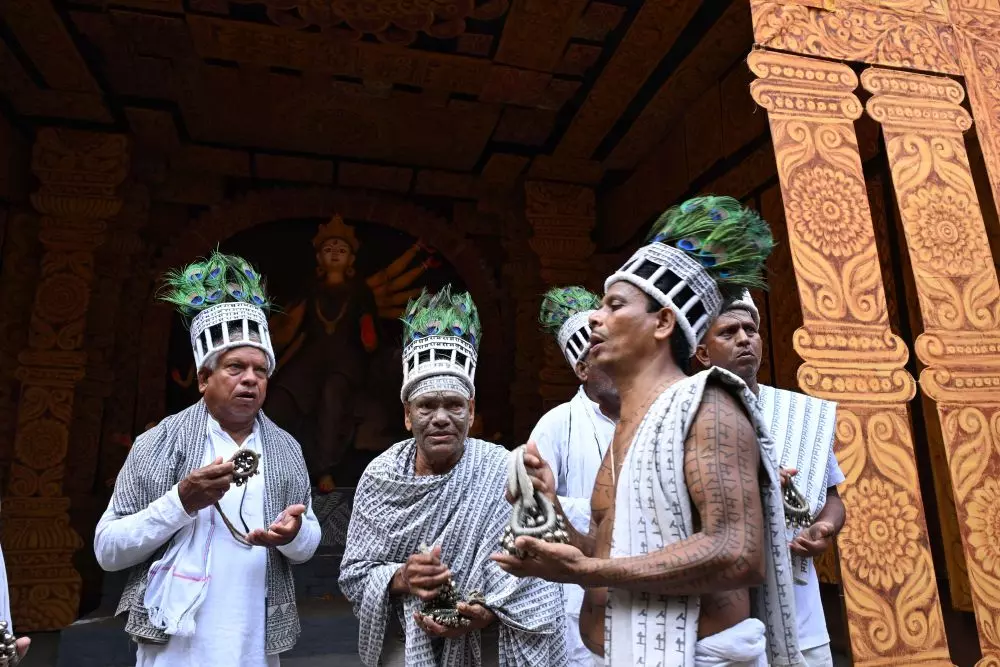
At Suruchi Sangha in New Alipore, a south Kolkata Puja once associated with TMC leader Aroop Biswas, the theme this year centres on Syama Prasad Mookerjee. The committee is now led by BJP MLA Sourav Sikdar. The pandal displays trace Mookerjee’s life and political career through photographs, sculptures and other exhibits. His association with the Jana Sangh and his campaign against Article 370 of the Constitution (which allowed for some special provisions for the erstwhile state of Jammu and Kashmir and was scrapped by the Narendra Modi government at the Centre in 2019) also feature in the presentation.
The theme reflects the BJP’s longstanding effort to place Mookerjee at the centre of Bengal’s political history. For the party, he is both a Bengali political figure and an ideological forebear.
Sikdar said the theme would highlight a history that, in his view, successive Congress, Left and TMC governments had sought to keep out of public view. The festival gives that history a public platform beyond party meetings and political literature.
BJP MLA Sajal Ghosh’s Santosh Mitra Square Puja invokes Vande Mataram while Young Boys Club on Tara Chand Dutta Street has chosen ‘Ram Rajya’ as its theme. These are among the prominent pandals whose themes echo the ruling party’s commonly-espoused ideological stand.
“One of the things that makes Durga Puja special is its capacity to highlight contemporary issues and reflect them through its themes and installations. That is what makes it a living heritage of street art. Political expression has always been part of this tradition, but when it turns into overt political propaganda, it risks overshadowing artistic imagination, undermining the very creative freedom that makes the festival distinctive,” pointed out Amal Sarkar, political commentator and author.
Even pandal-hoppers acknowledge that pandals built around overt political propaganda do not always appeal.
“When a pandal becomes too much about promoting a party or a leader, it loses its wider appeal. People may look at it out of curiosity, but that does not necessarily mean it will draw the same crowds as a theme that captures their imagination,” said Kuntal Chakrabarty, a government employee and resident of Kolkata’s Behala area, who makes it a point “to visit 25-30 pandals every year”.
Added Joydev Mistri, a businessman from the city’s Thakurpukur area: “Many of Kolkata’s best-known pandals continue to draw on art, literature, environmental issues, local history and social concerns without resorting to overt political messaging.”
Perhaps nowhere is ideological hostility surrounding the celebrations this year, as starkly reflected as in the “Bam Bodh” (Slaying the Left) slogan raised by the Kamardanga Sarbojanin Durgotsav Samiti in Kolkata’s Entally area. The committee has chosen “Hindu Sanatan Rashtra” as its pandal theme.
Suraj Kumar Singh, one of the organisers of the Puja, said the committee would not allow Left-wing bookstalls near its pandal this year. “There will be ‘Bam-Badh’. Call it our slogan or theme line. This is what we have decided,” he said. Singh added that the Puja would feature documentaries on the Marichjhapi massacre (a 1979 eviction drive against refugees from Bangladesh) and other alleged atrocities under Left rule in West Bengal.
Kamardanga Sarbojanin Durgotsav Samiti in Kolkata’s Entally area has adopted 'Bam Byodh' (Slaying the Left) as its slogan. The committee has chosen “Hindu Sanatan Rashtra” as its pandal theme. Photo: Debosree Chatterjee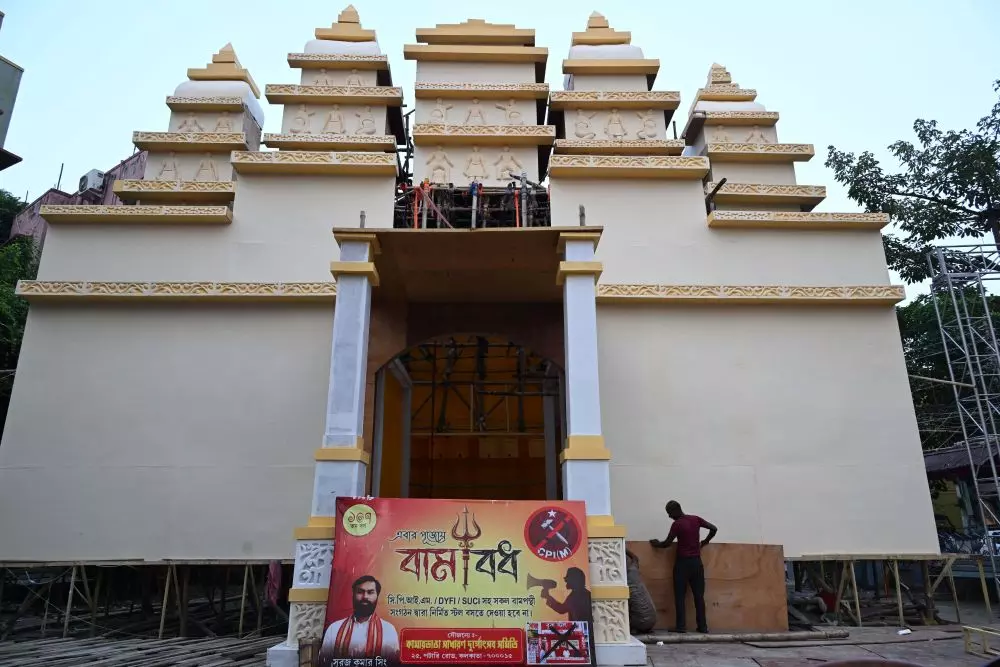
The objection to Left-wing bookstalls is not just limited to one Puja committee. The CPI(M) has alleged that it is facing difficulties in obtaining permission from the concerned government departments to set up bookstalls near Puja pandals, as it has done for decades in the past.
This has raised concerns about an institutionalised attempt to curb political diversity at a festival long used to articulate competing political ideologies.
In Bongaon, the party alleged that it was prevented from setting up its traditional bookstall on Jessore Road, even as a stall linked to the RSS-affiliated Hindu Jagran Manch was allowed at the same spot, prompting it to move the high court.
Also read: Why some Indians are looking to ‘rent’ a partner for garba and dandiya events this Navratri
The concern over shrinking space for competing political ideologies was even expressed in the court when Justice Saugata Bhattacharyya, while hearing the CPI(M)’s plea, told the state government, “Don't stifle the voice of other parties, that is not the spirit of democracy.”
For the next five to six days, Bengalis will take a break from routine to celebrate a festival the arrival of which is keenly awaited through the year. The queues at the pandals (or the absence of crowds) will indicate how far this year’s Puja political messaging is successful in catching the eye of the revellers.