- Home
- India
- World
- Premium
- THE FEDERAL SPECIAL
- States
- Perspective
- Videos
- Sports
- Education
- Entertainment
- Elections
- Features
- Health
- Business
- Series
- In memoriam: Sheikh Mujibur Rahman
- Bishnoi's Men
- NEET TANGLE
- Economy Series
- Earth Day
- Kashmir’s Frozen Turbulence
- India@75
- The legend of Ramjanmabhoomi
- Liberalisation@30
- How to tame a dragon
- Celebrating biodiversity
- Farm Matters
- 50 days of solitude
- Bringing Migrants Home
- Budget 2020
- Jharkhand Votes
- The Federal Investigates
- The Federal Impact
- Vanishing Sand
- Gandhi @ 150
- Andhra Today
- Field report
- Operation Gulmarg
- Pandemic @1 Mn in India
- The Federal Year-End
- The Zero Year
- Science
- Brand studio
- Newsletter

World Chocolate Day: How entry of craft chocolatiers has changed cacao cultivation in India
Most of India’s cacao production happens in the South. As craft chocolate makers enter the market, demand for premium ingredients has pushed a shift toward quality-driven practices, but it continues to be grown primarily as an intercrop beneath taller plantation trees. On World Chocolate Day, July 7, a look at how homegrown artisanal chocolate brands have impacted cocoa cultivation in India.

From April to June, every Wednesday, Dinesh Rao, manager at a three-acre arecanut estate near Mangaluru, Karnataka, prepares for the sale of cacao pods harvested from trees grown as an intercrop on the plantation. The estate has about 25 cacao trees, scattered across the plantation, thriving under 30 to 40 per cent shade. The cover helps regulate temperature, conserve soil moisture and...
From April to June, every Wednesday, Dinesh Rao, manager at a three-acre arecanut estate near Mangaluru, Karnataka, prepares for the sale of cacao pods harvested from trees grown as an intercrop on the plantation. The estate has about 25 cacao trees, scattered across the plantation, thriving under 30 to 40 per cent shade. The cover helps regulate temperature, conserve soil moisture and improve bean quality.
“The yield during our harvest season tapers off steadily,” Dinesh says, adding that their beans are sent to an industrial chocolate maker’s factory. At peak production, a single tree yields about two-three kilograms a week, or roughly five-seven wet cacao pods. This translates to 450–600 grams of wet beans, which after sun-drying yield 180–250 grams of dry beans. For context, about 50–115 grams of cacao beans are needed to make one bar of dark chocolate, depending on cocoa percentage.
Most of India’s cacao production is concentrated in the South. According to National Horticulture Board and Ministry of Agriculture and Department of Animal Husbandry figures, 41.39 per cent of India’s cacao production in 2024-25 came from Andhra Pradesh, followed by Kerala (35.92%), Karnataka (13.22%) and Tamil Nadu (9.48%).
Also read: Beyond mid-day meal debate, how the humble egg remains both comfort food & delicacy in Bengal
Cacao, or cacao plants, require a high temperature, plentiful rains and shade. The International Cocoa Organisation mentions ideal conditions as “maximum annual average of 30– 32ºC and a minimum average of 18–21ºC” and “annual rainfall level of between 1,500mm and 2,000mm”. It adds that “cocoa tree[s] will make optimum use of any light available and traditionally has been grown under shade. Its natural environment is the Amazonian forest which provides natural shade trees”.
Many of these conditions are satisfied in the plantations in the South.
While India does not currently feature among the top cocoa-producing countries in the world, according to reports, it aims to be a self-sufficient, globally competitive cocoa economy by 2040-41.
The target helps, given the country’s growing chocolate market.
The International Market Analysis Research and Consulting Group (IMARC Group) valued India’s chocolate market at “USD 3.05 Billion in 2025 and is projected to reach USD 5.62 Billion by 2034, growing at a compound annual growth rate (CAGR) of 7.01 per cent from 2026-2034”. Artisanal and craft chocolate was found to be the fastest-growing segment, “growing at an 11.52 per cent CAGR”.
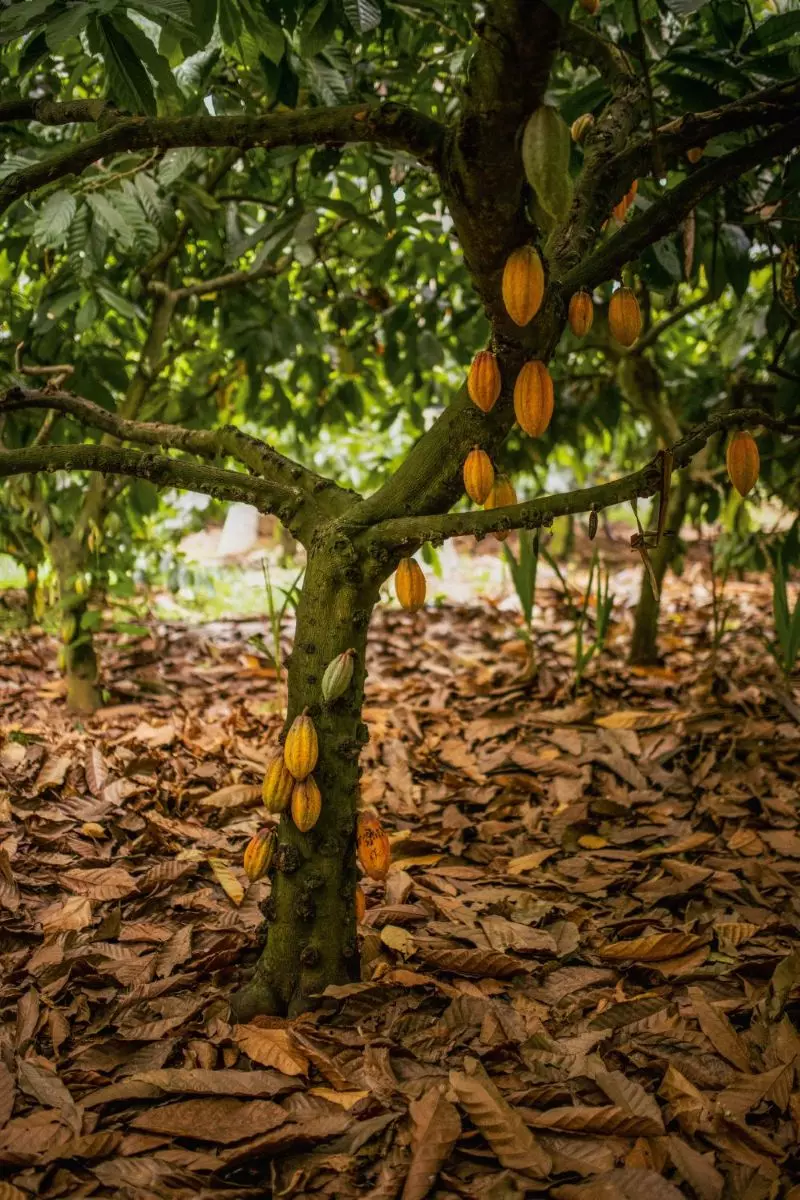
In India, cacao is almost always grown as an intercrop beneath taller plantation trees such as coconut, arecanut, oil palm or rubber. As niche craft chocolate makers enter the market, demand for premium ingredients has pushed a shift toward quality-driven practices, say those in business.
For premium or craft chocolate production, maintaining the right level of shade is considered good agricultural practice: it promotes healthier trees, steadier pod production and slower bean development, all of which can enhance flavour.
Chaitanya Muppala, founder of Manam Chocolate, sources cacao from farms in West Godavari and often refers to the three pillars of quality: genetics, terroir (the complete natural environment in which a plant is grown) and post-harvest practices.
“Cacao trees in India are seed-propagated, with the initial ICS [Imperial College Selection] stock traced back to the 1960s,” he says. “That means decades of cross-pollination. We couldn’t change genetics and we didn’t want to import from other countries because of regulatory constraints. Terroir also can’t be changed. That leaves post-harvest practices where we’ve made significant progress.”
Muppala describes a ‘bar to beyond’ philosophy, signalling an evolution from bean-to-bar chocolate making to a broader culinary ecosystem built around Indian cacao.
Most of the major players in craft chocolates are closely involved in the post-harvesting processes.
Near the Godavari River, in Rajahmundry (Andhra Pradesh), is Bon Fiction’s cacao processing facility. Its founders, Akhil Grandhi and his wife Prathima Grandhi, call their chocolates ‘Tree-to-bar’ which details the extent of their involvement in making it. “What I have seen is that the farmers in Andhra already follow the best agricultural practices,” says Akhil. “What was missing was the post-harvest process [fermentation and drying of beans] which is where Bon Fiction stepped in.”
According to him, in a premium bar of dark chocolate, there are two ingredients – cocoa and organic sugar. “If the quality of cacao is good, that is all we need. As things get more premium, we need to taste the ingredients. Not mask it.”
Muppala established the Distinct Origins Cacao Fermentery in Tadikalapudi in 2021, working with about 200 member farmers. Instead of buying processed beans, the fermentery sources fresh pods and manages post-harvest processing centrally, allowing farmers to focus on cultivation.
Beans are sorted, then fermented under monitored conditions, tracking temperature, pH (acidity), humidity and sugar levels. They are then slow-dried under sun and shade, hand-sorted, graded and vacuum-packed.
“We’ve used software-driven systems at every stage, from data collection to genomics to polygon mapping [visualising and analysing geographic areas using polygons] to showing buyers the location of the farms in order to ensure traceability and certified data chain,” Muppala says. Farmers use an app for transactions while Manam Chocolate bars carry QR codes detailing origin, including farm-level sourcing.
Akhil, too, has invested in data-driven processing. By analysing fermentation and flavour profiles, he selects specific varieties for different chocolate profiles. “Our cacao is now exported to chocolatiers globally, including in Europe,” he says.
Other craft chocolate makers also boast of similar due diligence. If Soklet has its own cacao estate, Paul and Mike depend on a system of farm partnerships and Kocoatrait follows a direct trade model.
Traditionally, cacao farming in India resembles systems in Côte d’Ivoire and Ghana — the world’s top two cocoa-producing countries in 2025 — relying on smallholders, say those in the know.
In South India, cacao flowers and fruits year-round, with two main harvest peaks: September to January, after the monsoon, and June to August during the summer flush. In well-irrigated farms, smaller harvests continue throughout the year. Because pods ripen unevenly, harvesting is done selectively rather than in a single cycle.
The steady labour can provide a reliable income, but it also demands constant attention.
In earlier years, low demand meant farmers invested less in inputs such as fertilisers. Today, rising demand from craft chocolate makers is changing that. “If we use gobbara (manure), yields increase significantly,” Dinesh says.
Farmers such as Boyapati Venkateshwara Rao have shifted in the past five-six years from chemical inputs to vermicompost and coconut husk mulch, improving soil health and consistency in bean quality. “I am also a partner farmer with Manam Chocolate,” he says.
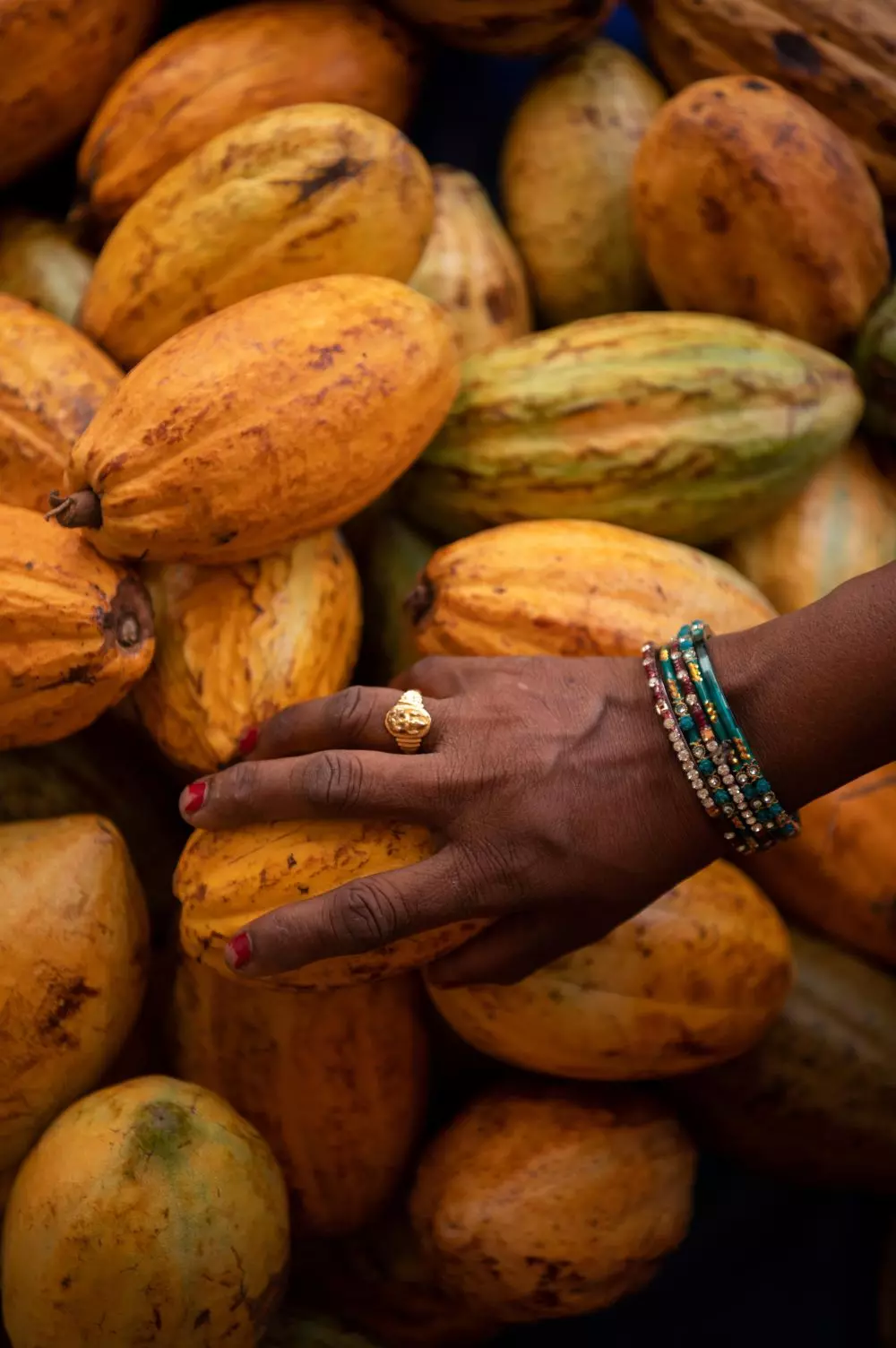
Harvested cacao pods at a farm in India. Photo: By special arrangement
And yet, despite the push from craft chocolate, production continues to largely follow the intercrop model, say those involved in cultivation.
“You won’t see monocrop cacao here; it isn’t economically practical,” Dinesh says.
Indian craft chocolate spans a wide spectrum, from Naviluna’s experimental single-origin bars to Soklet’s terroir-focused approach. If Manam produces around 30 couvertures, 36 varieties of tablets and a total of 350 products across 50 categories, at the other end, Naviluna offers a small, tightly curated range of about nine flavours.
Prices reflect the labour-intensive process; Naviluna’s 72% Tokai Coffee & Pineapple bar costs Rs440, Manam’s Indian Origin Tablet No. 1 (45% milk) is Rs495, and Bon Fiction’s Coconut Covenant (55% dark coconut milk and sugar) is Rs295. These are not your average chocolates.
“The fact that India can produce single-origin chocolate is itself a matter of pride,” says Vishwanath Rao, a software engineer and chocolate connoisseur who publishes a monthly chocolate newsletter.
While many craft chocolatiers describe themselves as pioneers of bean-to-bar or tree-to-bar chocolate in the country, Indian products have also begun receiving international recognition, including awards and export demand.
According to Akhil, India has the supply and the processing capabilities in place, but demand has yet to catch up (his observation a departure from the IMARC Group’s optimistic market valuations).
“I’ve personally seen the acreage double over the past two years,” says Akhil. “Now demand has to grow as well.”
If that happens, India’s cacao production, currently accounting for less than 1 per cent of global output, should increase.
Muppala points to regulatory shifts in Europe, particularly the EU Deforestation Regulation (EUDR), as a potential catalyst for exports given its emphasis on traceability and deforestation-free sourcing. “That’s the reason we have taken the efforts to make our products traceable to any potential buyer.”
For Dinesh, however, expansion remains uncertain. “At peak harvest, we get about Rs 120 a kilogram and earn Rs 30,000 to Rs 40,000 a year,” he says. “I’ve heard of an estate in Dharmasthala [Karnataka] that grows cacao as a monocrop. But I think we’ll have to wait a while before we reach that stage.”