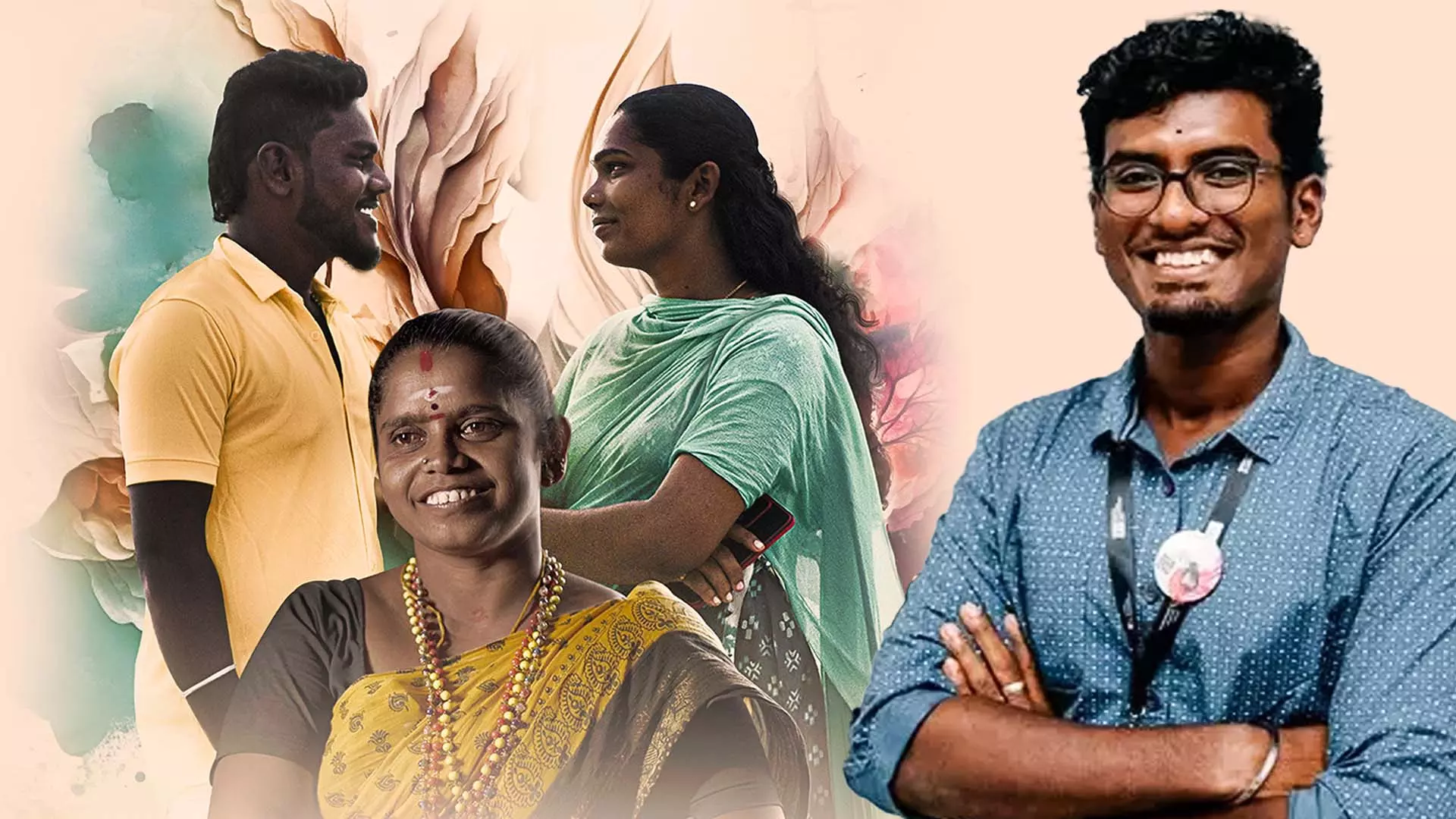
Shiva Krish on how Amma’s Pride chronicles Tamil Nadu’s first recognised trans marriage
The director of the Oscar-qualified documentary on how he documented Tamil Nadu’s first legally registered trans marriage, the power of parental support, and his mission to take this story to 12,000 village panchayats

Amma’s Pride, a short documentary led by trans voices, has qualified for the Oscars. It follows a landmark fight for dignity: the legal recognition of a trans woman’s marriage in Tamil Nadu. Its director, Shiva Krish, tells The Federal how the film grew from a news report into an intimate portrait of family, acceptance, and an impact campaign aimed at taking the story beyond festivals and into everyday spaces. Excerpts from the interview:
Can you take us through the journey of making Amma’s Pride and was there any moment that stayed close to your heart?
Around mid-2019, I came across a news article about Srija legally registering her marriage in Tamil Nadu. She was the first trans person in the state to do so, and that felt like a major milestone—not just for Tamil Nadu, but for the country. I wanted to make a film around that moment.
I am based in Chennai, while Srija’s family lives in Tuticorin. I reached out through contacts, but the family was initially apprehensive, having already faced intense media scrutiny and online trolling. I explained my approach to documentary filmmaking and shared my earlier work with NGOs. That helped build trust.
Before filming anything, I spent time with the family and bonded with them. It was during this phase that I realised Srija’s mother, Valli, was her strongest support system—something I had not come across in media reports or research. Discovering this in person shaped the film’s central perspective.
Also Read: Amma’s Pride, Tamil documentary short by Shiva Krish, in the race for Oscars
This is a very sensitive and personal subject and many films unfortunately portray trans people in a very negative or derogatory way. What kind of research or preparation did you do to ensure there was no harm or misrepresentation?
Mainstream Indian cinema has consistently portrayed trans people negatively, often casting cisgender men in trans roles. From the outset, this film aimed to counter that by focusing on trans joy, resilience, and everyday life, rather than trauma alone.
This was not a fictional narrative—the story already existed in Srija’s life. One of the most important aspects was highlighting positive parental support, which is rare for trans and queer individuals, not just in India but globally. Srija’s relationship with her mother made that visible.
My shift from fiction to documentary filmmaking began during my work with NGOs after the Chennai floods. That experience, along with sustained engagement with trans and queer activists, informed this film. I consulted activists even before filming and sought their feedback during the rough-cut stage.
Equally important was showing the film repeatedly to Srija’s family. Before its public premiere, we screened the final cut for them in Tuticorin and took their blessings. Only after that did the film premiere internationally in Poland.
The filming spanned several years. If there were no time constraints, is there anything you would have added to the film?
No. Even though the film is compressed into 20 minutes, all the key and essential scenes are already there. There is no scene that I regret not including. Everything that is integral to the film is present.
This film does not attack or blame people who are unaware or not very open-minded. Rather, it takes an approach of love and empathy to change their perspective. Why was that important?
It was important because we wanted the film to be watched by as many people as possible, especially in India. We didn’t want it to remain only within film festivals or award circuits. From day one, the intention was to reach a mainstream audience.
For that to happen, it was important that viewers empathise with Srija’s family, her mother, and her partner Arun. That approach naturally shaped the language of the film.
Amma’s Pride has qualified for the Oscars, but visibility remains a challenge for documentaries. Are you considering streaming platforms?
Since its premiere last year, the film has been screened extensively through festivals and community screenings across India, the US, the UK, and Canada. Alongside this, we launched an impact campaign titled Path to Pride.
This led to the Stand Up for Love campaign on National Coming Out Day, when the film was made available globally for two days at an affordable price, adjusted to each country’s GDP. Through this initiative, the film’s message reached over 2,75,000 people on social media.
We are currently in discussions with streaming platforms and are also planning another virtual release, incorporating lessons from the earlier campaign.
The Path to Pride campaign has grown into a safe space for LGBTQ voices. What are your future plans for it?
Our primary goal is to reach village panchayats in Tamil Nadu. There are over 12,000 village panchayats, and we want to take the film to the grassroots. We’ve already done city screenings, but reaching villages will require Tamil Nadu government support, which we are actively pursuing.
Also Read: Chennai Pride March 2025: LGBTQIA+ voices demand rights, not just visibility
The documentary has been screened across different cultures and countries and many people have connected with it. Many have shared their own stories with it. So, is there any particular message from the audience that has stayed with your heart?
Many viewers across countries have resonated deeply with the film, particularly with Valli. People often mention her smile and strength, cutting across language and cultural barriers.
One moment that stood out was during a screening in a slum housing area, where a woman said she regretted having spoken badly about a trans person in her village. Standing beside her child, she said she would support her own child if they chose to transition.
More recently, a father of a trans child at a screening in the US shared that the film gave him hope about his child’s future, including the possibility of partnership and marriage. That sense of reassurance has been one of the most meaningful responses to the film.
(The content above has been transcribed from video using a fine-tuned AI model. To ensure accuracy, quality, and editorial integrity, we employ a Human-In-The-Loop (HITL) process. While AI assists in creating the initial draft, our experienced editorial team carefully reviews, edits, and refines the content before publication. At The Federal, we combine the efficiency of AI with the expertise of human editors to deliver reliable and insightful journalism.)