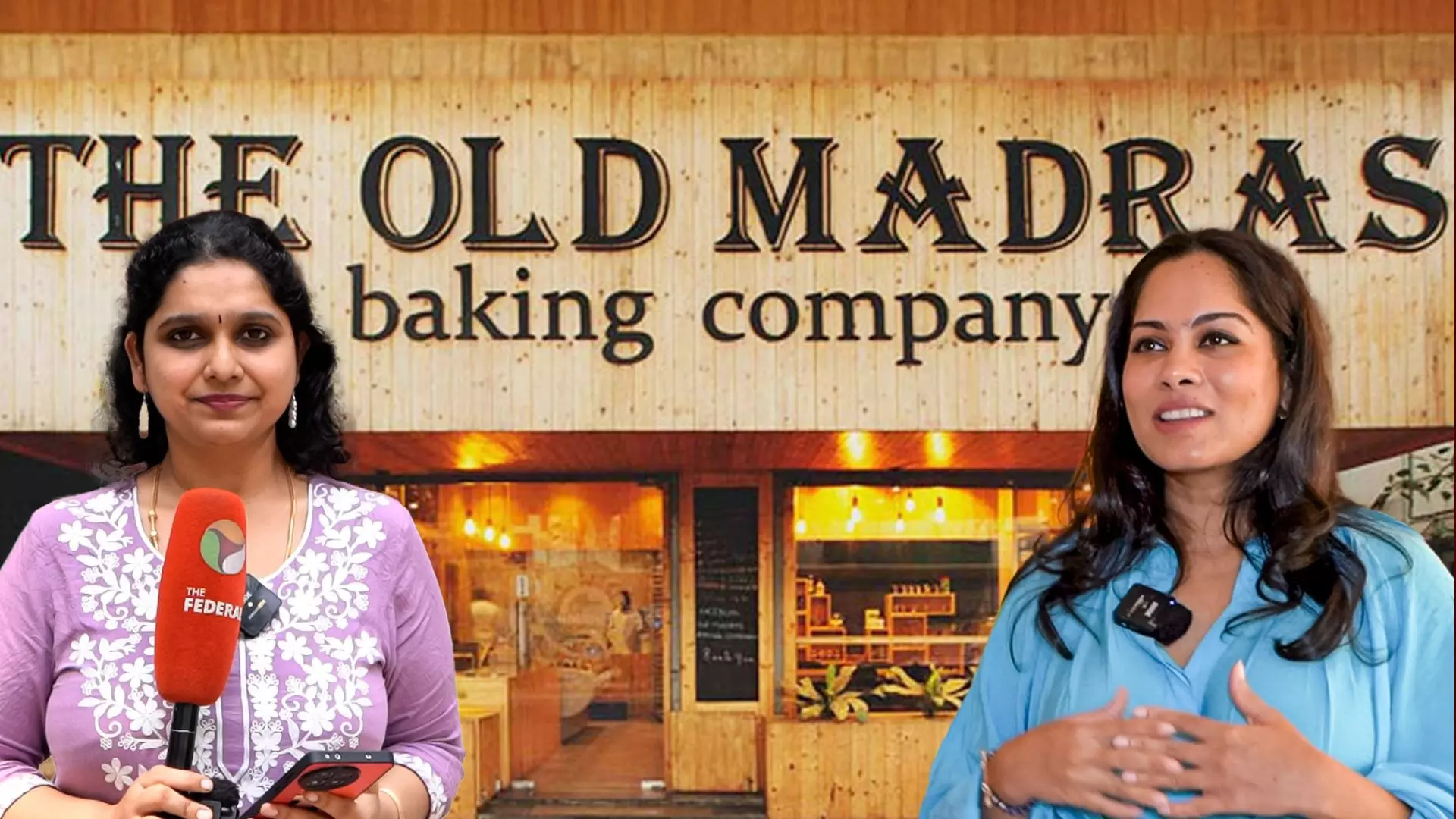
Sweta Garapati, entrepreneur and change maker.
How Sweta Garapati shaped her culinary journey with Old Madras Baking Company
Garapati, the co-founder of Old Madras Baking Company, discusses her entrepreneurial journey, challenges she faced and her efforts to empower women through food

In an era dominated by industrial bakery chains and mass-produced sweets, the Old Madras Baking Company stands out for its natural and distinct flavours.
According to Sweta Garapati, co-founder of the Old Madras Baking Company, the brand is a tribute to the storied legacy of the traditional Iyengar bakeries that once defined the culinary heart of old Madras. The Federal spoke to Garapati, about her journey in the culinary world and her efforts to empower women in rural India. She shares her entrepreneurial journey, the challenges she faced as a woman entrepreneur, and her mission to uplift women in rural Andhra Pradesh through Joseph's Farm.
Her story is packed with passion, perseverance, and a deep commitment to both good food and social change.
What sparked the idea for Old Madras Baking Company?
To be honest, the spark came from my dad. He’s been in the food industry, and I had recently moved back to India and wanted to do something related to women’s empowerment. My dad suggested we open a bakery with a concept of making all-natural, preservative-free bread accessible to everyone. So, we opened our first outlet in Alwarpet, Chennai.
Also read: How ‘Mylapore’ became the battleground in overseas trademark dispute
It became an exciting opportunity for me because I realised there was so much to learn, and I started really enjoying what I was doing. It also turned into a passion to serve good food to people in a meaningful way.
The name Old Madras Baking Company is quite evocative. What’s the story behind it?
The idea came from a modern take on an Iyengar Bakery. In Chennai, people traditionally buy their daily bread from Iyengar bakeries. We wanted to bring a modern version of that experience. When we thought of the name "Old Madras Baking Company," it immediately invoked a sense of nostalgia with a fresh, modern outlook.
It felt perfect for what we were trying to create, and it has worked beautifully for us so far.
If you had to pick one product that defines Old Madras Baking Company, what would it be?
It’s really hard to pick just one, as I love everything we make, but I think I’m most proud of our whole wheat and cereal bread. At the time when we launched them, it was challenging to make 100 per cent whole wheat bread. We were among the first to do it, and we made it tasty as well. I’m proud of that because we made sure no maida (refined flour) was added.
Another favourite is our coconut bun. It was actually a happy accident. A family friend asked us to make a bun with coconut filling, and we created it as a sample. It turned out so well that it became a huge hit with our customers.
Is there a smell or scent from your childhood that triggered your love for baking?
I’ve always loved good food, and that’s been a major driver for me. We’re very particular about ensuring our food tastes great, is healthy, and follows all our standards, but at the end of the day, taste is paramount.
Also read: Why California Burrito has resisted over-Indianising its menu | CEO interview
That’s what motivates me to bake with love.
The culinary world is often male-dominated, especially when it comes to chefs and experts. Did you feel intimidated stepping into this space, or did it fuel you to make a change?
There’s definitely a dichotomy. At home, it’s mostly women in the kitchen, but outside, it’s mostly men. However, I’ve seen that changing in the last 11 years, which is very encouraging. Women are stepping into this space more now. Traditionally, the operational intensity of the industry made it less appealing for women, but now that’s changing, and it’s great to see.
I feel that a woman’s touch in the kitchen truly makes a difference – with attention to detail, warmth, and love that comes across in the products.
As a woman entrepreneur, have there been moments where you felt things were harder for you? Or did it make you stronger?
Definitely. There have been many instances where I’ve been questioned in ways that men wouldn't be. My husband is also an entrepreneur, and we often compare notes. There were times when we would visit new locations, and the landlords would speak to him, assuming he was the one running the business. He would have to correct them.
These small moments happened often, but I do see the landscape changing, and I’m hopeful that more women are getting the opportunities and recognition they deserve now.
There’s often a perception that women in the food business are just continuing what they do at home. How did you navigate this perception in your career?
In the beginning, I used to try and fight it because whenever I told people I was running a business, they would assume it was just a small home-based business. I would often argue with people and try to prove my point. But over time, I realised there’s no need to do that.
I believe we’ll gain visibility by doing our job well, and I’ve focused on that journey while staying positive.
Can you tell us more about Joe's Farm and how it connects to your mission to empower women?
Joe’s Farm is something very close to my heart. It was actually the idea with which I moved back to India. We work with women in a small village called Ayodhya Patnam in Andhra Pradesh, where my grandparents are from. These women, who are wives of marginal farmers, had little access to financial independence. They would work on each other’s farms but never had their own income.
We realised that making pickles was an art they all knew well because they’d been doing it for their homes for years.
So, we started a project where they could use my grandma’s recipes, make pickles, and sell them. It gave them an extra source of income, and it was incredible to see the impact it had on their lives. One woman supported her granddaughter’s education with the money, while another was able to buy a mixer and grinder for her home.
It’s amazing to witness how a woman’s contribution can change the dynamics of a family.
If you could change one thing for women entrepreneurs in India, what would it be?
It would be access to more opportunities and resources. I’ve noticed that while more women are now raising their hands and ready to take up opportunities, they still often don’t get the same chances that men do. I hope we see more support for women entrepreneurs in the coming years. We’ve come a long way, but we still have a long way to go.
Finally, if you had one piece of advice for someone watching who wants to take the leap into entrepreneurship, what would it be?
Believe in yourself and go for it. I was a very shy kid, and I never imagined myself as an entrepreneur. But I’ve realised it takes a little bit of courage to start, and then resilience to keep going. You just have to take that first step, and the rest will follow.
Old Madras Baking Company’s journey is not just about delicious, freshly baked buns—it’s about creating change and empowering communities, one step at a time.
Clearly, if Sweta’s story inspires you to pursue your dreams, now is the perfect time to take the leap.
The content above has been transcribed from video using a fine-tuned AI model. To ensure accuracy, quality, and editorial integrity, we employ a Human-In-The-Loop (HITL) process. While AI assists in creating the initial draft, our experienced editorial team carefully reviews, edits, and refines the content before publication. At The Federal, we combine the efficiency of AI with the expertise of human editors to deliver reliable and insightful journalism.