








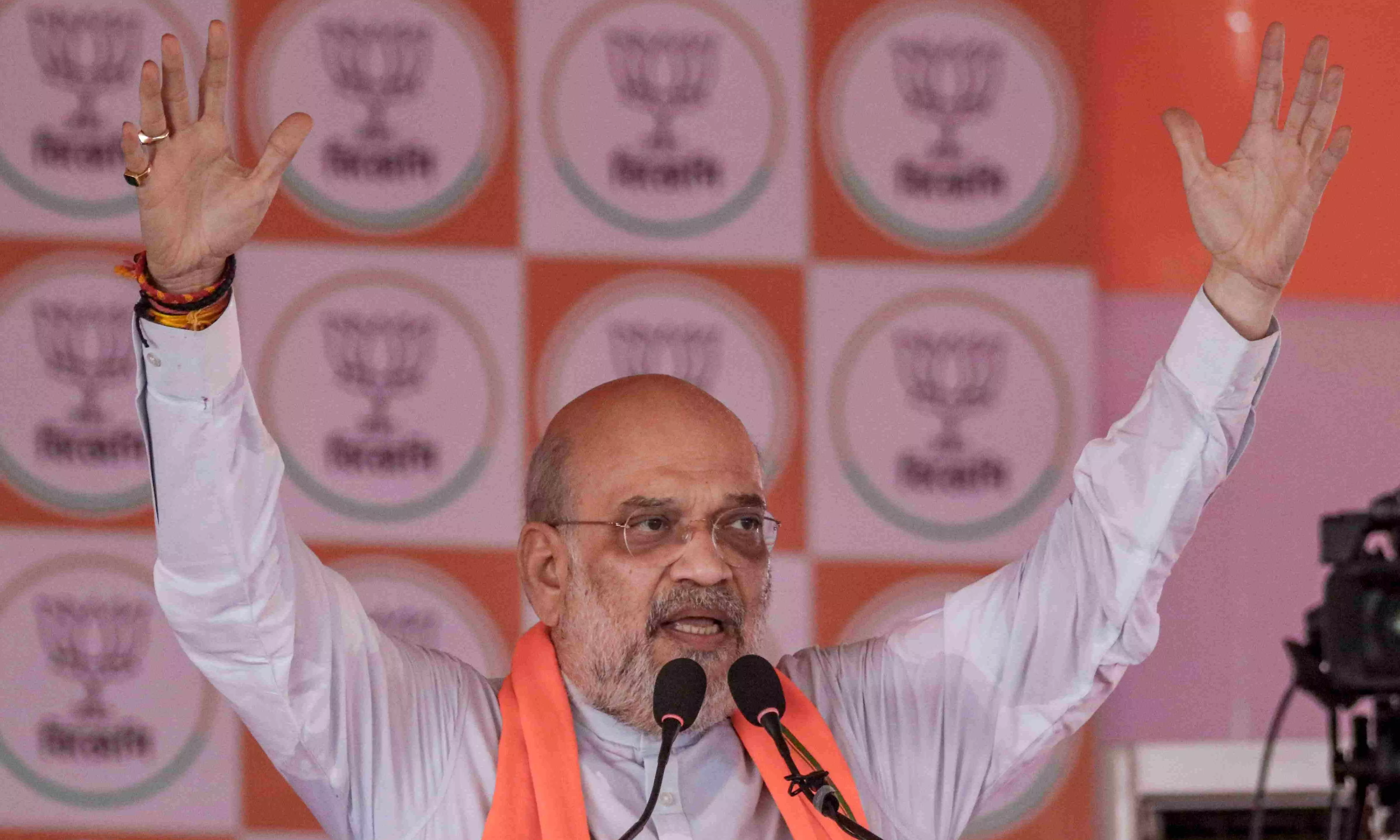
Shh said honouring a long-term demand of the people, the Rajbanshi language would be included in the Eighth Schedule of the Constitution. Photo: PTI
Amit Shah pledges constitutional resolution to Gorkhaland issue without dividing Bengal
Union Home Minister Amit Shah vows a constitutional solution to the Gorkhaland issue, outlines north Bengal projects and anti-infiltration push ahead of West Bengal polls

The contentious Gorkhaland issue took centre stage in Amit Shah’s speech at a BJP rally on Tuesday (April 14) with the Union Home Minister claiming that if his party is voted to power in West Bengal, it would resolve the issue in in the Darjeeling hills in a constitutional manner without dividing the state.
Focus on Gorkhaland
Addressing the rally in Gangarampur in Dakshin Dinajpur district, Shah further stated that the BJP’s election manifesto mentions a host of north Bengal-centric development projects.
"I want to tell my Gorkha brothers of Darjeeling that, once in power, the BJP will not only develop an eco-adventure hub in the hills, but also resolve the Gorkha issue in a constitutional manner without dividing the state," said Shah.
Also Read: West Bengal will reply to bombs and bullets with votes: Amit Shah
Shah also referred to the BJP’s manifesto, promising that an AIIMS, a state-of-the-art 600-bed cancer hospital, separate IIT and IIM campuses, and a dedicated sports university would be constructed in the region.
He said honouring a long-term demand of the people, the Rajbanshi language would be included in the Eighth Schedule of the Constitution.
History of unrest in the Hills
The demand of Nepali-speaking Indians in the Darjeeling hills for a separate state of Gorkhaland has repeatedly led to violent agitations despite the formation of the semi-autonomous Gorkhaland Territorial Administration (GTA) in 2011 to administer the upper reaches of Darjeeling and parts of the foothills. The region has witnessed violent agitations as late as 2017.
Also Read: Bengal poll is peak drama: Mamata's welfarism, BJP's UCC promise, 91 lakh voters missing
The region has gone through multiple twists and turns over political partnership between the local Gorkha parties, like the Gorkha Janmukti Morcha (GJM) and the Gorkha National Liberation Front (GNLF), and bigger players like the BJP and TMC, where the demand for a separate Gorkhaland has always acquired political centre stage.
Shifting alliances ahead of polls
In the upcoming Assembly elections, the TMC is in a strategic seat-sharing alliance with the Anit Thapa-led Bharatiya Gorkha Prajatantrik Morcha (BJPM), a breakaway faction of Bimal Gurung's GJM, and has left the Darjeeling, Kalimpong and Kurseong seats to its partner.
The BJP, on the other hand, has yet again secured the support of Gurung, its former alliance partner in the hills, although the saffron party is directly contesting the polls from the region this time.
Promises crackdown on infiltration
Laying his thrust on the issue of illegal immigration in West Bengal, the Union home minister said that the BJP will end political violence, syndicate and cut-money raj in the state and evict infiltrators with priority.
"Press EVM buttons next to the lotus sign so hard that once they are pressed in regions of north Bengal, infiltrators across India can feel the electric shock," he said.
Also Read: Mamata Banerjee alleges BJP threats to TMC leaders, warns of Bengal ‘division’ plan
Shah has been paying regular visits to the state over the last few weeks and has held multiple rallies across the state in the run-up to the April 23 polls, when voters in north Bengal districts would exercise their franchise, sharpening the infiltration issue as one of the most prominent poll planks of the saffron party.
West Bengal will vote in two phases, on April 23 and 29, and votes will be counted on May 4.
(With agency inputs)