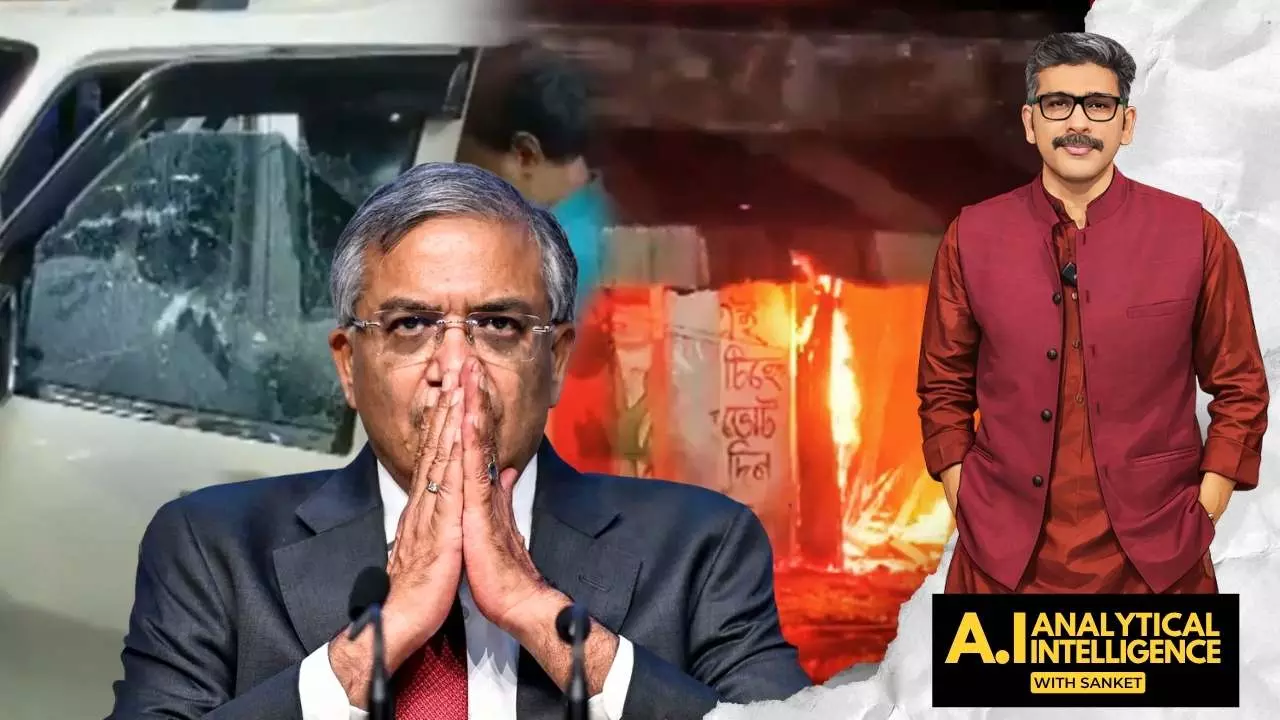
Bengal violence raises questions over Election Commission's accountability | AI With Sanket
Sanjay Jha and TR Srinivas debate post-poll violence, the accountability of Chief Election Commissioner Gyanesh Kumar, and the role of central forces in West Bengal

“Lives are being lost and the Election Commission has completely abdicated its responsibility post-elections,” former Congress spokesperson Sanjay Jha said during a heated discussion on post-poll violence in West Bengal. As clashes, killings, and attacks continue after the Assembly election results, questions are now being raised over the accountability of Chief Election Commissioner Gyanesh Kumar and the deployment of nearly 700 companies of central paramilitary forces in the state.
The Federal spoke to Sanjay Jha and BJP spokesperson TR Srinivas on the continuing violence in West Bengal, the allegations surrounding BJP victory rallies, and whether the Election Commission failed to contain the deteriorating law and order situation after polling concluded.
Accountability debate
Opening the discussion, host Sanket Upadhyay questioned how violence could continue despite the deployment of nearly 70,000 central paramilitary personnel across West Bengal.
He pointed to the killing of Suvendu Adhikari’s personal assistant along with several other violent incidents since May 4, asking who should be held accountable for the breakdown in law and order.
Sanjay Jha called the situation “dark and depressing”, describing the violence as “mindless” and “senseless”. He argued that the Election Commission bore direct responsibility during the transition period before a new government formally takes over.
Also Read: What is behind West Bengal’s violent turn amid electoral churn?
“The Election Commission has been vested with the authority. The government effectively stops working during the election process until the new government is formed,” he said.
Jha said the scale of paramilitary deployment in Bengal resembled preparations for a Lok Sabha election and questioned why violence still spiralled out of control.
Fearless mobs
Jha expressed concern over what he described as a growing absence of fear among violent mobs despite extensive media coverage and video evidence circulating online.
“When people lose fear of consequences, it means they believe law and order is secondary,” he said, warning that the violence could become a recurring long-term problem if not immediately controlled.
He also argued that the Centre needed to explain the role played by the central forces deployed in the state.
“This is a moment for panic and quick redressal,” he said, adding that Chief Election Commissioner Gyanesh Kumar had “a lot to explain to the people of Bengal and India”.
The discussion then shifted towards allegations that many incidents were linked to BJP victory processions.
BJP response
TR Srinivas defended the BJP, claiming that many of those involved in the violence were not genuine BJP workers but opportunistic elements attempting to infiltrate the party ecosystem after the election results.
Referring to the killing of Suvendu Adhikari’s aide, Srinivas said investigations were underway and that vehicles and weapons connected to the crime had already been recovered.
“The accountability has to be fixed and it will be fixed,” he said.
Also Read: From Chakraborty to Rath, Bengal sees another violent death around Adhikari’s inner circle
Srinivas maintained that BJP leaders, including the party’s national leadership, had repeatedly instructed cadres not to engage in revenge violence.
“We will not continue the cycle of revenge violence,” he said, adding that BJP leaders wanted to bring “a changed government” rather than retaliatory politics.
He also claimed that some violence was being orchestrated by Trinamool Congress supporters posing as BJP workers.
Bulldozer rallies
Sanjay Jha, however, rejected the argument that most violent incidents were caused by outsiders masquerading as BJP supporters.
He referred to visuals of BJP victory rallies featuring bulldozers and senior BJP leaders, including Dilip Ghosh, openly participating in celebrations.
“To assume all these people are outsiders betrays logic,” Jha said.
He also referred to allegations by Trinamool Congress leader Abhishek Banerjee that over 100 TMC offices had been attacked after the results.
According to Jha, the atmosphere in Bengal had become deeply polarised due to aggressive campaigning and inflammatory rhetoric from multiple political actors during the election.
“I have never seen an election as communally vituperative as Bengal and Assam,” he said.
Dangerous language
Jha criticised political rhetoric used during the campaign, including statements allegedly made by senior BJP leaders.
He argued that victorious parties in a democracy should adopt a conciliatory approach after elections instead of deepening divisions.
“When you become chief minister or prime minister, you serve every citizen, whether they voted for you or not,” he said.
Jha warned that continued polarisation could make governance impossible and compared the current atmosphere with unresolved tensions in Manipur.
“We don’t want conflict where a government cannot function because there is a law and order crisis,” he said.
The Congress leader also questioned why Bengal could not witness a peaceful transition similar to states like Kerala.
EC 'took its eye off the ball'
A major focus of the discussion was the role of the Election Commission after polling concluded.
Upadhyay referred to a previous Election Commission statement promising violence-free elections in Bengal, and argued that responsibility did not end with the completion of voting.
Jha agreed, saying that while polling itself remained relatively peaceful, the Commission appeared to have “taken its eye off the ball” once results were declared.
Also Read: Post-poll violence in West Bengal: TMC offices vandalised after BJP landslide
“The accountability really stops with them. The buck stops at the top,” he said.
Srinivas acknowledged that the Election Commission bore responsibility for controlling the situation but argued that the security apparatus was now increasing vigilance and conducting raids.
He said the CRPF and police had intensified operations and that investigations were continuing into multiple incidents.
Blame game
The debate repeatedly returned to whether BJP leaders were adequately acknowledging the involvement of their own supporters in post-poll violence.
Upadhyay argued that several BJP leaders themselves had publicly appealed to cadres not to engage in hooliganism, indicating that party members were indeed involved.
Srinivas responded that the BJP leadership had clearly instructed workers not to indulge in violence and insisted that any person found guilty should face legal action.
“If somebody is caught, the law will take its own course,” he said.
However, he continued to argue that some Trinamool Congress workers could be disguising themselves as BJP supporters during violent incidents.
Call for calm
In his concluding remarks, Jha urged Prime Minister Narendra Modi, Home Minister Amit Shah, and the Election Commission to immediately intervene and appeal for peace.
“There should be a call for calmness and peace,” he said.
He warned that the language being used after the election victory appeared increasingly polarising instead of reassuring.
Also Read: Bengal polls: Mamata’s refusal to resign sparks a constitutional crisis
“The BJP state leadership must speak a language of harmony and rebuild Bengal with calmness,” he added.
Srinivas also appealed for peace, urging Mamata Banerjee and the Trinamool Congress to “accept the verdict gracefully” and help reduce tensions on the ground.
Despite disagreements over who was responsible for the violence, both panellists acknowledged that the continuing unrest posed a serious challenge for Bengal’s political transition.
(The content above has been transcribed from video using a fine-tuned AI model. To ensure accuracy, quality, and editorial integrity, we employ a Human-In-The-Loop (HITL) process. While AI assists in creating the initial draft, our experienced editorial team carefully reviews, edits, and refines the content before publication. At The Federal, we combine the efficiency of AI with the expertise of human editors to deliver reliable and insightful journalism.)