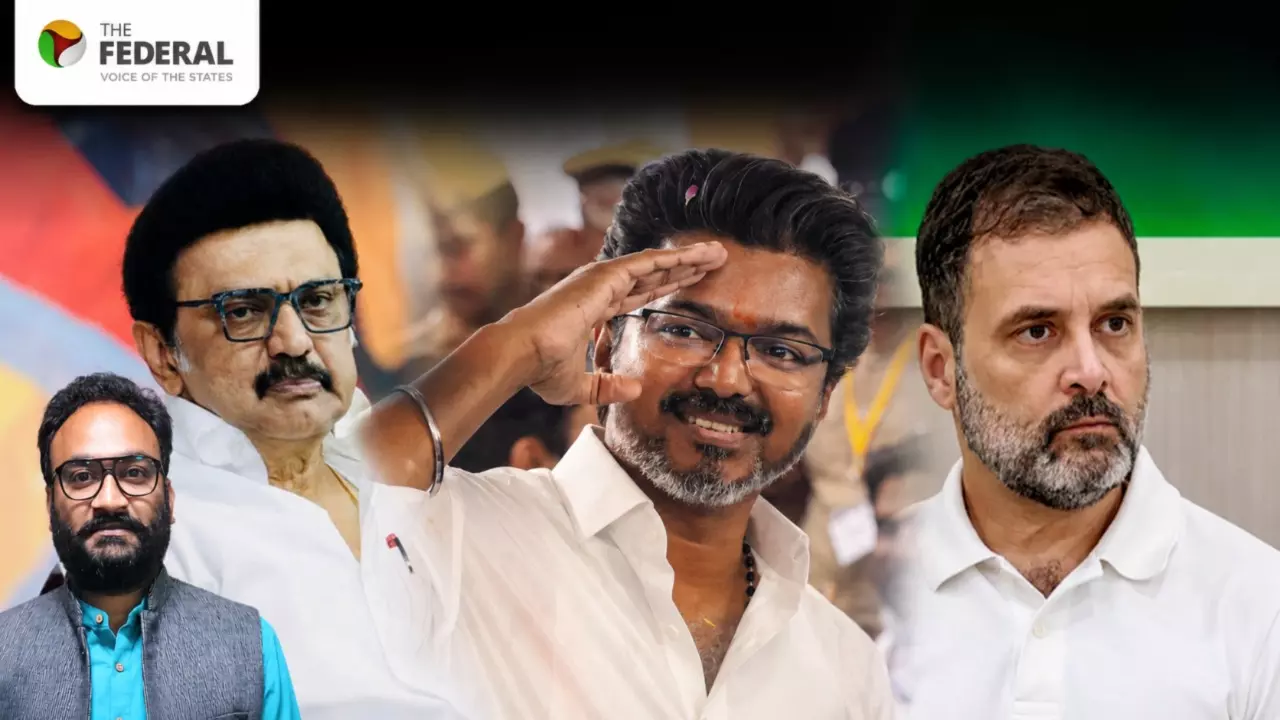
Vijay made cracks
'Congress hurried, and looked power-hungry in Tamil Nadu'
Has Congress’s quick switch from DMK to TVK rattled the INDIA Bloc and raised fresh questions over Rahul Gandhi’s alliance politics ahead of the UP polls?

The political developments in Tamil Nadu after the 2026 Assembly election results have triggered sharp reactions within Opposition ranks, with the Congress backing Vijay’s TVK government after contesting the elections alongside the DMK. In this interview, The Federal's political editor Puneet Nicholas Yadav talks about the Congress-DMK fallout, Akhilesh Yadav’s swipe at the Congress, the future of the INDIA Bloc, and the implications for Uttar Pradesh politics.
How do you see the Congress quickly moving from the DMK alliance to supporting TVK?
Well, there are two aspects to this. Even before the elections, there was a section within the Congress — particularly some second-rung leaders considered close to Rahul Gandhi — who believed that the Congress should have broken away from the DMK before the elections themselves and aligned with the TVK.
At the same time, there was another group of senior leaders who felt that the Congress should continue its long-standing alliance with the DMK.
After the election results, however, the situation changed rapidly because the DMK was voted out of power and Vijay’s TVK made a stunning debut. Even though the Congress itself managed to win only five seats, it quickly started sending feelers to the TVK about supporting government formation because the TVK lacked a majority despite emerging as the single-largest party.
Now, one can certainly say the Congress backstabbed the DMK, jumped ship, and acted opportunistically. There is definitely some truth to that.
But the DMK and other INDIA bloc allies must also ask themselves what the alternative was. Would they have preferred a scenario where the BJP-led NDA got an opening? Or the rumours of the AIADMK and DMK coming together just to stop a Vijay-led government? In a state like Tamil Nadu, would such an arrangement have been politically or socially advisable?
And finally, would that not have undermined the clear mandate in favour of the TVK and Vijay?
During the campaign too, the Congress was actually very guarded in what it said about the TVK. It criticised the BJP and the AIADMK for aligning with the BJP, but it was never overtly critical of Vijay.
That itself should have alerted the DMK that if the election results did not go according to plan, the Congress would reopen communication channels with the TVK. That is exactly what happened.
Even throughout the campaign, the Congress-DMK campaign lacked cohesion. Rahul Gandhi refused to share the stage with M K Stalin during the campaign.
Unlike previous elections where there were grand public displays of brotherhood between the two leaders, none of that was visible this time.
The rift was already visible during the campaign itself and has now formally manifested through the Congress switching sides.
How can the Congress now justify supporting the TVK after contesting against it?
I don’t think convincing the people of Tamil Nadu will be particularly difficult for either the Congress or the TVK.
Throughout the campaign, it was already clear that a sizable section within the Congress wanted an alliance with the TVK even before the elections.
Secondly, the CPI and CPM — all of whom have now extended support to Vijay — have justified their decision by saying they wanted to prevent the BJP or a communal force from coming to power in Tamil Nadu.
They have also argued that the TVK and their own parties share a common commitment to secularism.
The Congress’s own support letter to the TVK clearly states that the alliance is conditional on the TVK not aligning with communal forces or any force that weakens the Constitution.
So, to that extent, they have politically covered themselves.
Also, the scale of Vijay’s victory matters here. For a political newcomer to win 108 seats against deeply entrenched parties like the DMK and AIADMK clearly indicates that the people of Tamil Nadu wanted a TVK government.
That makes it easier for parties like the Congress, CPI, CPM and VCK to justify their support by saying they are respecting the people’s mandate.
At the same time, the Congress can also argue that while it was part of the DMK alliance, it was not part of the DMK government.
It can say the anti-incumbency was directed at the DMK government’s actions, not necessarily against the Congress itself.
The bigger debate is not whether the Congress supported the TVK, but the manner in which it did so.
The DMK still retains a sizeable vote share of over 30 per cent. Explaining to those DMK voters why the Congress treated its ally in this manner is where the challenge lies.
Is it fair for the DMK and INDIA bloc allies to accuse the Congress of betrayal?
These accusations are natural whenever alliances are formed or broken in Indian politics.
This is not the first time the Congress and DMK have split. Even the DMK has acted similarly in the past.
In fact, ahead of the 2014 Lok Sabha elections, it was the DMK that unilaterally announced at a press conference that it was breaking ties with the Congress.
Similarly, the Trinamool Congress in West Bengal has always maintained that the INDIA bloc exists only at the national level and not in state politics.
Also, the VCK, CPI and CPM — all part of the INDIA bloc and previously aligned with the DMK — have now switched sides too.
So the issue is not alliance switching itself.
The real issue is the manner in which the Congress did it.
The Congress could have softened the blow politically. It could have delayed the announcement by a few days like the CPI, CPM and VCK did.
It could have sent a senior leader such as Digvijaya Singh, B K Hariprasad, Bhupinder Singh Hooda or Ashok Gehlot to personally speak to Stalin.
Even P Chidambaram, who shares a good rapport with Stalin, could have been tasked with explaining the Congress’s compulsions.
The Congress could also have initially offered outside support rather than immediately appearing eager for power-sharing.
That would have allowed it to claim the moral high ground by saying it was merely respecting the mandate and ensuring a secular government.
Instead, the Congress immediately announced its support and appeared power-hungry.
That is the difference between what the Congress did and what the CPI, CPM and VCK did.
The Left parties and VCK at least created the impression of consultation and political compulsion before supporting the TVK.
What does this mean for the Left parties nationally?
For the Left, the bigger crisis is existential.
After losing Kerala, the Left no longer governs any state. They have some MPs and MLAs here and there, but they are no longer a major electoral force.
Their challenge now is organisational survival, rebuilding leadership, and redefining their politics.
This is not just about Tamil Nadu. Their real concerns lie in rebuilding themselves in Kerala, reviving in West Bengal, and recovering in Tripura.
Whether they support the government in Tamil Nadu or not makes little difference electorally because they only have four MLAs there.
Their problems are far larger than government formation in Tamil Nadu.
Is this episode signalling the beginning of the end for the INDIA bloc?
The manner in which the Congress handled this has naturally caused discomfort among many allies and even sections within the Congress itself.
Akhilesh Yadav’s post on X made that very clear.
He shared photographs of his meetings with Mamata Banerjee and M K Stalin and essentially said that some leaders do not abandon allies in difficult times.
The Congress demands a large share of seats during seat-sharing negotiations because it is a national party, but then struggles to convert those seats into victories.
He did not mention the Congress directly, but the message was obvious.
This discomfort has been building for some time.
During the West Bengal campaign, Rahul Gandhi publicly criticised Mamata Banerjee in a way that even the BJP amplified.
If such remarks had come from someone like Adhir Ranjan Chowdhury, it could have been dismissed as state-level politics.
But when Rahul Gandhi himself says such things, allies take note.
The Congress’s position within the opposition alliance is based on compulsion because it remains the largest national opposition party with around 99 MPs.
Also Read: Vijay, the man who says very little: Is silence golden in politics too?
But that does not give it the freedom to treat allies dismissively.
One after another, allies have had problems with the Congress — whether it is the RJD in Bihar, the TMC in Bengal, or now the DMK in Tamil Nadu.
The only saving grace for the Congress this election cycle is Kerala, where it managed to win while Mamata Banerjee and Stalin lost.
Otherwise, the Congress itself has often been the weakest link electorally.
It also performed poorly in Assam during this round of elections.
So this episode has created bad optics for the INDIA alliance.
Are regional parties increasingly viewing the Congress as an electoral liability?
That has been true for some time now.
In states where the Congress is not the dominant alliance partner — such as Bihar, Jharkhand, Tamil Nadu or Uttar Pradesh — it often becomes the weak link.
The Congress demands a large share of seats during seat-sharing negotiations because it is a national party, but then struggles to convert those seats into victories.
That weakens alliances instead of strengthening them.
An alliance works best when all parties act as force multipliers.
Also Read: From CM's 'right hand' to CM: Suvendu Adhikari set to lead Bengal's first BJP govt
In Tamil Nadu, the Congress earlier brought value to alliances through sections of minority and Dalit votes.
But in many other states, the Congress no longer contributes enough electorally.
Without allies, the Congress is almost nowhere in many states.
In Tamil Nadu, when it contested alone in the 2014 Lok Sabha election, it failed to win a single seat.
In Uttar Pradesh, when it contested alone in the 2022 Assembly election under Priyanka Gandhi’s leadership, it won only two seats in a House of 403.
Naturally, allies begin viewing the Congress as an electoral liability.
How could this affect Uttar Pradesh politics ahead of the next election?
Uttar Pradesh remains the most crucial political state in India because of its 80 Lok Sabha seats and massive political influence.
The Congress has steadily declined there for decades and survives mainly through alliances.
It needs a stronger ally like the Samajwadi Party to remain relevant.
If its relationship with the Samajwadi Party deteriorates, the Congress faces a very bleak future in Uttar Pradesh.
In the 2022 Assembly election, despite Priyanka Gandhi leading the campaign, the Congress won only two seats.
But in the 2024 Lok Sabha election, its alliance with the Samajwadi Party helped the two parties together win 43 out of 80 seats.
The Congress hopes that momentum will continue into the Assembly election.
However, the Tamil Nadu episode has complicated matters. The Congress is still not viewed as an organisationally strong or electorally viable party. And now it also risks being seen as an unreliable and opportunistic ally.
When seat-sharing negotiations begin in Uttar Pradesh, Akhilesh Yadav is likely to drive a very hard bargain.
The Congress could face difficulties both in securing the number of seats it wants and in maintaining the overall cohesion of the alliance narrative.
This is therefore a challenging moment not just for the Congress, but for the INDIA bloc as a whole.
The content above has been transcribed from video using a fine-tuned AI model. To ensure accuracy, quality, and editorial integrity, we employ a Human-In-The-Loop (HITL) process. While AI assists in creating the initial draft, our experienced editorial team carefully reviews, edits, and refines the content before publication. At The Federal, we combine the efficiency of AI with the expertise of human editors to deliver reliable and insightful journalism.