








DMK releases manifesto: Rs 8,000 ‘Illatharasi’ coupons counter AIADMK’s fridge
Two major promises central to the DMK’s previous election manifestos—abolition of NEET exam and complete liquor prohibition—not included this time

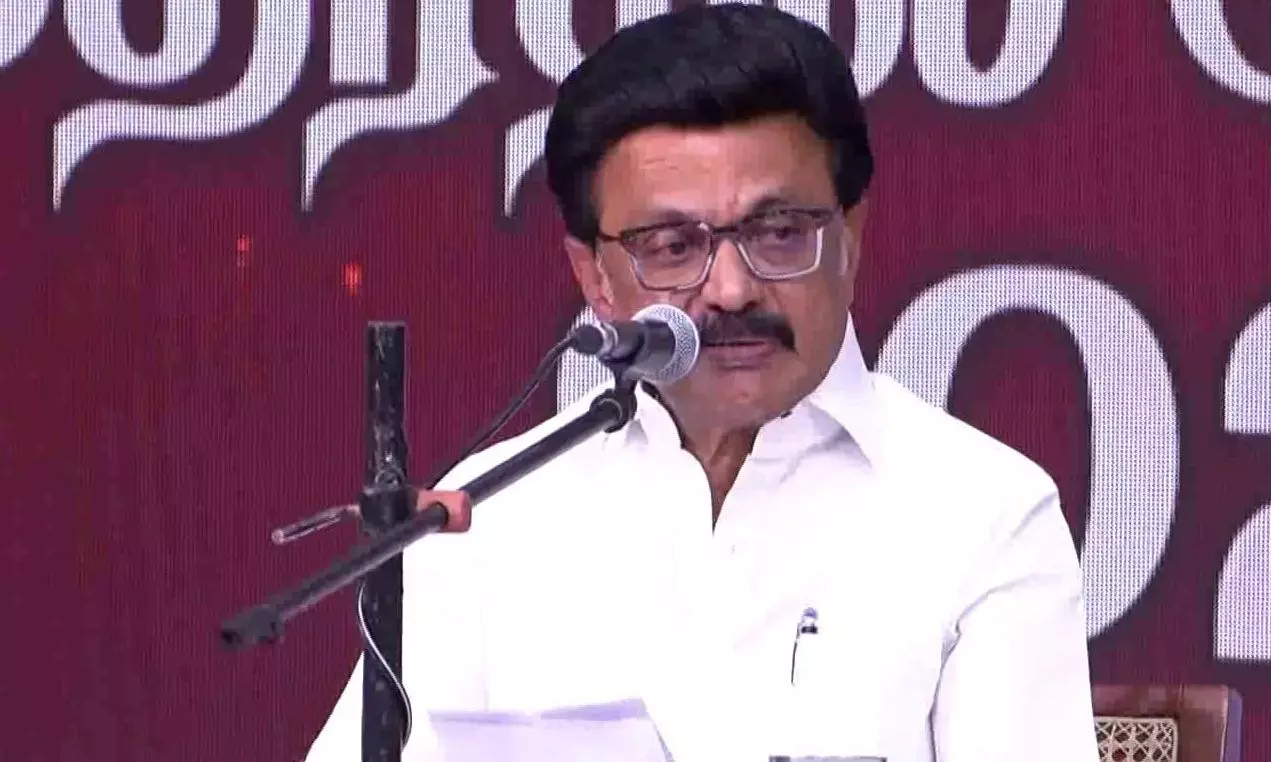
In a direct challenge to the main Opposition AIADMK’s recently released election manifesto, DMK president MK Stalin on Sunday (March 29) announced his party’s 2026 Tamil Nadu Assembly election manifesto at the party headquarters, Arivalayam.
What stood out among the host of promises was the game-changing “Illatharasi Coupon” scheme, offering Rs 8,000 worth of coupons to nearly 2 crore non-income-tax-paying homemakers for buying or upgrading household appliances. The scheme allows beneficiaries to buy or replace items such as washing machines, refrigerators, mixer-grinders, ovens, microwaves, or induction stoves.
This broad basket of kitchen and home essentials goes far beyond the AIADMK’s headline promise of one free refrigerator per family.
Also read: TN elections: NTK’s 50 pc women quota shakes up electoral landscape
The Tamil Nadu chief minister explained why the aid is being given as coupons rather than direct cash: “If we give money, they might spend it on other things. Coupons ensure the benefit reaches its intended purpose, easing the burden on homemakers.”
He described the entire manifesto as a “Super Star” document that would lay the foundation for DMK’s victory, predicting the party would win 200 seats in the April 23 Assembly elections.
The battle for homemakers
Just five days earlier, on March 24, AIADMK General Secretary Edappadi K Palaniswami released his party’s 297-point manifesto, which prominently featured free refrigerators for all rice ration-card-holding families to “reduce the household workload of homemakers.”
The AIADMK also promised Rs 10,000 one-time special assistance to every family to offset rising prices and tax burdens, plus Rs 2,000 monthly under the “Kulam Vilakku Scheme” directly to the female head of each family.
Additional sops included a Rs 25,000 subsidy for two-wheelers for working women and free bathing soap for ration-card holders.
Also read: Why Annamalai stayed away when Modi landed in Coimbatore | Seat-sharing snub
Both parties clearly target the same demographic—women and homemakers—in what has become a classic Tamil Nadu-style freebie war. The DMK’s coupon scheme is widely seen as a calibrated response to the AIADMK’s fridge promise, expanding the benefit to a wider range of appliances while framing it as a more thoughtful, choice-based intervention.
Major highlights of the DMK manifesto
For women and homemakers
• Rs 8,000 Illatharasi Coupon for 2 crore homemakers (non-income-tax payers).
• Kalaignar Magalir Urumai Thogai increased to Rs 2,000 per month (currently Rs 1,000); new eligible women added every year.
• Free bus travel for women to continue under Vidiyal Payanam.
• 1,000 new childcare centres for working women.
For families and health
• Chief Minister’s Breakfast Scheme expanded up to 8th standard (additional 15 lakh students).
• Medical insurance cover hiked to Rs 10 lakh; income limit raised to Rs 5 lakh per annum.
• 10 lakh new concrete houses in the next five years.For Farmers
• Free modern electric pump sets (no meters) for farmers getting free power.
• Paddy procurement price raised to Rs 3,500 per quintal; sugarcane to Rs 4,500 per tonne.
• Milk procurement price increased by Rs 5 per litre.
Also read: TVK unleashes youth-centric TN poll manifesto to disrupt state's traditional politics
For youth and education
• 35 lakh free laptops to college students over five years.
• Naan Mudhalvan skill training + Rs 1,500 monthly stipend for five lakh graduates.
• Pudhumai Penn and Tamil Pudhalvan schemes increased to Rs 1,500 per month.
• 1.5 lakh government job vacancies to be filled without delay.
Other key promises
• Pensions hiked: Senior citizens/widows to get Rs 2,000; differently abled to get Rs 2,000–2,500.
• 50 new Semmozhi Poongas (Tamil language parks); Semmozhi Conference in Chennai.
• Four future-ready global cities around Coimbatore, Salem, Madurai and Trichy.
• 10,000 new buses; 20,000 crore industrial development package.
• 18 lakh crore foreign investment target to create 50 lakh jobs; IT exports to be doubled to Rs 5 lakh crore.
• “Thayumanavar” scheme for vulnerable families; self-help group women to get collateral-free loans up to Rs 5 lakh.
Stalin declared, “This election manifesto will be the foundation for victory.”
Also read: TN elections: Vijay to contest from Perambur and Trichy East; unveils list of TVK candidates
Fridge versus coupon
Retired IAS officer P Balachandran welcomed the DMK’s approach, observing that “one party is forced to issue more attractive promises than the other and the DMK manifesto reflects exactly that.”
He questioned the practical utility of the AIADMK’s free-fridge promise, noting that “with just Rs 8,000, homemakers could buy only a small refrigerator anyway.” In contrast, he called the DMK’s Rs 8,000 coupon scheme “a good idea” because it gives homemakers the freedom to choose whichever household item they actually need.
“The manifesto successfully combines both development and welfare,” Balachandran added.
DMK election manifesto preparation committee chairperson Kanimozhi said the party had consulted experts from various fields before finalising the document. “We have included only those promises that are feasible and can actually be implemented,” she stressed.
Competitive welfarism
Tamil Nadu politics has been defined by competitive welfarism since the Dravidian era. The DMK itself tasted massive success in the past when former president M Karunanidhi’s promise of free colour television sets in the 2006 elections helped the party sweep to power—a move that became a template for subsequent populist schemes by both the DMK and AIADMK.
The AIADMK, under J Jayalalithaa, famously distributed free mixers-grinders, fans, and even gold for weddings. After the DMK returned to power in 2021, it expanded schemes such as the Rs 1,000 monthly women’s assistance (Magalir Urumai) and free bus travel for women.
Also read: TVK chief Vijay seeks transfer of top IPS, IAS officers for fair Assembly elections
Anbumani's criticism
PMK president Dr Anbumani Ramadoss launched a sharp attack on the DMK’s election manifesto. He said that in the 2021 Assembly elections, the DMK had announced 505 promises but failed to fully implement 439 of them.
“There was no need for a new election manifesto this time. They could have simply released the list of unfulfilled promises as their new manifesto,” he remarked.
He also criticised how Stalin changed his position, after previously reducing the claim of fulfilled promises from 80 per cent to 75 per cent, he is now projecting 100 per cent fulfilment. “Like all the previous dramas, this drama too will not work,” Anbumani Ramadoss said.
NEET, liquor ban out
Notably, the DMK’s 2021 manifesto promised to scrap the NEET medical entrance exam—a pledge that helped it win a landslide. However, after years of legal battles, the party has chosen not to repeat that specific promise in 2026, focusing instead on a broader basket of immediate, tangible benefits.
In contrast to previous elections where the promise of total liquor prohibition (Maduvilakku) was often a major campaign plank especially for the DMK neither party’s 2026 manifesto makes any reference to imposing a ban on alcohol. This omission stands out, as liquor policy has historically been a sensitive and politically charged issue in Tamil Nadu.
Political observers note that with the Assembly elections just weeks away on April 23, both Dravidian majors are locked in an intense battle to woo women voters, who form a decisive chunk of the electorate.
The DMK’s coupon scheme cleverly gives homemakers flexibility to choose what they actually need, while the AIADMK’s fridge promise is more symbolic and visible. Whether coupons or fridges, one thing is clear: in Tamil Nadu’s 2026 election theatre, the kitchen remains the most fiercely contested battleground.
