Dravidian Model: Decades of work or just one party’s narrative?
S Srinivasan and A Kalaiyarasan said the model is the product of decades of policy continuity covering welfare and social justice | Talking Sense with Srini

With the DMK aggressively foregrounding the "Dravidian Model" as its governance hallmark ahead of the April 23 Assembly elections, the phrase has moved to the centre of political messaging in Tamil Nadu.
Touted as a framework that combines welfare, growth and social justice, it is also being tested against questions of fiscal strain and evolving economic challenges.
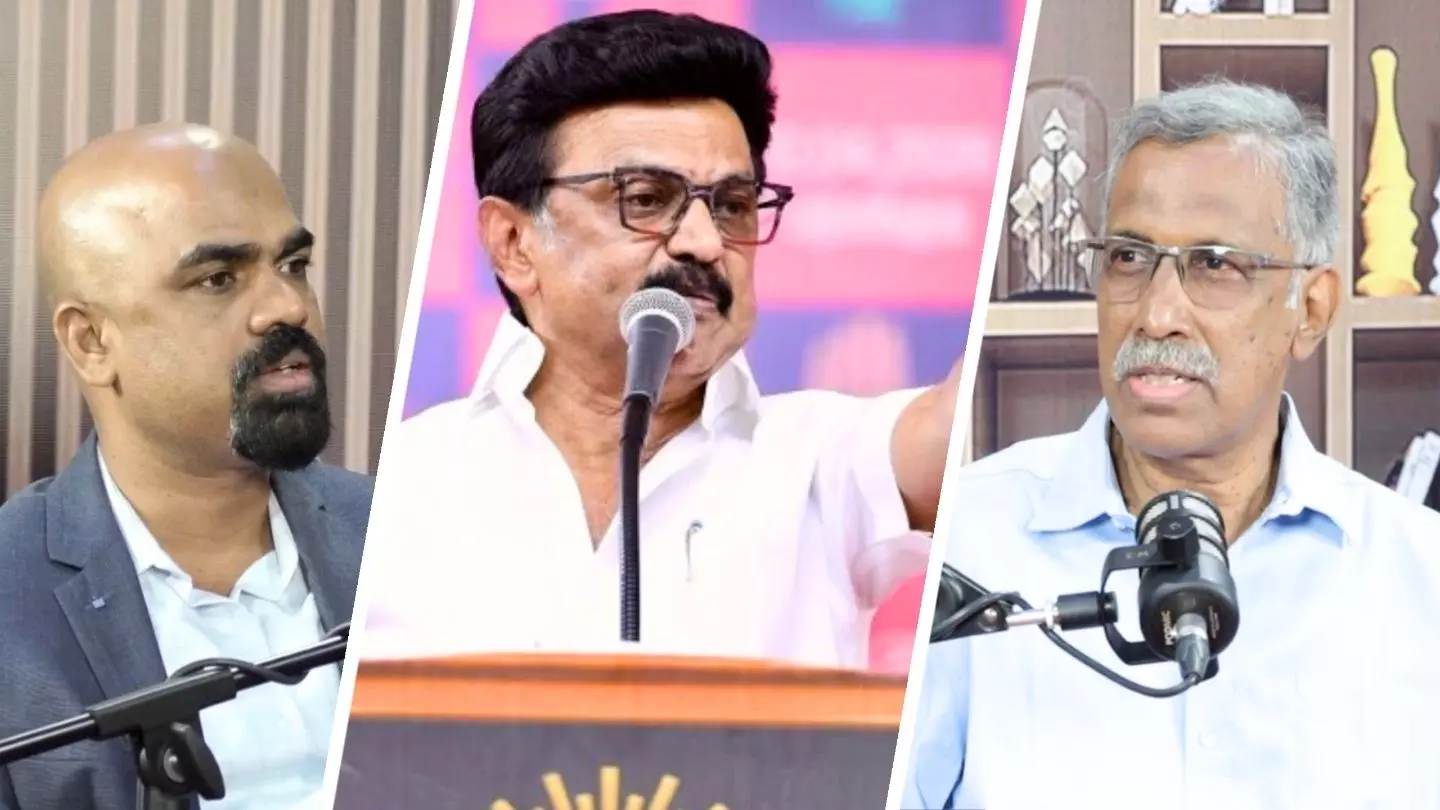
These issues were explored in today’s (April 14) episode of The Federal's flagship YouTube programme, Talking Sense With Srini, featuring The Federal’s Editor-in-Chief S Srinivasan and economist Kalaiyarasan A.
What is the Dravidian model?
Srinivasan described the Dravidian model as a composite framework. “It’s not just one. It’s also political, it’s also social, it’s also economic,” he said, adding that it draws from a legacy beginning with the Justice Party and rooted in “social equality”.
He pointed to early interventions such as reservation, mid-day meals, and investments in education and health as key pillars. “A combination of a whole lot of these things is what they are calling it as a Dravidian model,” he said.
Also read: BJP promises Rs 2,000 aid for women, 3 free LPG cylinders in TN manifesto
Kalaiyarasan placed the model within a larger economic debate. “India’s growth and development cannot be understood in a singular frame… it has to be understood through its regions,” he said. Arguing against a linear approach, he added, “You don’t have to see as a sequential like first growth versus development… you can actually do a simultaneous intervention,” describing Tamil Nadu as a case where “you get a model where you get a simultaneous intervention of the growth and development.”
He underscored two distinguishing features. “It’s a growth with development… you have a relatively better manufacturing base,” he said, adding that the state also performs strongly on social indicators such as “education, health, poverty levels.” This, he noted, is supported by a broad-based industrial structure where “economic clusters spread out across the state,” enabling more inclusive growth.
‘Not all freebies are bad’
On welfare and so-called freebies, Srinivasan argued for a nuanced view. “Not all freebies are bad,” he said, pointing to schemes like free bus travel for women as enabling labour force participation. “If you give them free transport, you encourage them to go to the nearest place, work and come back,” he said, calling it an “economic multiplier”.
Also read: TN minister TRB Rajaa interview: 'Real anti-incumbency is against NDA, not DMK'
Kalaiyarasan pushed back against blanket criticism of welfare spending. “Many of these policies… were seen as populism… but actually later many of these policies became national-level policies,” he said. He added that such interventions have “worked in benefiting the majority and also worked in fact complementing the growth”.
On fiscal sustainability, he dismissed alarmist readings. “It is bluntly wrong,” he said, explaining that deficits need to be seen in context. “Having a fiscal deficit to some extent is good for the economy,” he argued, as long as limits are respected.
Challenges ahead
Both underlined that the model is the product of decades of policy continuity rather than any single government. Srinivasan pointed to how successive administrations built on earlier interventions, expanding welfare while maintaining governance capacity.
Looking ahead, Kalaiyarasan flagged emerging challenges. “It is not enough to send children to schools. It is also equally important what skills they acquire,” he said, pointing to employability and technological shifts as the next frontier.
As Tamil Nadu heads into elections, the Dravidian model remains both a political claim and an evolving policy framework, with its future hinging on how effectively it adapts to new economic realities.