








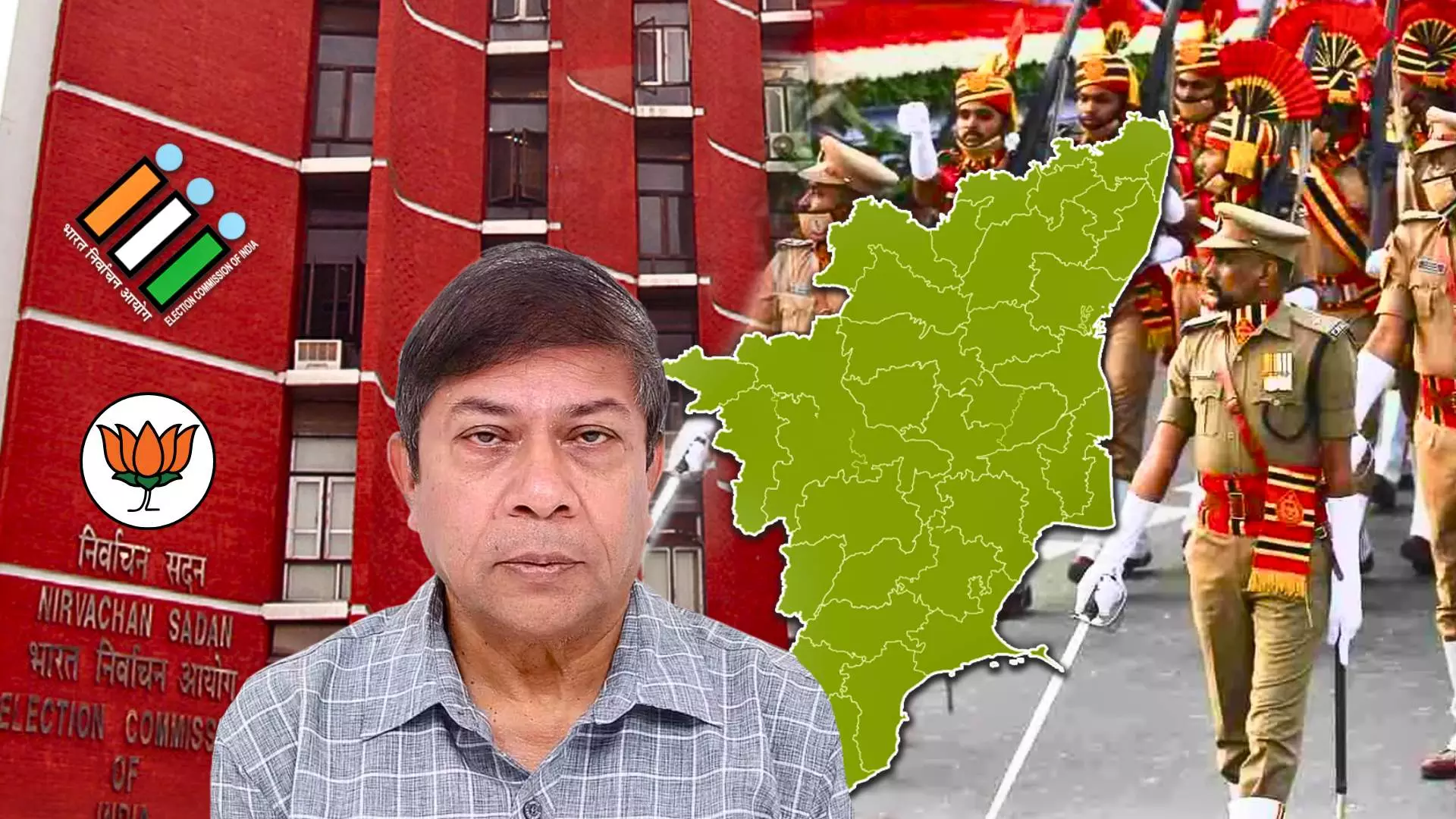
EC transfers in TN will ‘paralyse governance’ | Ex-IAS G Balachandran interview
Mass transfers of top Tamil Nadu officials spark sharp criticism. Is the Election Commission acting fairly, or politically?

A sweeping transfer of top bureaucrats in Tamil Nadu during an election period has triggered sharp questions about institutional neutrality, with one former senior official bluntly stating he has “no faith” in the Election Commission’s impartiality. The unprecedented reshuffle — involving the chief secretary, DGP, home secretary, and DVAC head — has raised concerns over governance disruption and political overreach. The Federal spoke to G Balachandran, retired IAS officer, to unpack the implications.
Your first reaction to these transfers?
I have said earlier that I do not have any faith in the neutrality, impartiality, or integrity of this Election Commission, and that view is based on strong evidence.
In the 2024 parliamentary election, Mr Narendra Modi said that if you have two cows, one will be taken away and given to an illegal immigrant. This is a highly objectionable statement. He should have been issued a notice. Another BJP leader, the Chief Minister of Uttar Pradesh, said “we are 80 per cent, you are 20 per cent.” The whole country knows whom he meant, yet no action was taken.
Also Read: EC's officer reshuffle in poll-bound states faces legal heat: What's the plan? | Capital Beat
Similarly, in the Odisha elections, BJP leaders claimed the BJD would hand over power to a Tamil and that the Puri Jagannath temple treasury had been smuggled to Tamil Nadu. There was no evidence, yet no action was taken. In Bihar, they alleged Biharis were attacked in Tamil Nadu — again without proof. These are statements based on religion, language, and region, all objectionable, but the Election Commission remained silent. That reflects its integrity.
What are the rules for transferring officials during elections?
There are two grounds. If an officer has completed more than three years in a post as on the date of election announcement, they must be transferred. Second, if an officer is found to be biased, the Election Commission can transfer them.
The Commission’s authority is limited to election conduct and law and order. If someone is working in an unrelated department, the Commission should not intervene.
Also Read: Has EC’s Bengal reshuffle crossed the line? | Jawhar Sircar interview
In West Bengal, Mamata Banerjee had already transferred officers who completed three years. Yet, the Commission transferred even newly-posted officers. What evidence did they have of bias?
In Tamil Nadu, four SPs were transferred based on complaints, apparently without thorough examination. This suggests the Commission is not acting independently but as a branch office of the BJP.
Can top officials like the chief secretary be transferred?
Any officer connected to the elections can be transferred, including IAS officers. The chief secretary and home secretary are in charge of law and order, so technically they fall under this scope.
However, while the Commission has the authority, it also has a moral responsibility to justify its actions. I do not see any moral grounds here.
What about complaints from political parties on bias?
Permissions for rallies are issued based on police advice. The Election Commission takes the final call after consulting law enforcement.
If established parties like the BJP or AIADMK have genuine complaints, they must be examined. But some allegations lack seriousness. For instance, if meetings are cancelled after permission is granted, it cannot automatically be blamed on the police.
Also Read: Ahead of Kerala Assembly elections, EC orders transfer of officials
The Commission must act quickly, verify complaints and communicate findings transparently. It must not only be neutral but also be seen as neutral.
How do such transfers affect governance?
The chief secretary is the coordinator of the entire state administration, not just law and order. Transferring such an officer just before elections creates practical problems.
Government work cannot stop. Funds must be released for ongoing schemes in departments like agriculture or animal husbandry. A new chief secretary will not immediately understand departmental capabilities or officials’ efficiency.
Also Read: Election Commission removes West Bengal's top bureaucrats
Normally, decisions are based on familiarity with departments and officers. A sudden change disrupts this process and delays governance. This is not the right way to function.
Why was the DVAC director transferred and then reinstated?
It shows confusion within the Election Commission. They entered an area beyond their scope and then backtracked.
There may have been indirect reasons, such as perceived bias in handling a case involving a minister. The Commission can interpret such actions as affecting electoral neutrality and justify transfers, but this remains speculative.
Is rapid double transfer of officers common?
No, it is not common in my experience.
Even if an officer is accused of having affiliations, that alone should not lead to immediate reversal of transfer. Decisions must be taken after considering all aspects. One must weigh all pros and cons before acting; otherwise, it reflects poorly on the institution.
Are such disruptions necessary for free and fair elections?
No, they are avoidable. In West Bengal, officers continued across regimes because they were trusted to remain neutral. In the UK too, senior bureaucrats continue regardless of which party is in power.
Also Read: EC sacks top bureaucrats, senior cops in poll-bound Bengal; Mamata to hit the streets
Civil servants work for the government, not political parties. While some bias may exist, the system has checks — decisions pass through multiple levels, ensuring balance.
Are allegations of bias among officers valid?
In Tamil Nadu, some officers have been labelled as pro-DMK or pro-AIADMK. This has led to transfers whenever governments change, which is unfortunate and should not happen.
(The content above has been transcribed from video using a fine-tuned AI model. To ensure accuracy, quality, and editorial integrity, we employ a Human-In-The-Loop (HITL) process. While AI assists in creating the initial draft, our experienced editorial team carefully reviews, edits, and refines the content before publication. At The Federal, we combine the efficiency of AI with the expertise of human editors to deliver reliable and insightful journalism.)
