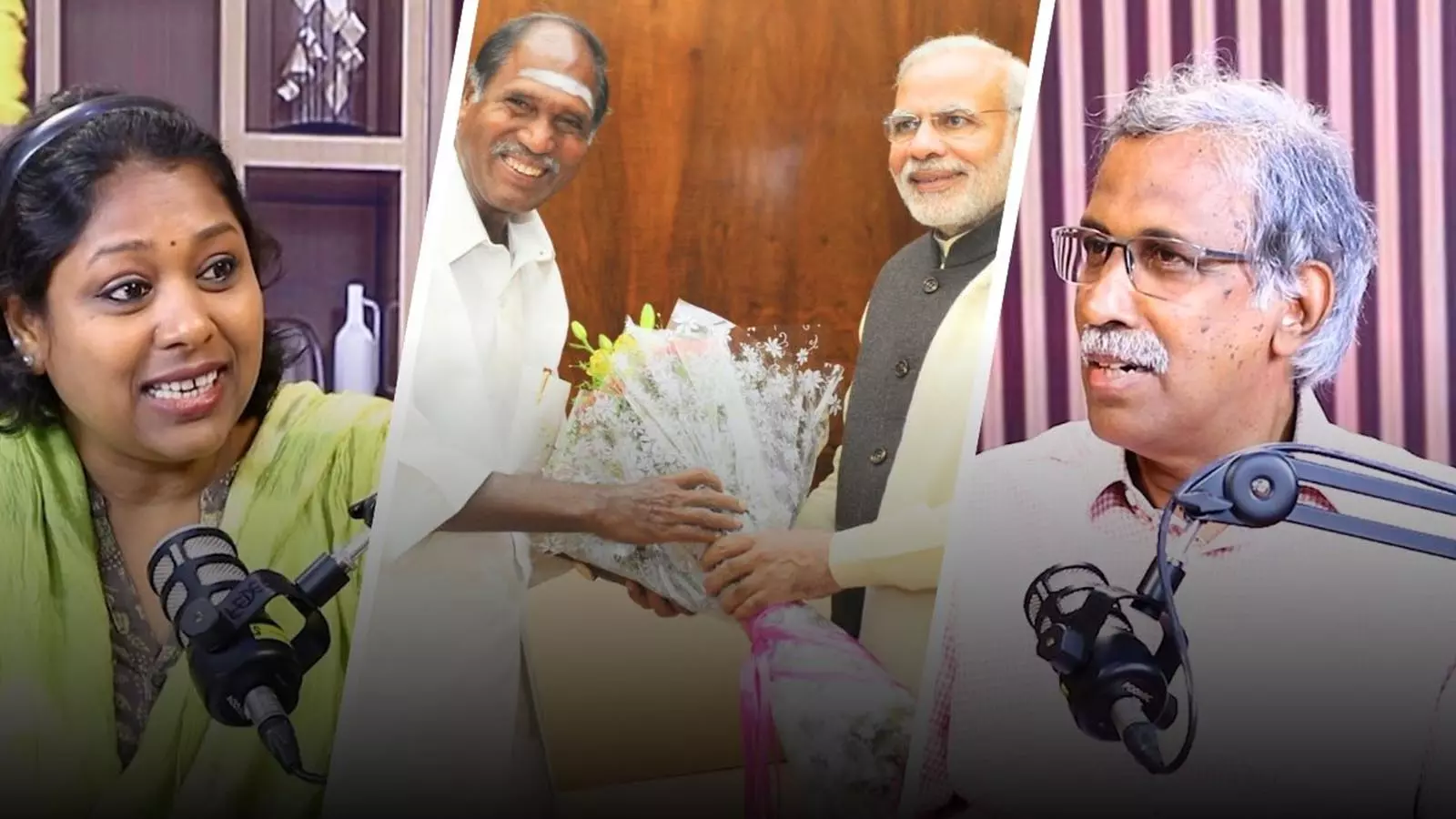
From French legacy to saffron shift: Is Puducherry changing? | Talking Sense With Srini
Puducherry’s voters remain pragmatic and believe it’s good to go with the party at the Centre so their interests are protected; that calculation may once again determine the outcome of the elections

Puducherry’s electoral contest is heating up, with identity, governance, and political pragmatism converging to shape both the campaign narrative and the ground reality in the Union Territory.
The long-standing demand for statehood has resurfaced, but remains fraught with contradictions. Speaking on Talking Sense With Srini, The Federal’s Editor-in-Chief S Srinivasan pointed to structural constraints. “It’s a very small region. It can’t sustain itself financially.”
Puducherry’s dependence on central grants and its low-tax regime, particularly on liquor and vehicle registration, create disincentives for full statehood.
“Many people may not like it because it takes away the advantages,” he said, underlining the gap between political messaging and economic reality.
Hyperlocal politics
On the ground, hyperlocal politics dominates.
“People know their politicians by name, by family, and what they have done,” said Pramila Krishnan, Assistant Editor, The Federal, after travelling across constituencies.
Also Read: Are pro-incumbency trends changing India’s elections? | Talking Sense With Srini
In a tightly-knit polity, she noted, voters prioritise accessibility and delivery over party symbols.
“They identify the candidate and judge how much they have improved facilities and infrastructure,” she added.
BJP’s rise
The Bharatiya Janata Party’s rise marks a significant shift. From negligible presence decades ago, the party has expanded rapidly post-2014. Krishnan observed that this growth is closely tied to central influence.
“They have direct control over the day-to-day governance, so they grew in a big way.”
Also Read: Double engine govt in Pondy: Political myth or real growth? Namasivayam interview
While grassroots networks have strengthened, she cautioned that ideological penetration remains limited.
“Hindutva has not seeped in as such,” she said, describing the shift as more strategic than cultural.
Puducherry’s cosmopolitan character
Srinivasan framed Puducherry as politically distinct from Tamil Nadu.
“It has a cosmopolitan character. The Dravidian identity doesn’t fully apply,” he said, citing its multilingual composition and French legacy. This has blunted the appeal of Dravidian parties, even as national parties gain ground.
Also Read: Puducherry elections: AINRC must stay with BJP for funds, says minister
Electorally, the NDA appears better placed.
“AINRC and BJP have the edge,” Krishnan said, pointing to smoother alliance coordination.
In contrast, tensions within the Congress-DMK combine have played out publicly, weakening their position.
Governance deficits
Yet, beyond alliances and vote shares, governance deficits loom large. Despite its tourist appeal, Puducherry struggles with basic infrastructure.
“For all its charm, it lacks municipal strength,” Srinivasan noted, citing poor roads, water issues, and urban congestion.
Also Read: BJP releases list of nine candidates for Puducherry Assembly polls
Ultimately, Puducherry’s voters remain pragmatic. As Krishnan put it, “They believe it’s good to go with the party at the Centre so their interests are protected.”
In a Union Territory where power flows from New Delhi, that calculation may once again determine the outcome.