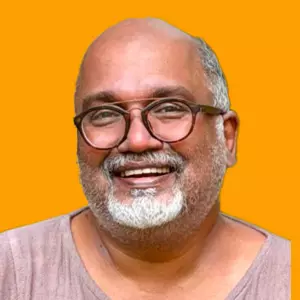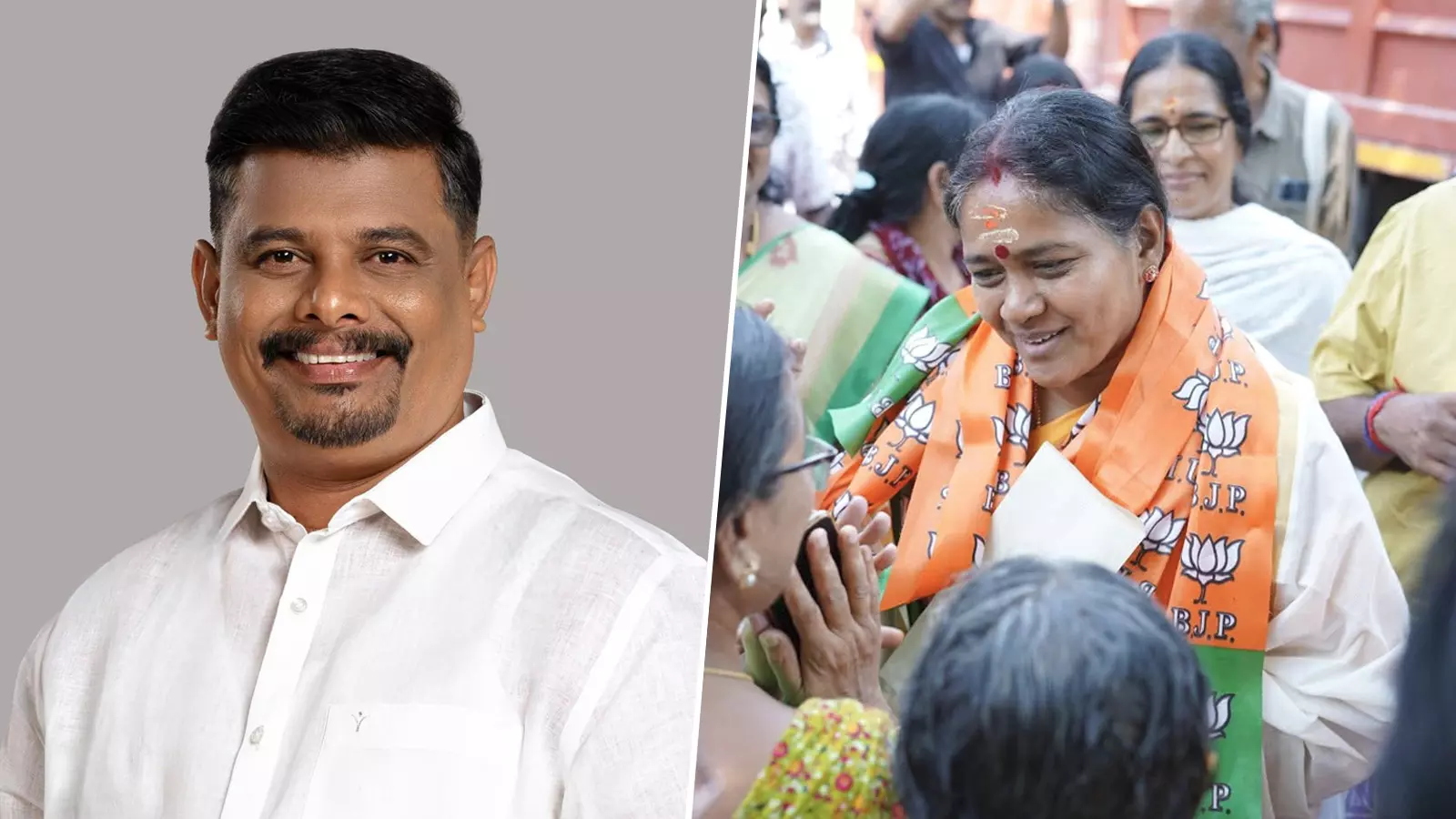
In Palakkad, the CPI(M) has backed Independent candidate NMR Razaq against BJP's heavyweight Sobha Surendran, a move Congress calls a deal.
Kerala elections: Congress alleges BJP-CPM deal, Left hits back
From Palakkad trigger to statewide flashpoint, Congress alleges CPI(M)-BJP nexus as analysis of previous election data complicates the claim and fuels the debate

The United Democratict Front (UDF) in Kerala has sharpened its attack on the Left Democratic Front (LDF) by alleging a covert understanding with the BJP, and the charge has now been escalated into a central campaign narrative.
The immediate trigger for the allegation lies in Palakkad, where the CPI(M) has fielded an independent candidate, NMR Razaq, a very popular hotelier based in the town, in a contest that also features BJP heavyweight Sobha Surendran. The Congress, for its part, has fielded Ramesh Pisharody, a television comedian-turned-first-time candidate. There are similar allegations in Manjeshwar, Konni and Ranni too.
Congress sharpens attack on Left
It was in this context that the Congress first began alleging a “deal” between the CPI(M) and the BJP at the constituency level, arguing that the Left’s decision not to field an official party candidate and opting for a minority face, could split anti-BJP votes and indirectly benefit the saffron party. What began as a localised charge in Palakkad soon expanded into a broader political line.
Also read | CM Pinarayi Vijayan questions Rahul Gandhi’s political acumen ahead of Kerala polls
That escalation was evident on March 25. With Rahul Gandhi staying away from a Congress rally due to the ill health of Sonia Gandhi, Mallikarjun Kharge stepped in and mounted a direct attack on the CPI(M), accusing it of maintaining a tacit understanding with the BJP. Around the same time, Rahul Gandhi, from Delhi, reiterated the allegation, giving it national visibility and reinforcing the Congress’s attempt to shape the narrative across Kerala.
“The CPI(M) and the BJP are now in an open nexus, effectively functioning as what we call ‘CJP’. They are deliberately fielding weak candidates and engaging in vote transfers as a strategy for political survival,” alleged Kharge.
Rahul, in his virtual address to the rally, went a step further in attacking the LDF. “I have 40 cases filed against me. I have been interrogated for five consecutive days by the Enforcement Directorate, and the BJP targets me every single day. I want to ask the people this: why does the BJP not attack the Kerala Chief Minister? Why are the corruption cases against him not moving forward? This, to me, is the clearest proof of collusion between the BJP and the LDF,” Rahul said.
The Congress campaign has since leaned heavily on this line, particularly in its outreach to minority voters. The argument being advanced is that a divided opposition space, especially where the Left’s tactical choices come into play, could end up aiding the BJP.
Numbers tell different story
However, electoral data from recent years presents a more complex picture that does not fully align with the allegation.
The Thrissur Lok Sabha election of 2024 remains a key example. The BJP’s Suresh Gopi secured a landmark win with over 4.1 lakh votes, around 37 per cent vote share. The CPI candidate followed with around 3.3 lakh votes, roughly 31 per cent, while the Congress candidate finished third with about 3.2 lakh votes, nearly 30 per cent. The result underlined a pattern seen in several triangular contests, where the BJP’s rise has coincided with an erosion in the Congress vote base.
Nemom provides a longer electoral arc that reflects the same trend across three Assembly elections.
In 2011, the CPI(M)’s V Sivankutty won the seat with 50,076 votes, or 42.99 per cent. The BJP’s O Rajagopal secured 43,661 votes, 37.49 per cent, while the United Democratic Front (UDF) candidate Charupara Ravi polled 20,248 votes, or 17.38 per cent, finishing third.
In 2016, Rajagopal went on to win the seat with 67,813 votes, taking 47.46 per cent. The CPI(M)’s Sivankutty came second with 59,142 votes, 41.39 per cent. The UDF candidate, V. Surendran Pillai, received 13,860 votes, just 9.70 per cent. The BJP’s breakthrough was accompanied by a steep decline in the Congress vote share.
In 2021, the CPI(M) regained the seat with Sivankutty polling 55,837 votes, or 38.24 per cent. The BJP’s Kummanam Rajasekharan secured 51,888 votes, 35.54 per cent, while the Congress candidate K Muraleedharan improved to 36,524 votes, 25.01 per cent, but still remained in third position. The margin of victory was 3,949 votes.
Left dismisses Congress narrative
Across these three elections, the pattern remains consistent. When the BJP strengthens its position, the Congress tends to lose ground more sharply, while the CPI(M) retains a relatively stable presence either as winner or runner-up.
Chief Minister Pinarayi Vijayan was sharp in raising these issues and mounted a scathing counteroffensive against Rahul Gandhi. During the campaign, he directly took on the Congress leader.
Also read | Kerala CM Vijayan calls Congress' allegations of CPI(M)-BJP tie-up ‘baseless’
“Rahul Gandhi is a national leader, yet he lacks even the basic awareness of an ordinary Congress worker in Kerala. He refuses to learn from experience or past mistakes, and it is difficult to understand how he has come to this point. Rahul Gandhi and the Congress are effectively acting as the BJP’s ‘B-team’ in the country, and this stance is now being seen across India,” said the chief minister.
Not only the chief minister, all the CPI(M) and LDF leaders are repeatedly pointing out that the electoral record demolishes the Congress allegation of a sustained BJP-CPI(M) understanding. If such a deal were structurally influencing outcomes, the repeated instances of Congress being pushed to third place in key contests become difficult to explain.
The Congress, however, continues to draw from specific political episodes to support its argument. The Guruvayur constituency in 2021, where the Indian Union Muslim League alleged that CPI(M) benefited from BJP votes after the latter’s nomination was rejected, is one instance. The CPI(M) has denied the charge.
Row expands beyond Palakkad
Further, claims by P Yathindradas, a former District Congress Committee general secretary who later defected, that there were discussions between UDF and BJP leaders during the 2021 Assembly elections, have added another layer to the debate.
“It was CH Rasheed, the current UDF candidate, who took the initiative for the talks with the Sangh Parivar leadership in 2021 to get their core votes in favour of the IUML candidate K NA Khader,” said the former UDF campaign manager.
For the CPI(M), the Congress campaign is an attempt to reshape the electoral narrative in a triangular contest where the BJP’s incremental gains have altered traditional vote patterns. Left leaders maintain that their political opposition to the BJP remains consistent and that the Congress is using the allegation to consolidate its base.
What is clear is that the Palakkad trigger has now evolved into a statewide and even national-level campaign theme. From a constituency specific charge over candidate selection, the Congress has expanded the argument into a broader claim of political alignment, amplified by Kharge and Rahul Gandhi.