Kerala polls: Between UDF-LDF’s usual vote exchange, a steady expansion of BJP base
BJP’s progression shows a steady expansion over two decades, with the most pronounced growth between 2011 and 2016; this election marked a conversion into seats

Although the UDF marked a thumping victory in Kerala, crossing the 100-seat mark, and the BJP-led NDA came back with a record three seats, the underlying vote share pattern in Kerala remains, in many ways, consistent with its long-standing electoral character.
The UDF has expanded its vote share from 39.41 per cent in 2021 to 46.64 per cent, marking a sharp gain of 7.23 percentage points. The LDF has recorded a mirror decline, dropping from 45.28 per cent to 37.66 per cent. In terms of votes, the UDF has crossed one crore ballots, polling 1,00,59,021 votes, thanks to the IUML’s vote surge, while the LDF stands at 81,21,021. The NDA, led by the BJP, has secured 31,08,831 votes across the state.
Also read: Kerala election results: What led to LDF's rout and what next for the Left?
This movement is also reflected in party-level data. The Congress has risen to 28.79 per cent, improving on its 25.12 per cent performance in 2021. The Indian Union Muslim League has registered one of the more notable gains, climbing to 11.01 per cent from 8.27 per cent. On the Left side, the CPM has declined to 21.77 per cent from 25.38 per cent, while the CPI has dropped to 6.64 per cent. The erosion extends across several smaller allies within the LDF, many of whom have not translated their vote share into seats.
BJP’s trajectory in Kerala
Set against this large-scale shift between the two dominant fronts is the trajectory of the BJP. The party’s vote share stands at 11.42 per cent, contributing to an NDA total of 14.41 per cent. Compared to 2021, when the NDA had 12.52 per cent, this represents a modest increase. This time, the alliance was also expanded with the induction of the corporate-backed Twenty20 party.
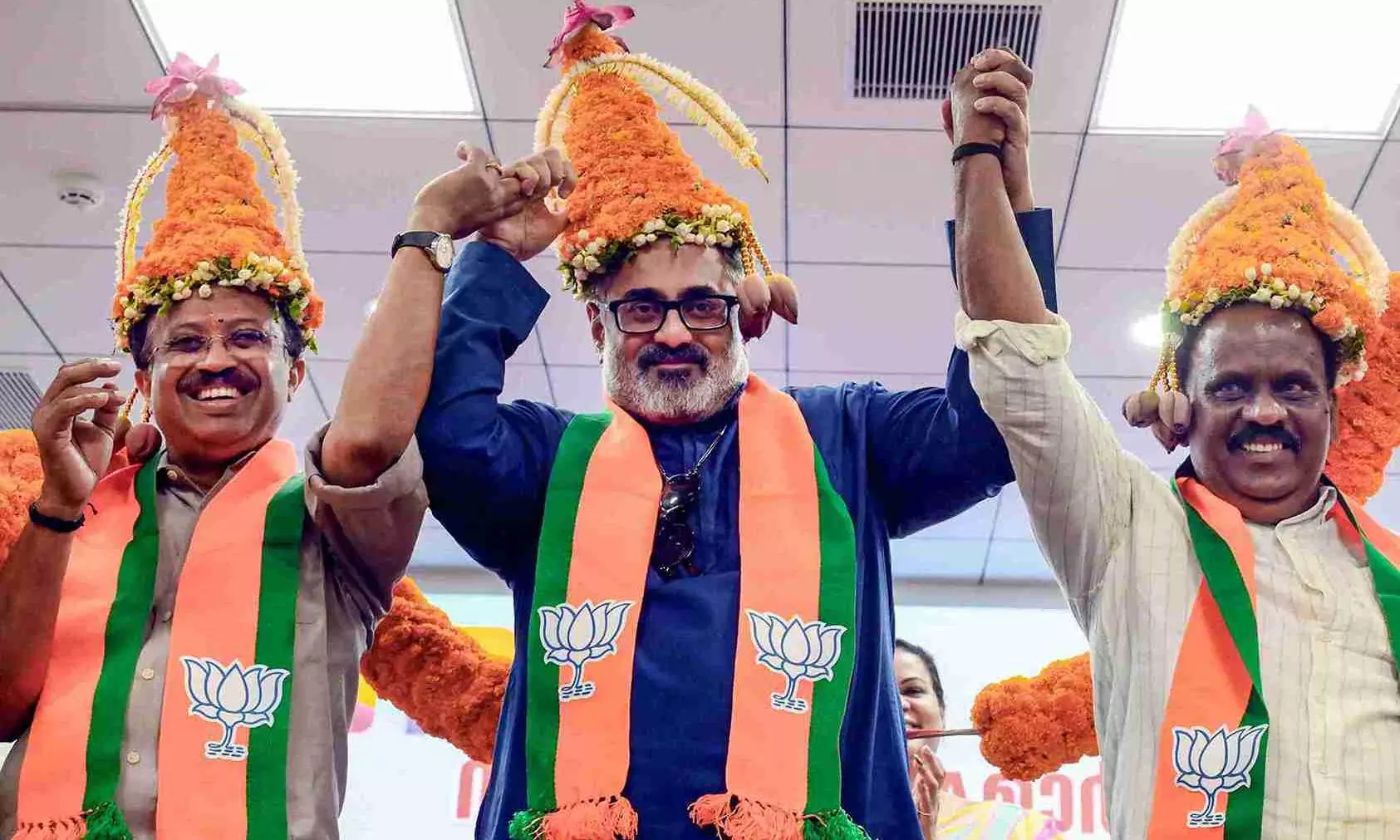
Yet, the electoral outcome marks a significant moment, with the BJP winning three Assembly seats after drawing a blank in the previous election. The historical trend of the BJP’s vote share in Kerala provides important context to this outcome.
Also read: How UDF won Kerala after a decade: From 'total disarray' to total dominance
From just 5.02 per cent in 2001, the party’s vote share dipped slightly to 4.75 per cent in 2006 before rising to 6.03 per cent in 2011. A major shift occurred in 2016, when it crossed into double digits at 10.53 per cent. This was followed by 11.3 per cent in 2021 and now 11.42 per cent in 2026.
Steady expansion over two decades
The progression shows a steady expansion over two decades, with the most pronounced growth occurring between 2011 and 2016. The subsequent elections reflect a consolidation of that base at a higher level. The latest figure, while only marginally higher than 2021, represents the peak of this trajectory.
What makes this election distinct for the BJP is not just the percentage, but its conversion into seats. In 2021, a comparable vote share did not yield representation. In 2026, that same range of support has resulted in three victories. This underlines the importance of how votes are distributed geographically, rather than just their aggregate share.
A comparison with recent elections further highlights the pattern. In the 2024 Lok Sabha elections, the NDA secured 19.24 per cent (16.68 per cent for BJP and 2.56 per cent for BDJS) of the vote in Kerala. In the 2025 local body elections, there was a drop to 14.71 per cent for the NDA. The current Assembly figure of 14.41 per cent shows a further drop from these numbers.
Also read: With Pinarayi's LDF loss in Kerala, India left with no Left-ruled state
Across Kerala, a total of over 2.15 crore votes were polled. The distribution of these votes reinforces the state’s enduring bipolar structure, with the UDF and LDF accounting for the bulk of the electorate. Within this framework, the BJP’s position as a third force is reflected not just in its vote share, but increasingly in its ability to secure representation.
Two different kinds of electoral movement
The key feature of this election, therefore, lies in the coexistence of two different kinds of electoral movement. On one hand, there is a clear and substantial transfer of votes between the UDF and LDF, visible in both percentages and seat outcomes. On the other, there is a longer-term, incremental expansion in the BJP’s support base, now accompanied by a breakthrough in terms of seats.
Also read: UDF landslide in Kerala: The multiple factors that toppled Left
The BJP’s vote share has risen steadily from 2001 to 2026, with a sharper increase after 2011, and stabilised at a higher level in recent elections. The latest, marked at 11.42 per cent, aligns with this pattern of gradual growth followed by consolidation, while the three-seat outcome adds a new layer to the story. The vote share pattern remains broadly familiar, but the outcomes it produces are beginning to evolve.
There are as many as 29 constituencies where the NDA has crossed the 20 per cent vote mark, pointing to a pattern of concentrated strength rather than diffuse presence across Kerala.
In several seats, this support is not just significant but highly competitive. In Nemom, the NDA secured 41.1 per cent of the vote, while in Chathannoor it polled 38.5 per cent. In Kazhakkootam, another seat it won, the vote share stood at 35.9 per cent. Even in constituencies it did not win, the numbers indicate a strong footing, with 36.4 percent in Manjeshwar, 33.8 per cent in Palakkad and over 30 percent in seats like Kasaragod, Attingal and Thiruvalla.
This spread of relatively high vote shares across select constituencies suggests that the NDA’s performance cannot be assessed purely through its modest overall increase in vote share. The presence of multiple constituencies with vote shares well above 20 per cent underlines a growing competitiveness that goes beyond the aggregate state-level numbers.