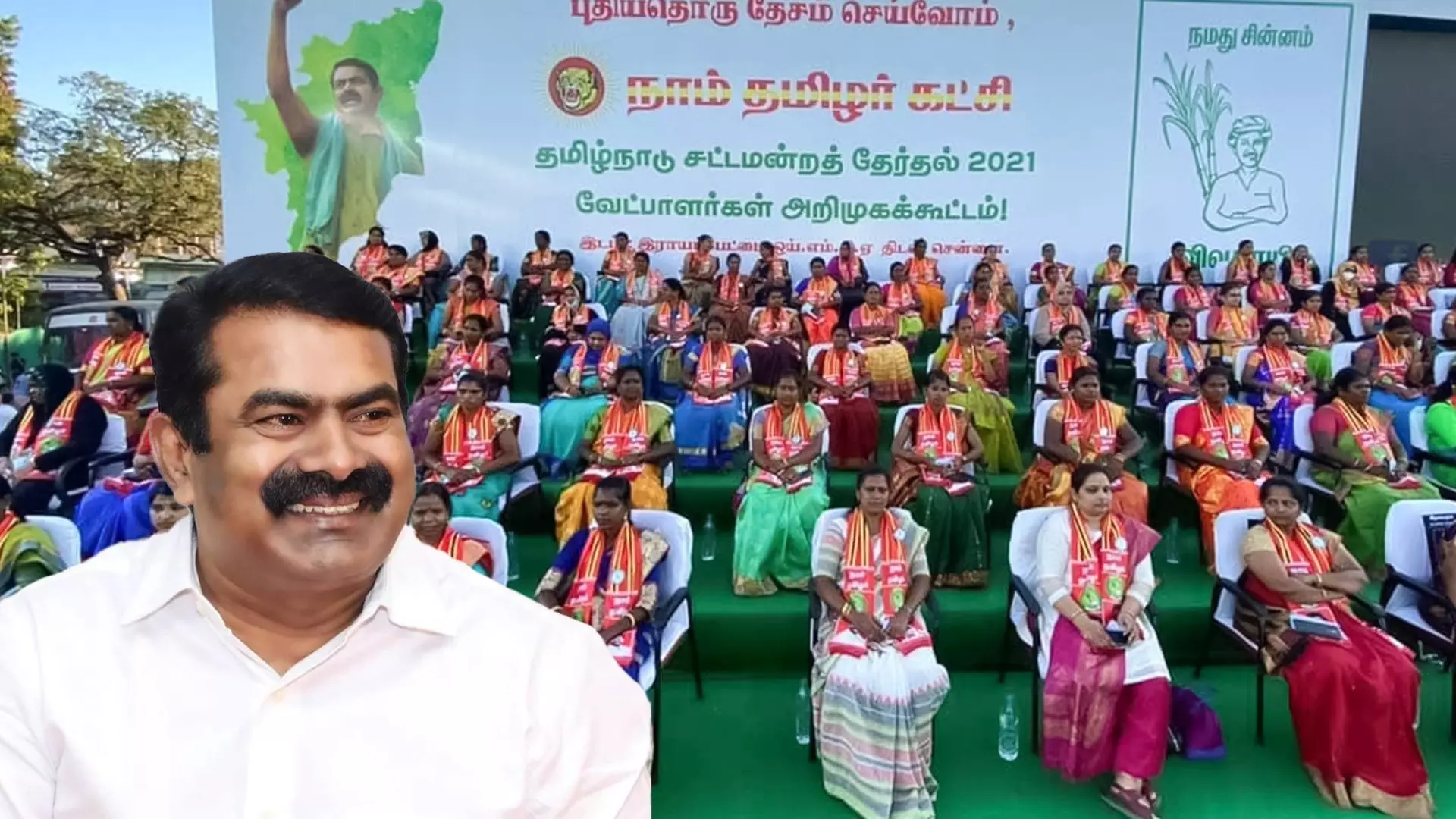
TN elections: NTK’s 50 pc women quota shakes up electoral landscape
Gender partiy or electoral strategy? NTK's women candidates policy is creating ripples in TN's political landscape. But will this lead to true empowerment?

As Tamil Nadu gears up for the 2026 Assembly elections, a quiet yet powerful shift is emerging in the state’s male-dominated political landscape. The Naam Tamilar Katchi (NTK), led by C Seeman, is leading this transformation by making a bold statement: 50 per cent of their election candidates are all set to be women.
This move, which began in 2019, has seen nearly 200 women contest in both Assembly and Lok Sabha elections under the NTK banner.
The rise of women in politics
For many of these women, entering politics is not about family legacies or following in the footsteps of political dynasties; it's about stepping into the political arena on their own terms. Many of the candidates are from professional backgrounds such as doctors, advocates, and researchers, who have never considered full-time politics until now.
Dr Punitha Shanmugam, an MSc and PhD holder in Physics, is one such candidate. She worked as a post-doctoral scientist in China before venturing into politics. "Politics, to us, is synonymous with our very way of life," she said. "We are currently compelled to demand all our fundamental rights solely through the path of protest."
Also read: Why Annamalai stayed away when Modi landed in Coimbatore | Seat-sharing snub
Her entry into politics, alongside many other women from similar professional backgrounds, marks a major shift in the kind of representation that’s being seen in Tamil Nadu.
"It was Seeman who taught us that everything is political," Dr Shanmugam added, highlighting how NTK has empowered women to become leaders in their own right.
A game-changer?
What’s truly remarkable is the fact that these women are not just contesting elections but are doing so on the platform of NTK’s revolutionary 50-50 per cent reservation policy for women.
This is not just a gesture; it's a part of a fundamental shift in Tamil Nadu's political culture. Over the past 60-70 years, neither the Union nor the state government has provided equal political representation for women, according to NTK leaders.
Seeman’s efforts have also been significant in empowering transgender individuals in the political sphere, a move that has sent shockwaves through the political establishment. "After all, who are you? You are human beings, just like us. You have endured even greater hardships than the struggles we face," Dr Shanmugam said, referring to NTK’s inclusive approach.
Also read: TVK unleashes youth-centric TN poll manifesto to disrupt state's traditional politics
This political empowerment is sending a clear message: women in Tamil Nadu are no longer willing to be passive participants in politics. They want to be active decision-makers and key players in shaping the future of the state.
The ripple effect
NTK’s policy of 50 per cent women candidates is not just changing the political landscape for their own party, but is also forcing other political entities to reconsider their stance on women’s representation.
As Dr Shanmugam noted, "Whether they are new political formations, such as the one led by Vijay, or older, entrenched parties like the DMK or the ADMK, they too will be forced to give more representation to women."
The impact of NTK’s approach is already visible in the shifting conversation about women’s political participation. Political analysts and experts believed that the inclusion of more women in politics could have a lasting impact on electoral strategies and governance models across Tamil Nadu.
Does it lead to real power?
However, there remains a crucial question: Does being a candidate in a political party truly translate into real power? While being nominated for elections is a significant step, many wonder where these women go after the elections. Are they part of the party structure? Are they involved in decision-making roles?
Also read: Tamil Nadu elections: Dalit doctor, filmmaker debut as parties spring surprises
“It’s one thing to field a woman as a candidate, but does she have real influence once the election is over?” asked a local political analyst. "Candidature is also a form of identity politics, but the question remains whether it leads to lasting empowerment or just political visibility."
As Tamil Nadu moves towards the 2026 Assembly elections, NTK’s approach will be tested. While it has opened doors for women to step into the political arena, it remains to be seen if this shift will lead to a more inclusive and truly empowering political culture, or if it remains merely an electoral strategy designed to appeal to the masses.
With hundreds of first-time women candidates now running under NTK's banner, the true test will come on May 4, 2026, when the votes are counted. Will these women be empowered beyond their candidacy, or will their role in politics remain confined to the visibility of the election campaign?
The content above has been transcribed from video using a fine-tuned AI model. To ensure accuracy, quality, and editorial integrity, we employ a Human-In-The-Loop (HITL) process. While AI assists in creating the initial draft, our experienced editorial team carefully reviews, edits, and refines the content before publication. At The Federal, we combine the efficiency of AI with the expertise of human editors to deliver reliable and insightful journalism.