'Privilege notice against PM Modi is a message to the nation' | Capital Beat
Experts flag attribution of motives to MPs as a potential breach of parliamentary privilege, while citizens’ group alleges misuse of state media during the Model Code of Conduct period

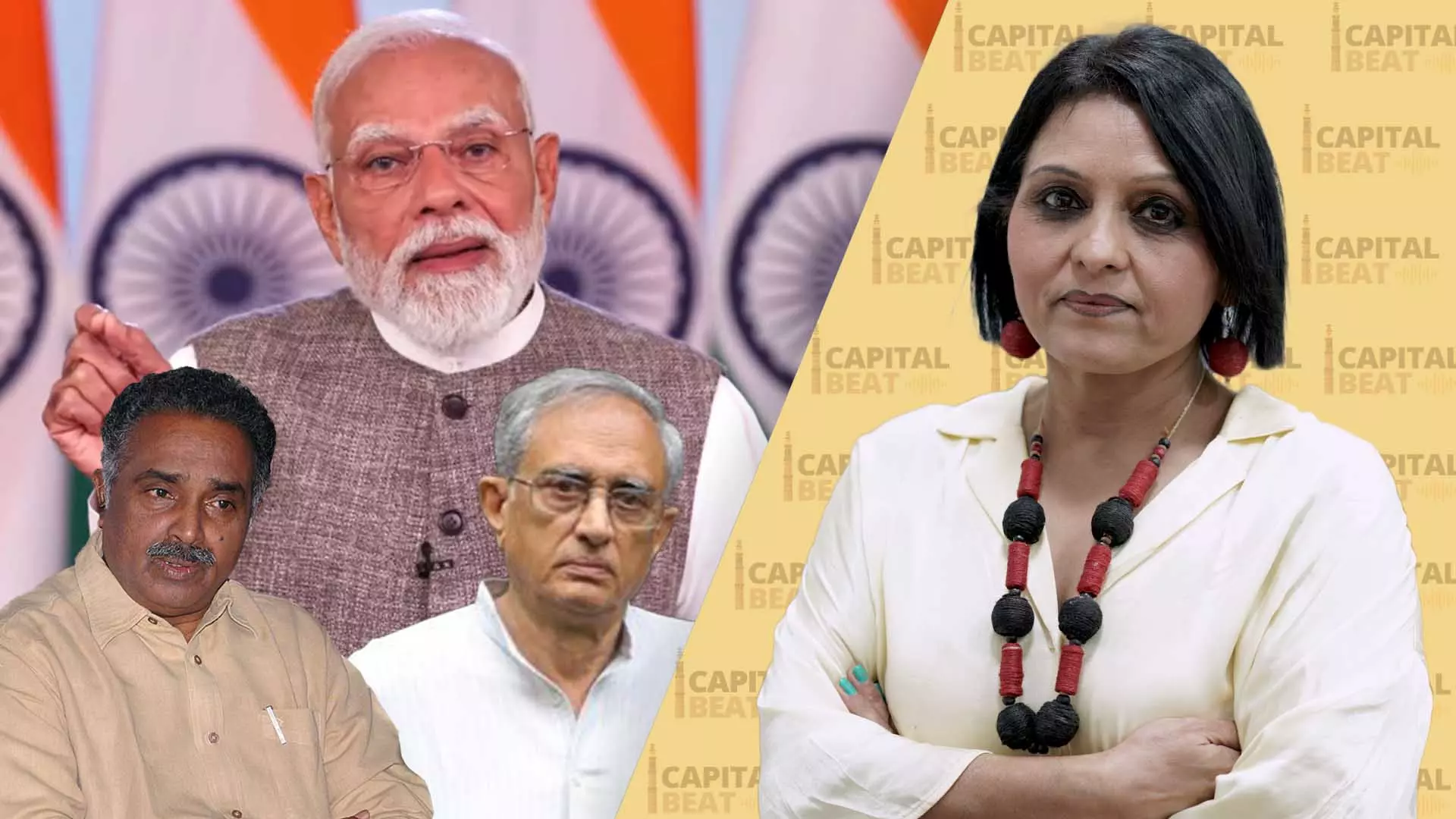
In this Capital Beat episode, Dr EAS Sarma, former secretary to the Government of India, and PDT Achary, former Secretary-General of the Lok Sabha, examined the privilege notice filed by Congress MP KC Venugopal against Prime Minister Narendra Modi and a separate complaint to the Election Commission alleging violation of the Model Code of Conduct (MCC). The discussion focused on parliamentary privilege, procedural limits, and the implications of the Prime Minister’s national address on the Constitution (131st Amendment) Bill.
Venugopal’s notice accuses the Prime Minister of casting aspersions on Opposition MPs’ voting patterns during a national address, calling it a “blatant abuse of power” and “contempt of the House". The letter highlights that the Prime Minister, in a 29-minute speech, criticised Opposition parties for blocking the bill, and attributed motives to Members of Parliament based on their speeches and votes.
The notice further describes the address as “unprecedented, unethical, and blatant misuse of power", arguing that such remarks by the highest executive authority amount to a serious breach of parliamentary privilege. The matter now rests with the Speaker, who must decide whether to admit the notice and refer it to the Committee of Privileges.
Speaker’s discretion, privilege framework
Achary outlined the procedural framework governing privilege notices, emphasising that the Speaker’s role is decisive.
“It is actually for the Speaker to decide whether there is a breach of privilege,” he stated, noting that no external authority determines the admissibility of such notices.
He explained that parliamentary privilege ensures that MPs can speak and vote freely without fear of external consequences.
Also Read: Congress moves privilege notice against PM Modi over address to the nation
“Members of Parliament must be able to speak freely and without any fear,” Achary said, adding that this protection extends to both speeches made in the House and voting decisions.
Achary identified the core issue raised in the notice: attribution of motives.
“You cannot attribute motive to the member for what he says in the House or how he voted in the House,” he said, describing this as the “essence of the breach of privilege". He added that such attribution, whether by a member or an outsider, could potentially constitute a violation.
Historical precedent, likely outcomes
Addressing precedent, Achary noted that privilege notices against Prime Ministers have been filed in the past but have not progressed beyond initial stages.
“There was no occasion when it was allowed… the Speaker did not allow it to go beyond that,” he said.
He further indicated that the Speaker must first determine whether the notice has merit before referring it to the privileges committee.
“That happens only when the Speaker is convinced that there is a merit in the notice,” he explained.
Also Read: Has PM Modi violated poll code? EC to examine complaint
On potential consequences, Achary described a wide range of punitive actions available in theory.
“There are warnings and reprimand and admonitions… in fact, a person can even be imprisoned,” he said, while adding that such extreme outcomes are unlikely. He also noted that the case may not proceed beyond the initial stage.
“At the threshold itself, it may be rejected,” he observed.
MCC complaint
Parallel to the privilege notice, a group of around 700 citizens, including lawyers, bureaucrats, and activists, submitted a complaint to the Election Commission alleging violation of the Model Code of Conduct. The complaint pertains to the Prime Minister’s April 18 national address on women’s reservation.
The letter alleges that the address was broadcast on official government platforms, including Doordarshan, Sansad TV, and All India Radio, all funded by public resources. It claims that using such platforms during the MCC period for what it terms “electioneering and partisan propaganda” constitutes a serious breach.
Also Read: ‘Mudslinging’, ‘outright lies’: How Opposition reacted to PM Modi’s address
The complainants have urged the Election Commission to examine the content and manner of the address, assess it against MCC provisions, and take appropriate action. They also requested equal airtime for Opposition parties if prior permission had been granted, or removal of the speech from official platforms if it violated the code.
Concerns over institutional response
Dr Sarma, one of the signatories, highlighted concerns regarding the Election Commission’s responsiveness.
“In the last few years, the response of the present Election Commission somehow has not been very meaningful at all,” he stated, referring to previous representations.
He emphasised the importance of public trust in constitutional institutions.
Also Read: Kharge says Congress opposed delimitation, not Women’s Quota Bill, slams Modi
“The credibility of the Election Commission of India depends on public trust,” Sarma said, warning that a lack of response could undermine its effectiveness.
Sarma also pointed to broader issues related to the bill and the national address, including the linkage between women’s reservation and delimitation. He described the combination as “a very strange combination”, and noted concerns regarding representation and census-based delimitation.
Need for discussion on Constitution amendments
Sarma referred to long-standing parliamentary conventions, stating that members typically refrain from criticising parliamentary proceedings outside the House in a targeted manner.
“A member cannot go outside Parliament and criticise people more or less individually… this is a convention,” he said.
He also stressed the importance of broader public engagement with constitutional amendments.
“This particular Constitution amendment bill should be before every panchayat in the country,” he said, calling for wider discussion on significant legislative changes.
Also Read: ‘MCC breach’: Left parties complain to EC over Modi’s Doordarshan address
On the impact of the privilege notice and MCC complaint, Sarma framed both actions as part of a larger democratic process.
“It is a message to the nation,” he said, adding that such issues should generate public discussion regardless of institutional outcomes.
Achary reiterated that the Speaker must carefully examine the allegation of motive attribution.
“The Speaker will have to very seriously examine that particular point,” he said, underlining the gravity of the issue within parliamentary norms.
(The content above has been transcribed from video using a fine-tuned AI model. To ensure accuracy, quality, and editorial integrity, we employ a Human-In-The-Loop (HITL) process. While AI assists in creating the initial draft, our experienced editorial team carefully reviews, edits, and refines the content before publication. At The Federal, we combine the efficiency of AI with the expertise of human editors to deliver reliable and insightful journalism.)