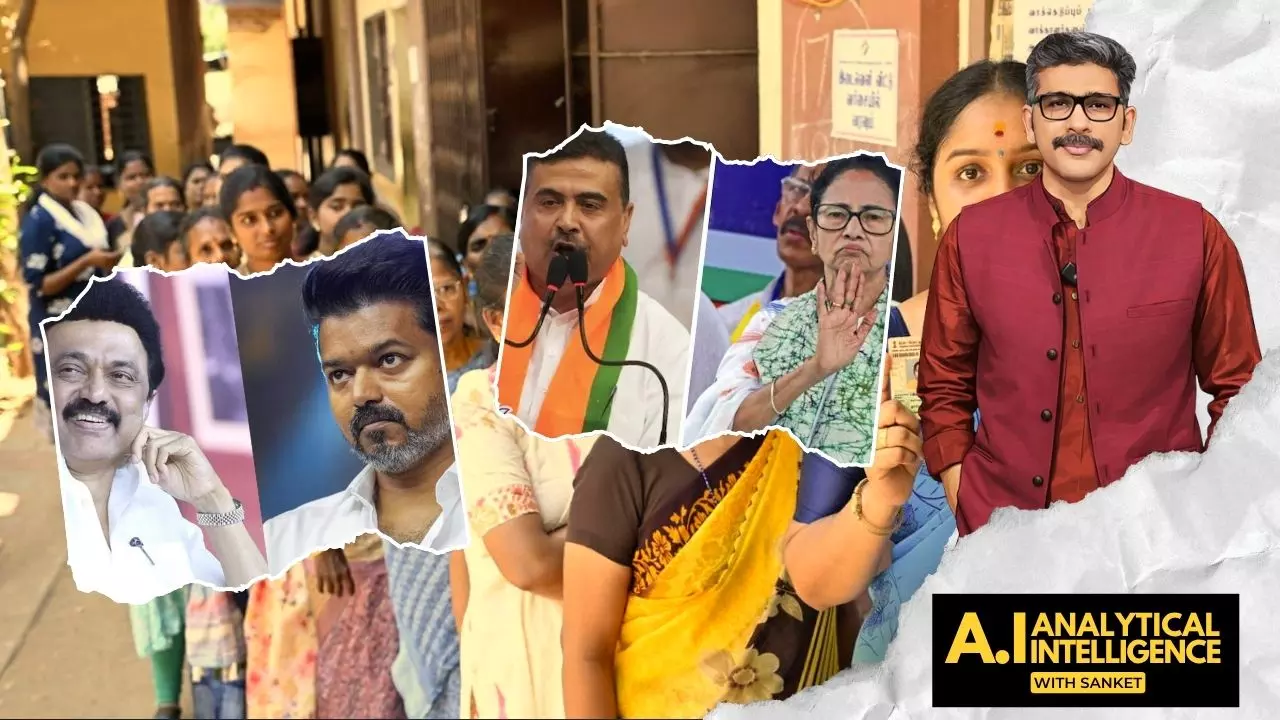
DMK VS TVK
High voter turnout, not landslides, may define Election 2026: Sanjay Kumar
Veteran psephologist says intense competition, voter anxiety, SIR drove record voter turnout, and that all the states are likely to see tough contests

“A high voter turnout across all five states is the most significant takeaway of these elections, and a landslide victory in any state would genuinely surprise me,” says noted psephologist and election analyst Sanjay Kumar.
As India awaits the final verdict in crucial Assembly elections across Tamil Nadu, West Bengal, Assam, Kerala, and Puducherry, Kumar, in an interview with The Federal, argues that political competition, voter mobilization, and anxiety over electoral processes are reshaping voting patterns more than simplistic narratives around exit polls.
The Federal speaks with the veteran psephologist and political analyst on the broader electoral mood, the impact of the Special Intensive Revision (SIR) exercise, Tamil Nadu’s evolving political equations, and whether Mamata Banerjee or the BJP has the upper hand in West Bengal.
What stands out most about these elections across five states?
The most noticeable thing in this election is the very high voter turnout across all five states. This should not be attributed only to the SIR exercise. Yes, SIR has played a role because it has helped clean electoral rolls by deleting ghost voters and correcting inflated voter lists. But beyond that, what is remarkable is the sheer level of voter participation.
This is not just about West Bengal or Tamil Nadu. Kerala, Assam, and Puducherry have also seen high participation. This is something that should be celebrated because Indian voters are participating in larger numbers than in previous elections.
Is this turnout merely because of voter deletions, or does it reflect broader political engagement?
All three factors are at play. First, inflated voter rolls from previous years have been corrected. If names that should not be there are removed, turnout percentages naturally rise.
Second, there is genuine voter interest because political competition has intensified. Strong contests push parties to mobilize voters more aggressively.
Third, there is voter anxiety. Some voters whose names remain on rolls but who live elsewhere may have returned specifically to vote. So, turnout is not simply a statistical artifact—it reflects a combination of electoral cleansing, political mobilization, and voter concern.”
How do you assess the SIR exercise, particularly in West Bengal where deletions became controversial?
SIR was needed. Electoral roll cleaning has long been necessary. However, there are anxieties, especially among voters who believe they were wrongly excluded despite valid documentation.
In Bengal, it appears the number of such anxious voters may be somewhat higher than in other states. So while the process itself is justified, implementation concerns have clearly created political sensitivity.
What is your broader reading of Tamil Nadu’s electoral contest?
It is difficult to make precise predictions without hard polling data. But yes, Jayalalithaa’s absence has weakened the AIADMK compared to its past stature.
Tamil Nadu has traditionally been defined by DMK versus AIADMK alliances, but AIADMK no longer appears as formidable as before. At the same time, Vijay’s political entry introduces an unpredictable factor.
India has examples of successful political newcomers, like the Aam Aadmi Party, and failures, such as Prashant Kishor’s Jan Suraaj. Tamil Nadu’s case is unique because Vijay is not just a politician but a superstar. Tamil Nadu has seen both successful and unsuccessful superstar political experiments before. So while DMK may appear slightly advantaged, surprises cannot be ruled out.
Can Tamil Nadu still revert to conventional DMK-AIADMK politics despite celebrity entrants?
Not necessarily. Politics can change dramatically. Few predicted AAP’s rapid rise in Delhi.
Tamil Nadu’s politics has historically revolved around these two Dravidian giants, but new players can reshape equations. Whether Vijay’s TVK can do so remains to be seen.
Beyond Bengal and Tamil Nadu, which other states are significant?
All elections are equally important. Kerala’s key question is whether the Left can break historical anti-incumbency trends yet again. Assam is equally crucial because Himanta Biswa Sarma has emerged as a major BJP figure, not just in Assam but across the Northeast.
Media optics may focus more on Bengal and Tamil Nadu, but each state carries major stakes.
How important are women voters in West Bengal?
I would not say Mamata Banerjee controls women voters, but TMC certainly has an edge among them.
Past voting patterns suggest women have favored TMC more strongly than rival parties. The women factor is increasingly significant not just in Bengal but across India, as seen in Haryana, Maharashtra, Bihar, and elsewhere. Whoever wins Bengal will likely owe a significant part of that victory to women voters.
Can issues like women’s reservation significantly influence voter behavior?
Such issues matter, but party loyalty remains the dominant factor. Around 65% of Indian voters increasingly vote along party lines. Compared to the 1990s, floating voters have sharply declined, while committed party loyalists have increased.
This means campaign issues still matter, but their power to dramatically shift voter behavior is less than before.”
What outcome would genuinely surprise you?
A one-sided landslide in any state. These elections appear closely contested across the board. While swings are always possible, an overwhelming mandate for any one alliance in any of these states would be the true shock.
The content above has been transcribed from video using a fine-tuned AI model. To ensure accuracy, quality, and editorial integrity, we employ a Human-In-The-Loop (HITL) process. While AI assists in creating the initial draft, our experienced editorial team carefully reviews, edits, and refines the content before publication. At The Federal, we combine the efficiency of AI with the expertise of human editors to deliver reliable and insightful journalism.