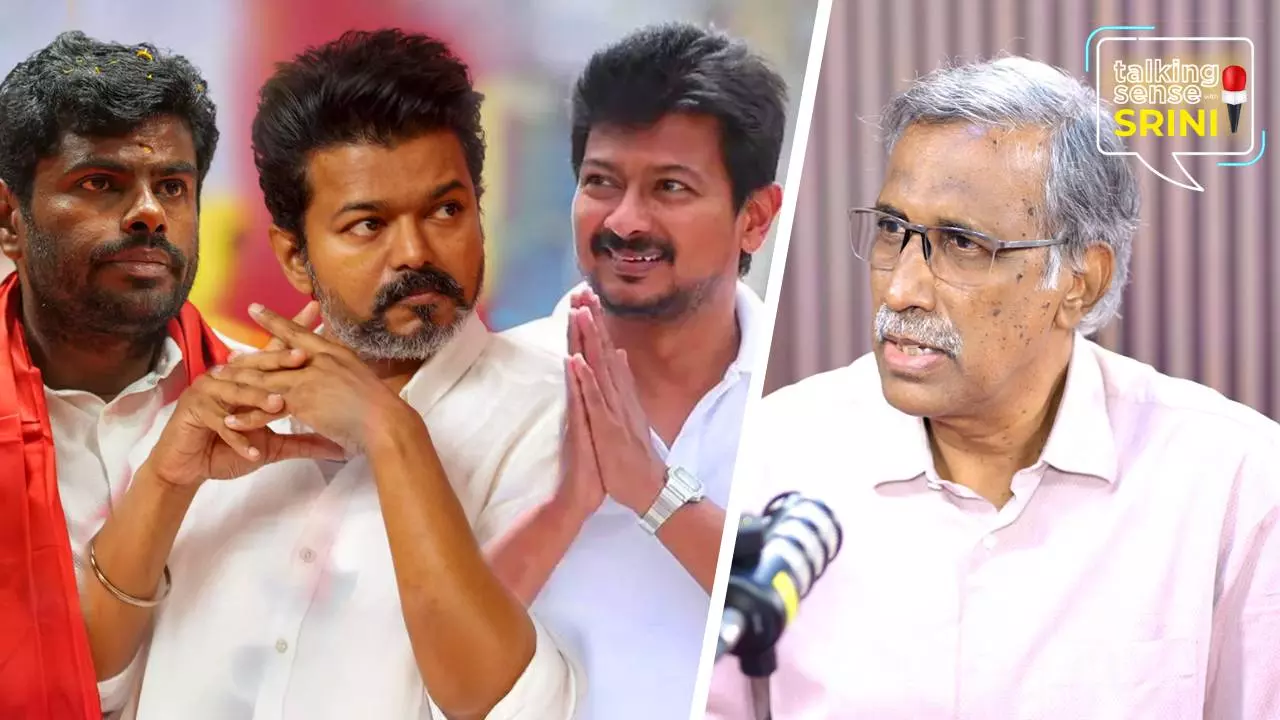
Vijay disrupts, Annamalai waits, and Udhay inherits | TN's Young Turks
Editor-in-Chief S Srinivasan dissects strengths, challenges, trajectories of three rising leaders, arguing charisma alone won’t decide TN's political future

Vijay's undefined politics
Srinivasan began with Vijay, whose entry into politics has generated intense interest across Tamil Nadu. Drawing parallels with past icons like MG Ramachandran and J Jayalalithaa, he cautioned that sheer popularity does not automatically translate into electoral success. Vijay’s greatest strength lies in his visibility—he is already a household name who needs no introduction to voters.
Yet, Srinivasan warned that mass appeal and crowd-pulling power cannot by themselves secure votes. He noted that Vijay has yet to clearly define his ideological stance, apart from positioning the DMK as his political rival and the BJP as his ideological opponent.
Annamalai's aggressive style
Turning to Annamalai, Srinivasan traced a markedly different trajectory.
The former IPS officer injected energy and aggression into the BJP’s Tamil Nadu unit, broadening its outreach and pushing the party to think bigger in terms of mobilisation and visibility. His ability to draw crowds and cultivate a strong personal brand has made him a prominent face of the party.
Also read: TN polls: Not denied seat; didn't want to contest elections, says Annamalai
Yet, Srinivasan observed that this assertive style has also created friction—both within the BJP and with allies like the AIADMK. He argued that Annamalai’s rise has been slowed by challenges of internal coordination and alliance management, even as the BJP continues to value him as a mass leader.
Dynastic politics
He also pointed out that Udhayanidhi’s elevation has been part of a broader pattern within the DMK, where several second-generation leaders have been elevated simultaneously.
Beyond charisma
This, Srinivasan said, has helped create a new internal balance within the party and limited resistance to his ascent. While there have been occasional controversies, he said Udhayanidhi has managed to establish himself within the party structure.