Tamil Nadu election spending: Rs 40 lakh cap vs Rs 5 crore reality
As campaign costs soar far beyond legal limits, corporate funding and electoral trusts reshape the playing field—can democracy stay fair?

It’s Assembly election season in Tamil Nadu. While the Election Commission (EC) caps candidate spending at Rs 40 lakh, the actual cost of running a competitive campaign is estimated at around Rs 5 crore—raising serious questions about funding and fairness in the electoral process.
Actor Vijay’s Tamilaga Vettri Kazhagam (TVK), preparing for its first election, is already facing a critical hurdle. Party organisers say they are not short of willing candidates—but most cannot afford the steep cost of contesting.
Also read: AIADMK likely to contest 170 seats in TN polls as NDA seat-sharing talks progress
This challenge is not unique to TVK. Across parties, the gap between the legal spending cap and real campaign expenses has made elections increasingly inaccessible to those without deep pockets or strong financial backing.
Funding gap
The Rs 40 lakh limit is meant to ensure a level playing field. But in reality, it has become largely symbolic. The actual spending required to win an election far exceeds this cap, pushing candidates to rely on alternative funding sources.
A key structural loophole lies in the distinction between candidates and political parties. While candidates have a spending limit, parties do not. This allows parties to pour unlimited resources into specific constituencies without violating election rules.
Also read: TN politicians 'worship' women on stage, and demean them at the same mic
Campaign essentials like helicopters, hoardings, mobilisation efforts, and social media promotions are often funded by parties, effectively bypassing the candidate spending cap.
Corporate flow
So where does this money come from? Largely from corporate donations. In the financial year 2024–25, reports indicate that the BJP received over Rs 6,000 crore in donations, while the Congress received Rs 522 crore—highlighting a massive funding gap.
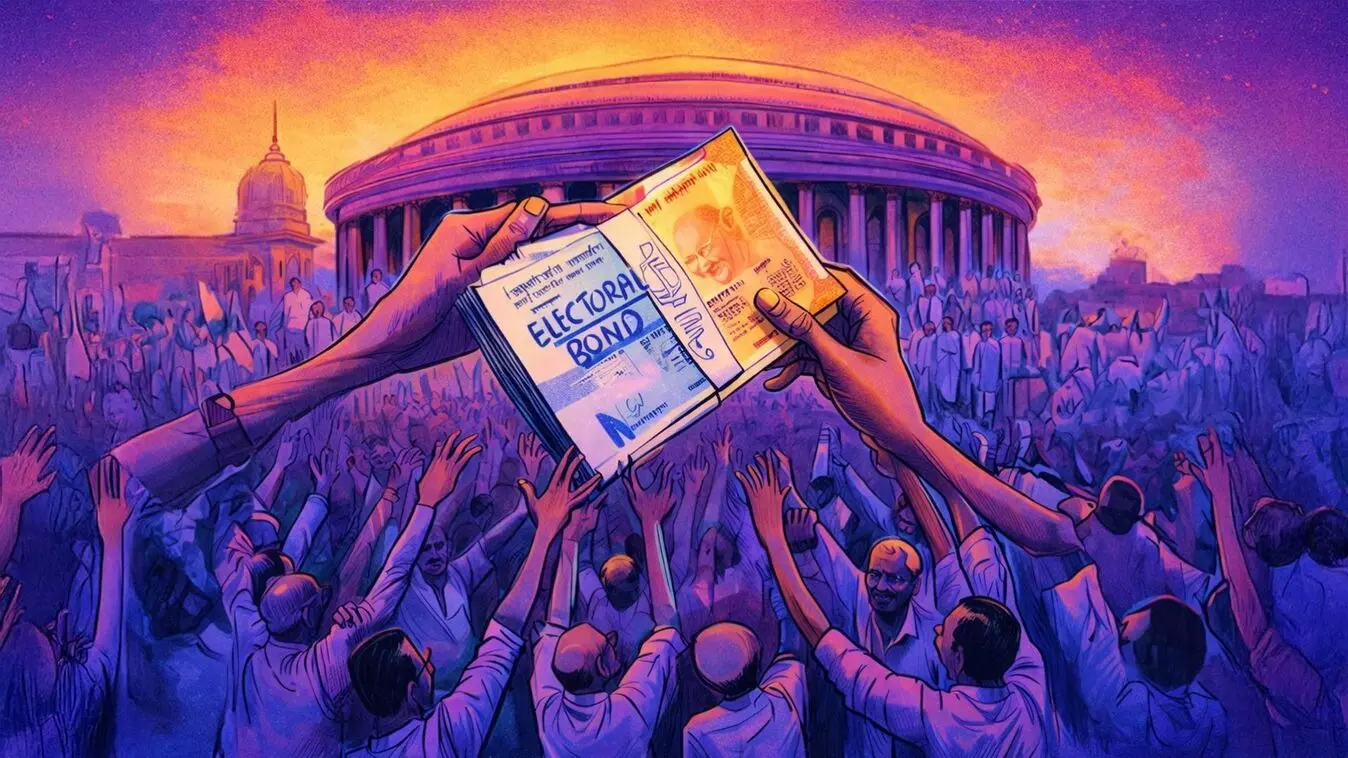
The funding landscape shifted significantly after the Supreme Court struck down the electoral bonds scheme in February 2024. Between 2018 and 2024, bonds worth over Rs 16,500 crore were purchased, with the BJP alone receiving more than Rs 8,200 crore.
The court ruled that electoral bonds violated citizens’ right to know, effectively ending anonymous corporate donations through that route. But the flow of money did not stop—it simply found a new channel.
Trust route
Enter electoral trusts—non-profit entities that collect donations from companies and individuals and distribute at least 95 per cent of these funds to political parties.
In 2023–24, electoral trusts donated around Rs 1,200 crore. The following year, after the bond ban, this figure surged to nearly Rs 3,800 crore. “The route changed. The money flow didn’t,” as the report highlights.
The largest contributor, Prudent Electoral Trust, alone distributed Rs 2,668 crore. Of this, Rs 2,180 crore went to the BJP, while the Congress received about Rs 216 crore.
Donor pattern
The biggest corporate donors in 2024–25 included Elevated Avenue Realty (Rs 500 crore), Tata Sons (Rs 308 crore), TCS (Rs 217 crore), and Megha Engineering and Infrastructure (Rs 175 crore).
Just the top 10 companies contributed nearly Rs 1,900 crore—accounting for about half of all electoral trust donations that year.
While electoral trusts are transparent about donors, how they decide which party gets how much remains unclear, adding another layer of opacity to the system.
Hidden funds
At the other end of the spectrum lies another loophole. Donations below Rs 20,000 do not require disclosure of the donor’s identity. Cash contributions are also allowed up to Rs 2,000 per person.
This enables parties to receive multiple small, anonymous contributions without breaking any rules.
The Bahujan Samaj Party (BSP) has, for over 18 years, declared zero donations above Rs 20,000, claiming all income comes from membership fees and bank interest. The issue is currently under scrutiny in court.
System flaw
The core issue, experts argue, is structural. Candidates are bound by a spending cap, but parties are not. This allows unlimited funds to be channelled into individual constituencies without technically violating election laws.
Former Chief Election Commissioner TS Krishnamurthy has described corporate funding as an “obnoxious nexus” between money and power.
Even as far back as 1957, the Bombay High Court warned that corporate donations could “throttle democracy”.
Big picture
Here’s the takeaway: the Rs 40 lakh limit is real—but largely cosmetic. Corporate money continues to flow freely through electoral trusts, while small donations remain anonymous.
The result is a system where financial muscle often outweighs merit. As Tamil Nadu heads into the 2026 elections, candidates without access to substantial funds face a steep uphill battle.
“Contest politics increasingly a game for the wealthy,” as the report underscores—a reality that continues to challenge the fairness of India’s democratic process.
(The content above has been transcribed from video using a fine-tuned AI model. To ensure accuracy, quality, and editorial integrity, we employ a Human-In-The-Loop (HITL) process. While AI assists in creating the initial draft, our experienced editorial team carefully reviews, edits, and refines the content before publication. At The Federal, we combine the efficiency of AI with the expertise of human editors to deliver reliable and insightful journalism.)