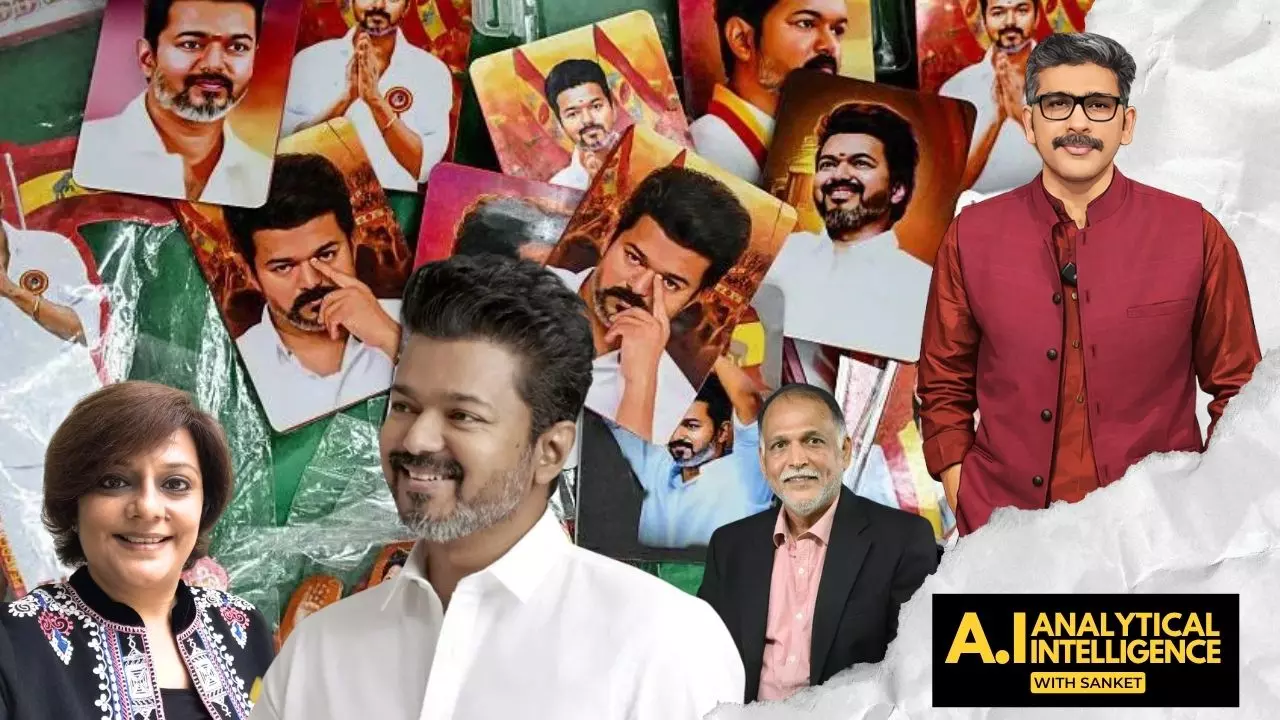
Vijay’s TVK single largest party in TN but falls short of majority; now what? | AI With Sanket
Vijay faces his first major test in forming an alliance; even if he manages to form the government, experts say the real challenge lies ahead: Governance

“I don’t think people trust him enough.” Senior journalist RK Radhakrishnan summed up the Tamil Nadu verdict that stopped actor Vijay just short of power.
As the state delivered a fractured mandate, breaking its tradition of clear outcomes, Sanket Upadhyay, In this episode of AI With Sanket, spoke to Radhakrishnan and senior journalist Latha Srinivasan to decode what this result means for Vijay, his party Tamilaga Vettri Kazhagam (TVK), and the future of Tamil Nadu politics.
Fractured verdict
Tamil Nadu, known for decisive mandates, has delivered a rare split verdict this time. Radhakrishnan pointed out that historically, voters either strongly backed or completely rejected parties like the DMK or the AIADMK.
“This time, it’s baffling,” he said. “DMK has not been decimated, and AIADMK has also held ground.”
The DMK secured 73 seats, a strong number despite not winning. At the same time, AIADMK returned with significant presence, indicating that neither of the Dravidian majors has been pushed aside.
Also read: Vijay doesn't have to 'prove' his majority since Constitution never asked him to
What stands out is that the losses were concentrated among alliance partners. Parties like the Congress and BJP, despite contesting multiple seats, managed to win only a handful.
Vijay’s position
Actor Vijay’s TVK emerged as the single largest party with 108 seats but fell short of the 118 required to form the government.
Radhakrishnan noted, “He needs at least 10 more MLAs. Otherwise, there is no show.”
This puts Vijay in a challenging position. Having entered politics promising change and rejecting traditional alliances, he must now navigate the very system he sought to disrupt.
Latha Srinivasan highlighted this contradiction: “The first big challenge is to find an alliance partner. That means entering conventional politics.”
Alliance dilemma
The path to power now depends on alliances, but the numbers are not straightforward.
Radhakrishnan broke down the arithmetic: Congress has five seats, PMK four, while Left parties and others hold two each. However, several parties have already ruled out supporting TVK.
“BJP will not support him. Some Left parties have also refused,” he said, adding that only limited options remain.
Also read: Vijay's TVK falls short of 118; where do 10 seats come from?
Despite this, Srinivasan suggested that smaller parties may still gravitate towards TVK. “They see this as the future and want relevance again,” she said.
This creates a paradox—while Vijay needs allies, potential partners are weighing their own political survival and benefits.
Governance test
Even if Vijay manages to form the government, experts say the real challenge lies ahead.
“Winning is one part. Governing is a different ball game,” Srinivasan said.
She pointed out that Vijay lacks grassroots political experience, unlike leaders such as MG Ramachandran or J Jayalalithaa.
Also read: Understanding the Vijay phenomenon in Tamil Nadu politics
Radhakrishnan added that both DMK and AIADMK are unlikely to destabilize his government. “They will let him govern and be held accountable,” he said.
This means Vijay will face scrutiny over his ambitious promises, including financial benefits for women, unemployed youth, and families.
Promise pressure
TVK’s manifesto has raised expectations significantly.
Radhakrishnan listed several promises: monthly cash support for women, unemployment aid, LPG cylinders, and financial assistance for families.
“It’s the wish list of every family,” he said, questioning how these can be delivered.
Srinivasan echoed the concern, noting that even party insiders admit implementation will take years.
“People expect instant change, like in films,” she said. “That mindset will be difficult to manage.”
Youth factor
A major driver of Vijay’s rise has been the youth vote.
Srinivasan observed that young voters and women formed a significant support base. Many were drawn by the promise of change and Vijay’s popularity.
Also read: DMK's darkest day: As TVK wave sweeps TN, Stalin reels under crushing defeat
However, she also noted that more experienced voters may have preferred the DMK due to its governance record.
Radhakrishnan described the support for Vijay as “blind faith” in some cases. “There is no debate. They just say vote for him,” he said.
This highlights a generational divide in political expectations and decision-making.
Trust deficit
Despite his strong debut, Vijay did not secure a full mandate.
“I don’t think people trust him enough,” Radhakrishnan reiterated.
He also credited the resilience of DMK and AIADMK, noting the absence of strong anti-incumbency against incumbent chief minister MK Stalin.
Srinivasan added that voters balanced their desire for change with caution. “There is faith, but also doubt,” she said.
Also read: Stalin loses Kolathur seat to former protege VS Babu in stunning upset
This dual sentiment explains why TVK surged but stopped short of a majority.
What next
Tamil Nadu now enters an unfamiliar political phase.
For the first time in years, coalition politics and negotiations may dominate the state’s landscape. The era of single-party dominance appears to be shifting.
Both analysts agree that the coming months will be crucial. Vijay must secure support, prove his leadership, and manage expectations—all at once.
“This is going to be extremely interesting,” Radhakrishnan said.
(The content above has been transcribed from video using a fine-tuned AI model. To ensure accuracy, quality, and editorial integrity, we employ a Human-In-The-Loop (HITL) process. While AI assists in creating the initial draft, our experienced editorial team carefully reviews, edits, and refines the content before publication. At The Federal, we combine the efficiency of AI with the expertise of human editors to deliver reliable and insightful journalism.)