EC's officer reshuffle in poll-bound states faces legal heat: What's the plan? | Capital Beat
Former IAS officer G Balachandran warns of 'stress' on federal autonomy as a TMC MP moves the high court against the poll body's sudden transfer of top Bengal officers

“There is no method in their madness.”
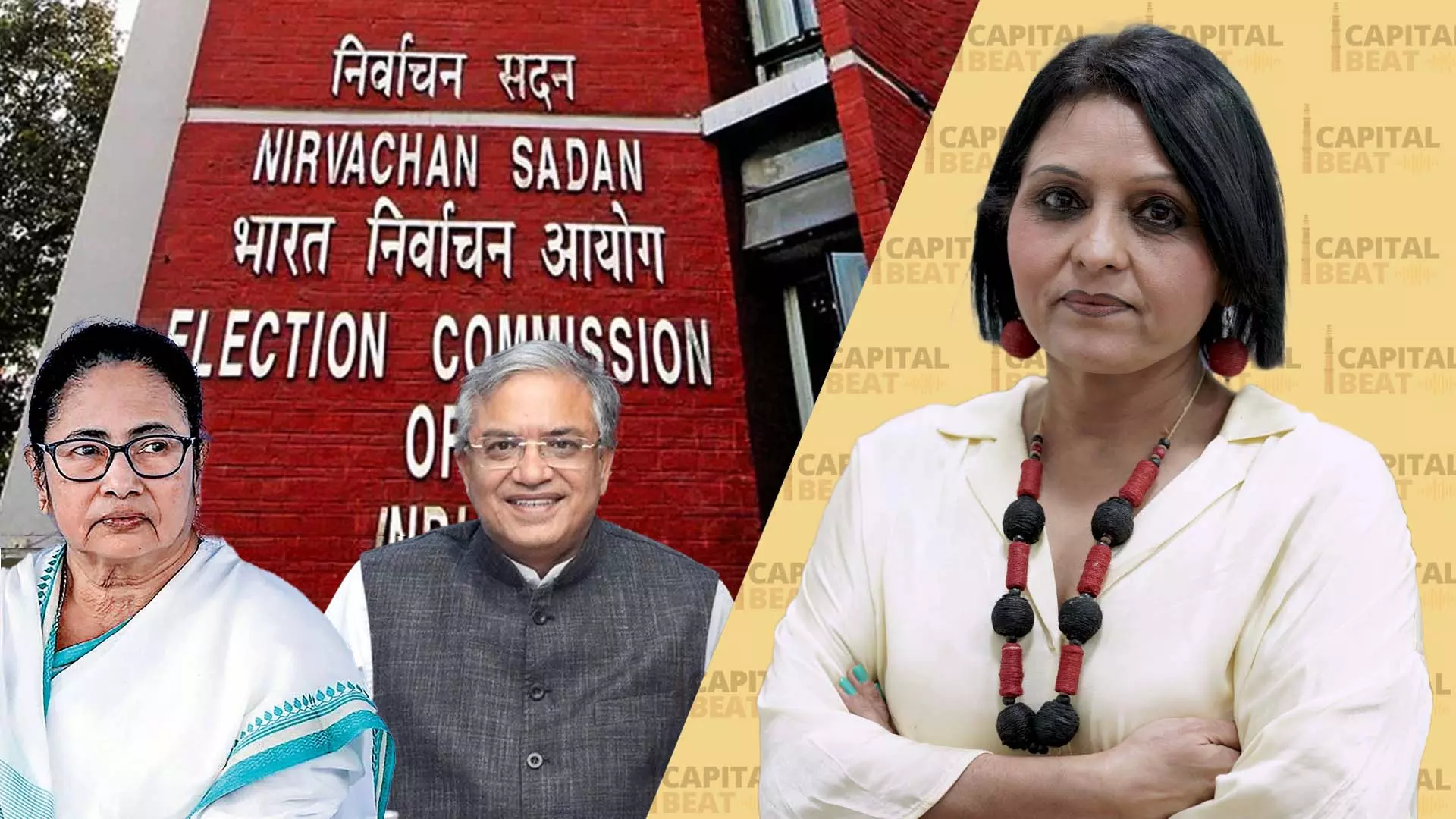
This was the reaction of retired IAS (Indian Administrative Service) officer G Balachandran as The Federal discussed with him in this episode of Capital Beat, the issue of sweeping reshuffle of IAS and IPS officers in some of the states that are going to polls in April, and the growing political and legal voices against it.
Also read: Has EC’s Bengal reshuffle crossed the line? | Jawhar Sircar interview
He was clearly critical of the Election Commission's (EC) recent transfer orders in those states.
The Federal particularly pointed to the controversy triggered after Kalyan Banerjee, a senior Trinamool Congress (TMC) MP and lawyer, moved the Calcutta High Court questioning the EC's decisions.
In Bengal, for example, a number of top administrative and police officers, including the chief secretary, principal secretary (home), director general of police (DGP) and Kolkata Police Commissioner, were replaced ahead of the two-phase election.
At the heart of the issue is whether the poll body’s actions — taken soon after election announcements — violate established norms and the federal balance between the Centre and states.
Bengal MP's legal challenge
Banerjee’s petition challenges the transfer of several senior officers, including the chief secretary, home secretary, and DGP, without consulting the state government.
The petition has also named Chief Election Commissioner Gyanesh Kumar as a respondent. The matter is expected to be heard soon.
Also read: Bengal elections | RG Kar victim’s mother to contest? 'Got BJP offer long back'
According to Balachandran, while courts may not directly intervene once the electoral process begins, they could informally advise the EC to adhere to established norms.
Norms questioned
Balachandran outlined the conventional process: officers who have completed three years in a posting are typically transferred during elections, and the state government is asked to provide a panel of three names for replacements.
“In this case, without giving any reason whatsoever, top officials were transferred. This is not the norm,” he said.
He added that even in cases where officers are suspected of bias, due process requires consultation with the state government — something he claims was bypassed.
Scale of transfers
The scale and speed of the transfers have raised eyebrows. Several senior officials were replaced within hours of the poll announcement on March 15.
Balachandran pointed out that similar actions were also taken in Tamil Nadu, where multiple IAS and IPS officers were transferred swiftly.
Also read: Why did BJP skip personal attack on Mamata in Bengal campaigning? | AI With Sanket
“What kind of picture does this present? It gives the impression that the Election Commission is acting like a sub-office of the Union government,” he remarked.
'Federal autonomy under stress'
The controversy has intensified political tensions, with Bengal Chief Minister Mamata Banerjee accusing the EC of interfering in the federal structure.
Balachandran echoed these concerns, stating that such actions undermine the autonomy of states.
“India is a Union of states with federal features. That autonomy is now under severe stress,” he said.
He warned that if such practices continue, they could become a norm in future elections across states.
Partial rollback
The EC later partially rolled back its decision, withdrawing the transfer of five out of 15 IPS officers.
However, Balachandran dismissed this as an afterthought. “They seem to have acted in a hurry. Even the remaining transfers appear biased because no reasons were given,” he said.
He argued that transparency and justification are essential when exercising such sweeping powers.
'New officer has to understand system'
Beyond legal and political implications, Balachandran highlighted the administrative impact of sudden transfers.
He cited the example of the food and civil supplies department, where leadership changes during a critical period could disrupt essential services.
Also read: Mamata unveils TMC manifesto, accuses EC of bias ahead of West Bengal polls
“A new officer takes time to understand the system. This affects governance, especially during elections,” he said.
Different political reactions
While the TMC has strongly opposed the moves, Balachandran noted that similar levels of protest have not been seen in Tamil Nadu.
He attributed this to political dynamics, suggesting that parties such as the Dravida Munnetra Kazhagam, which is in power in Tamil Nadu, feel more confident in their organisational strength.
In contrast, Banerjee may be more cautious due to perceived electoral challenges and political narratives around issues like infiltration.
'No faith in EC neutrality'
Balachandran launched a strong criticism of the poll commission, saying he had little trust in the body's credibility.
“I do not have faith in their neutrality. Their past behaviour has shown bias,” he said, citing instances from previous elections where controversial remarks by political leaders allegedly went unchecked.
He argued that such inaction contributes to a growing trust deficit.
'Ultimately, it's the people who matter'
On the legal front, the former bureaucrat believes the legal challenge may have a limited impact during the ongoing electoral process.
“The only option is to go to the people. Ultimately, they are the masters of democracy,” he said, referencing the constitutional principle of popular sovereignty.
Also read: Suvendu Adhikari kicks off BJP’s Bhabanipur campaign, 'will win by 25,000 votes margin'
He also raised concerns about the length and scheduling of multi-phase elections, questioning whether delays are necessary, given the resources available to the EC.
Larger implications
The controversy raises broader questions about the balance of power between constitutional institutions and state governments.
Balachandran warned that continued use of such “autocratic” measures could weaken democratic institutions and federal principles.
“If this becomes the norm, it will be unfortunate for the country,” he said.
The content above has been transcribed from video using a fine-tuned AI model. To ensure accuracy, quality, and editorial integrity, we employ a Human-In-The-Loop (HITL) process. While AI assists in creating the initial draft, our experienced editorial team carefully reviews, edits, and refines the content before publication. At The Federal, we combine the efficiency of AI with the expertise of human editors to deliver reliable and insightful journalism.