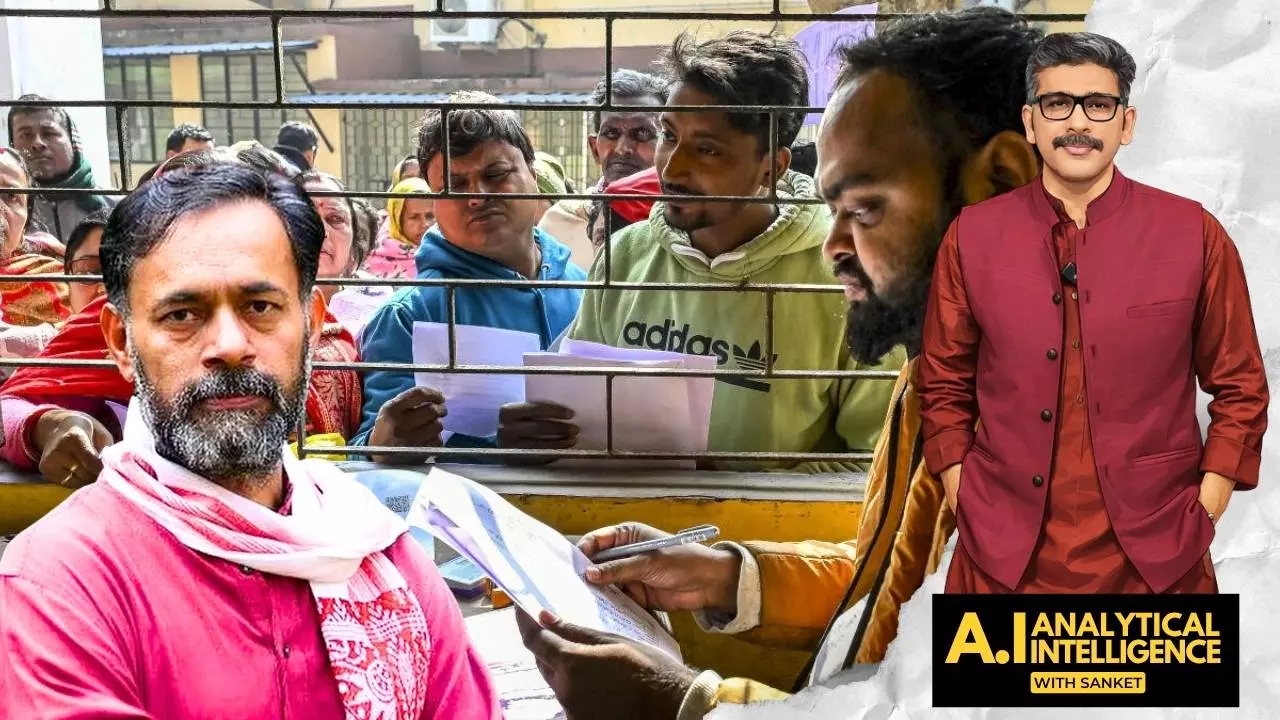
West Bengal voter roll revision: Yogendra Yadav flags ‘targeted deletions’
Political analyst Yadav alleges the SIR process enabled large-scale removals despite valid applications, raising concerns over fairness and the role played by institutions

The Special Intensive Revision (SIR) of electoral rolls in West Bengal has resulted in what political analyst Yogendra Yadav calls a “targeted political exercise", alleging that nearly 27 lakh voters were deleted through a flawed and hurried process, with institutional backing. The controversy has raised serious questions about electoral integrity and fairness ahead of elections. The Federal spoke to Yogendra Yadav on how West Bengal stands out from the rest of India in the SIR exercise and why the scale and nature of deletions are unprecedented.
You observed both Delhi and West Bengal. Are the concerns of the same magnitude?
Indeed. I had said in Delhi that West Bengal is an extraordinary case because the Election Commission, and unfortunately the Supreme Court, have treated West Bengal in a way unlike any other state. The results of SIR are extraordinary here. I went to the field, spoke to people who filed cases, and examined actual cases of rejected voters. These are shocking cases. Most people do not understand what is so unusual about West Bengal.
What makes West Bengal different from other states where voter deletions also happened?
There are two categories: exclusion and deletion. Exclusion refers to those who did not submit enumeration forms — due to absence, death, duplication, or other reasons. Deletion refers to those who submitted forms, provided evidence, and were still removed from the voter list.
Across India, most removals fall under exclusion. For example, in Bihar, 64 lakh names were excluded initially, but later there were only about 2 lakh deletions and 23 lakh additions. So the final number reduced.
Also Read: Polls a week away, 12,000 Murshidabad voters remain in a limbo | Ground report
In every state, exclusions were followed by small deletions and large additions. But Bengal is the only state where exclusions were followed by massive deletions. The first stage saw 58 lakh exclusions, which is normal. But in the second stage, 6 lakh deletions happened due to paperwork issues, and an additional 27 lakh deletions took place. So instead of reducing, the number rose to 90 lakh.
This is what makes Bengal unique — people who applied to remain on the list were deleted at a massive scale. There is also evidence suggesting these deletions were targeted at TMC voters.
What are ‘logical discrepancies’ and how were they used?
Logical discrepancies were introduced in all states, not just Bengal. These are computer-generated mismatches between current data and older records, like from 2002. For example, if my father’s name is recorded slightly differently, the system flags it as a discrepancy.
In most states, these were treated as clerical issues and ignored. But in Bengal, they were weaponised. While Gujarat had 1.2 crore discrepancies and Madhya Pradesh had 3 crore, very few cases there led to action.
In Bengal, however, 1.2 crore discrepancies were flagged, and 60 lakh cases were taken up for special adjudication. Notices were issued, and the Election Commission treated these as serious issues despite local officers saying otherwise.
How did the adjudication process unfold?
The Supreme Court stepped in and ordered special adjudication courts. Initially, 250 officers were appointed, later increased to around 700. But these officers had to decide on 60 lakh cases within a short time frame.
Even if a judge worked 10 hours a day without breaks, they would need to process about 25 cases per hour. This is practically impossible.
Also Read: 'Logical discrepancy not part of EC's framework, used in Bengal to benefit BJP': Mamata
Let me give you an example. A man named Sadam-ul-Haq was flagged because of a minor spelling difference in his father’s name — just a space between letters. Despite providing documents like a passport, his name was deleted.
Similarly, women were told their grandfather’s age did not match records. These are common discrepancies in India due to inaccurate age recording. Yet, these were grounds for deletion.
What role did the Supreme Court play in this process?
The Supreme Court used Article 142 to create this mechanism. While this power is meant to ensure justice, in this case, it led to an extraordinary system that produced flawed results.
The court later said people could appeal, but by then, the lists were frozen. The elections were over. It is like saying we will improve the operation, but the patient is already dead.
Also Read: No relief for Bengal's deleted voters as SC refuses to intervene, labels plea ‘premature’
Interestingly, Justice Joymalya Bagchi later remarked that voting is a fundamental right tied to one’s identity as a citizen. But earlier, it was said that missing one election is acceptable. This contradiction is concerning.
Are these discrepancies truly targeted at specific groups?
The software itself is neutral — it flagged discrepancies across communities. But the selection of cases for adjudication raises questions.
Out of 1.2 crore discrepancies, only 60 lakh were taken up. Who decided this? Why was Bengal treated differently from states like Gujarat or Madhya Pradesh?
Also Read: What the deletion of 91 lakh voters means for Bengal elections | Monideepa Banerjie
Data suggests that in constituencies like Nandigram, where Muslims form 25 per cent of the population, they account for 95 per cent of those deleted. In Bhabanipur, Muslims form around 40 per cent, but make up nearly 90 per cent of deletions.
Overall, estimates suggest that 65 per cent of the 27 lakh deleted names are Muslims, even though they constitute about 27 per cent of the population. Additionally, one-third of adjudication cases came from two Muslim-dominated districts — Murshidabad and Malda.
This pattern raises strong suspicion of targeted deletion. When political leaders claim improved prospects after SIR, it adds to these concerns.
Final takeaway on the SIR exercise?
To put it bluntly, the Election Commission, in league with the BJP, has deleted 27 lakh votes in a targeted political exercise. The process was unfair, hasty, and non-transparent. Unfortunately, the Supreme Court has endorsed it. This is a very sad moment for our democracy.
(The content above has been transcribed from video using a fine-tuned AI model. To ensure accuracy, quality, and editorial integrity, we employ a Human-In-The-Loop (HITL) process. While AI assists in creating the initial draft, our experienced editorial team carefully reviews, edits, and refines the content before publication. At The Federal, we combine the efficiency of AI with the expertise of human editors to deliver reliable and insightful journalism.)