What the deletion of 91 lakh voters means for Bengal elections | Monideepa Banerjie
Mass deletions under SIR shrink Bengal’s voter base by 12 per cent, raising questions over the impact on BJP vs TMC battle. Who really gains?

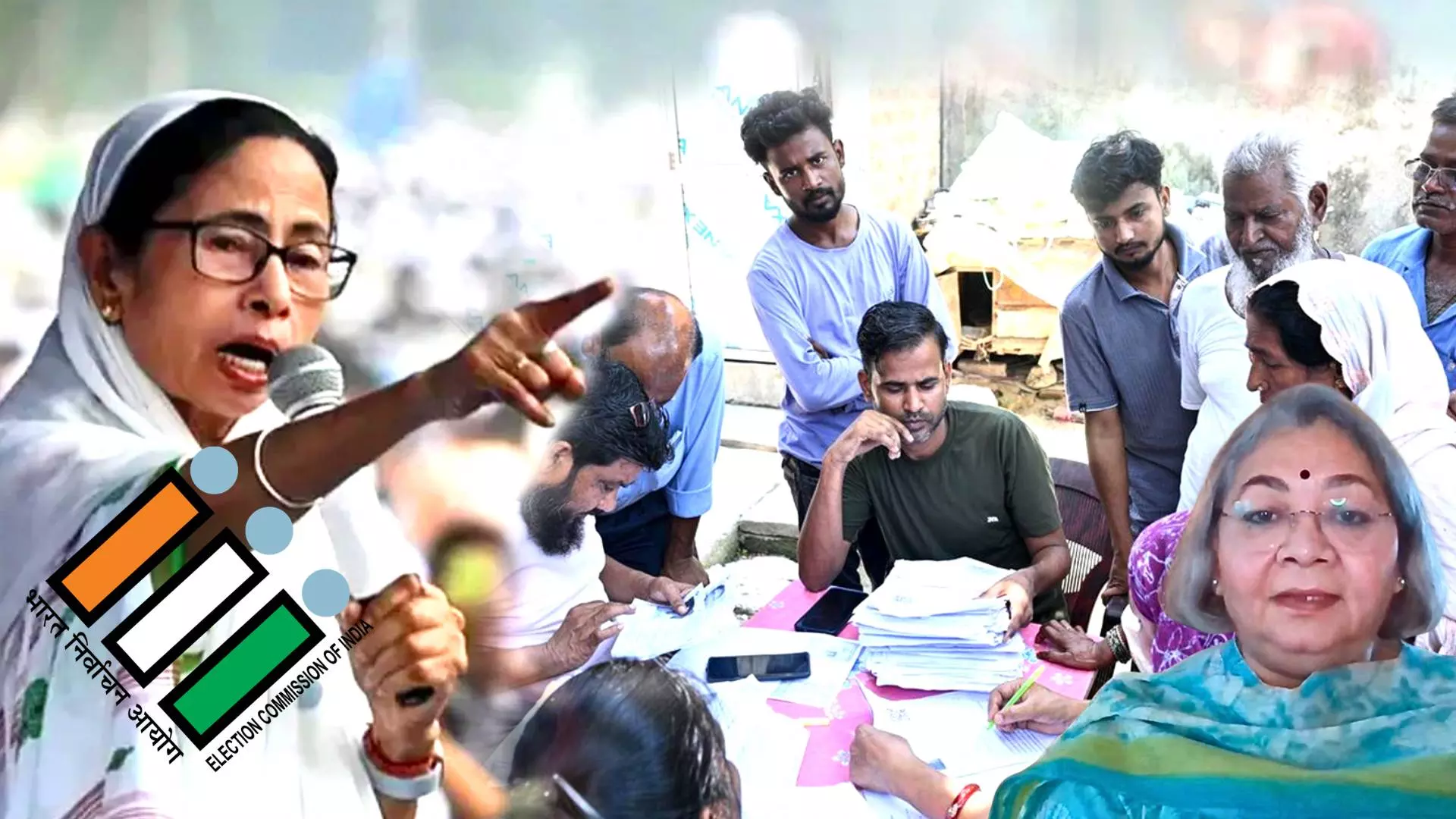
West Bengal’s electoral rolls have undergone a dramatic shake-up ahead of the 2026 Assembly elections, with nearly 90 lakh voters removed under the Special Intensive Revision (SIR). The state’s total electorate has dropped from 7.6 crore in 2024 to 6.7 crore, a steep 12 per cent decline that could significantly alter the political landscape.
The entire exercise of SIR has blown a hole in the West Bengal electoral roll and it's the size of Switzerland. The scale of deletions has triggered intense political debate, with both the BJP and the Trinamool Congress (TMC) interpreting its impact very differently.
The revision process began in December 2025, initially leaving out 58 lakh names. Subsequent scrutiny and adjudication led to further deletions, including 27 lakh names in early April, while 33 lakh voters remain in limbo following directions from the Supreme Court.
Political positions
The BJP has strongly backed the SIR process. Union Home Minister Amit Shah has argued that the revision would remove illegal immigrants from Bangladesh and Myanmar from the voter list.
Also read: Mamata accuses BJP, EC of bid to cancel her Bhabanipur candidature
On the other hand, Chief Minister Mamata Banerjee has consistently opposed the exercise, warning that genuine voters are being excluded. She has already approached the Supreme Court and may do so again over the 33 lakh voters still awaiting resolution.
The contrast between the position of the two parties is clear — the BJP sees political gain, while the TMC fears electoral damage.
Minority impact
A key assumption driving the debate is that the deletions disproportionately affect Muslim voters, who form around 27 per cent of West Bengal’s electorate and are seen as a strong support base for the TMC.
Preliminary analysis, including limited studies by Alt News, suggests that a higher proportion of Muslim voters may have been excluded in some constituencies like Bhabanipur and Ballygunge. However, the sample size is too small to draw state-wide conclusions.
Also read: Mamata attacks BJP with 'snake' jibe as Bengal poll battle hots up | Capital Beat
District-level data adds complexity. Minority-dominated regions like Murshidabad (66 per cent Muslim population) and Malda (52 per cent) — 4.5 lakh and 2.5 lakh voters, respectively — have seen heavy deletions. In these areas, the TMC had performed strongly in previous elections.
Shifting patterns
However, the impact is not limited to Muslim voters. In Nadia district, which has a relatively bigger Hindu population, as much as 78 per cent of names faced deletion in some areas.
Significantly, many of those affected are believed to be from the Matua community — a Hindu refugee group from Bangladesh that has traditionally leaned towards the BJP. This complicates the narrative that the deletions target only one community.
Some reports suggest that, overall, more Hindu voters may have been removed than Muslims — with one estimate claiming 63 per cent Hindu deletions compared to 34 per cent Muslim deletions.
Tight contests
The real electoral impact may be felt most in closely contested seats. In the 2024 parliamentary elections, around 50 assembly segments were decided by narrow margins.
Bhabanipur, Mamata Banerjee’s constituency, is a key example. While she won comfortably in 2021, the margin narrowed significantly in 2024. The latest voter list shows 47,000 deletions in the seat, with around 40 per cent reportedly Muslim voters.
Also read: 91 lakh voter deletions in Bengal: 'EC needs to get its act together' | AI With Sanket
The slightest shift in voter base in those 50 seats could make or break results.
Big question
With polling scheduled for April 23 and 29, West Bengal is heading into an election unlike any before. Analysts describe it as a battle between the BJP’s “cold calculated electoral mathematics” and Mamata Banerjee’s “indisputable chemistry with voters”.
Ultimately, the outcome will depend not just on those who vote — but also on those who have been left out.
Who wins: mathematics or chemistry?
(The content above has been transcribed from video using a fine-tuned AI model. To ensure accuracy, quality, and editorial integrity, we employ a Human-In-The-Loop (HITL) process. While AI assists in creating the initial draft, our experienced editorial team carefully reviews, edits, and refines the content before publication. At The Federal, we combine the efficiency of AI with the expertise of human editors to deliver reliable and insightful journalism.)