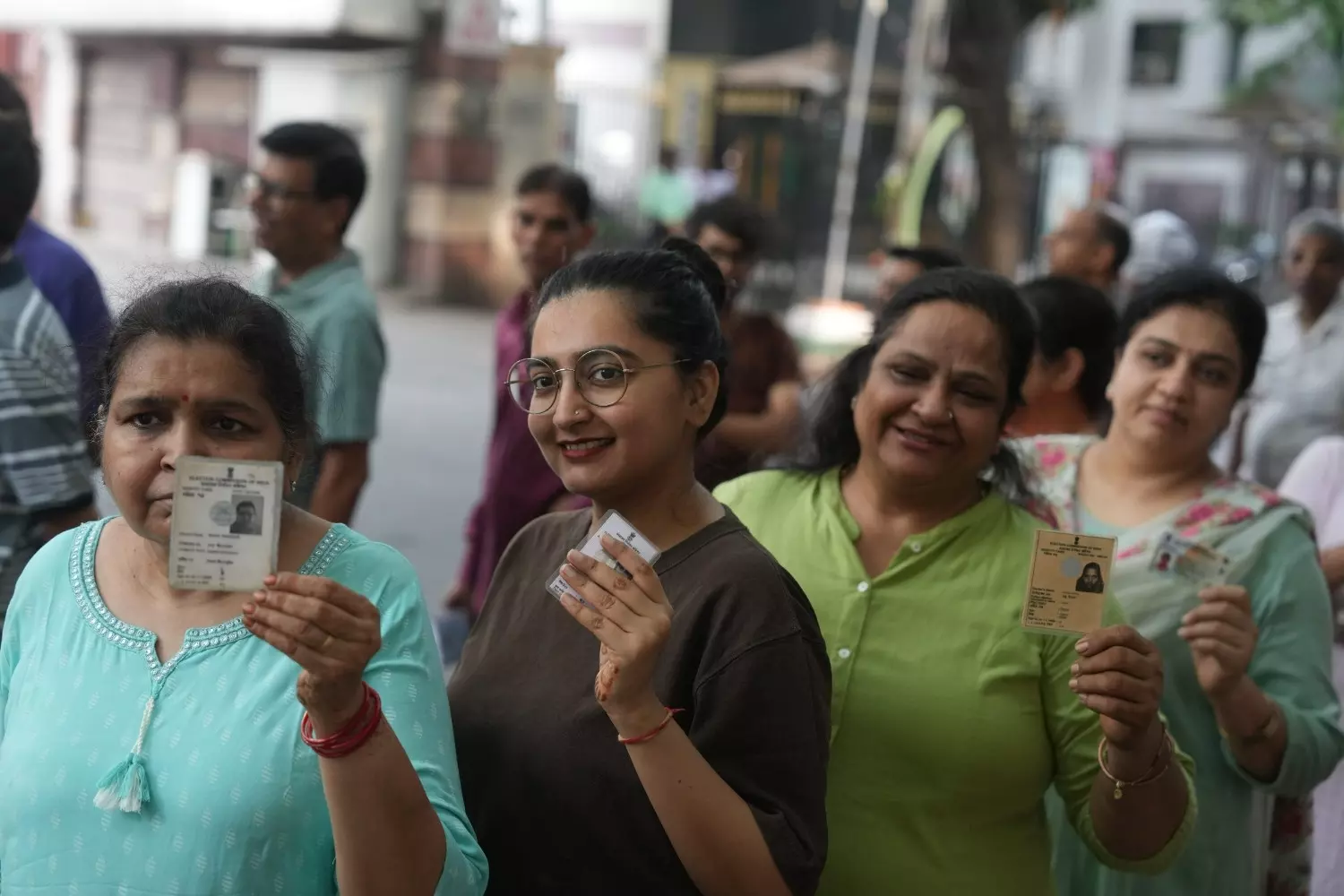
Kolkata's women voters, Mamata’s most loyal base, appeared to have moved away. (Picture for representation only). PTI
Why urban women and middle class turned their back on Mamata Banerjee
It is ironic that a woman who was known to have a finger on the state’s pulse did not have a clue what was brewing in her backyard. And that itself is telling

It has been a week since the people of West Bengal declared their mandate. A new government is in place and a new chief minister has issued a slew of new orders. But the people of Bengal still do not seem to have gotten over their obsession with bashing and trolling former chief minister and Trinamool Congress (TMC) supremo Mamata Banerjee, the woman who engineered “Poriborton” (change) 1.0 in the state a decade and a half ago by replacing the Left Front.
There have been multiple instances of public anger directed at TMC leaders and workers. Mamata’s firebrand party MP Mohua Moitra faced chants of “chor” (thief) on a flight to New Delhi. Numerous social media reports and videos have highlighted incidents in which locals have heckled or physically attacked local-level TMC leaders.
Since the election results have been declared, much dissection has been done to figure out the reasons behind this monumental electoral loss that seemed impossible even two years ago, when the Lok Sabha elections were held. And yet, even a day before the results, hardly any neutral observer predicted it. Many a liberal observer totally dismissed the exit poll results as “BJP propaganda”.
Silent eruption
Indeed, what marked the elections was the thunderous silence of a people who kept their secret close to their chests—and exactly the opposite now, as people give vent to their pent-up frustrations and anger on social media.
Also read: Despite her call for a mega anti-BJP platform, why Mamata seems to be a lonely warrior
Minorities apart, two of Mamata Banerjee’s biggest strengths were the urban middle class and women of all classes who formed the backbone of her support base. And this time, these two categories of voters went resoundingly against her. The votes that went to the BJP were not so much “BJP votes” as they were “anti-Mamata votes”.
So why did the city-bred women and the urban middle class vote against her? While in the villages, the saffron narrative of ghuspethiyas (infiltrators) and the promise of better cash payments played a big role, the sole factor that seemed to have played a role in the city was—not the RG Kar incident as you might have guessed—but “durniti” (corruption) and highhandedness of the party cadres.
What women say
In Kalighat, Mamata Banerjee’s backyard, a 60-something homemaker spoke in a hushed tone to The Federal, with a TMC party office right across the street and another less than 50 metre away. The polls are done, the results are out, but the fear continues.
“I voted for the TMC until 2021. But this time, I voted for the BJP. Mamata Banerjee kept saying, ‘I am the candidate in all the seats. Maybe she is not so corrupt, but who were we voting for? We were voting for her goons, in seat after seat,” said the woman. She claimed that there were police officers in her family who were equally fed up with the rampant corruption and hooliganism in the party.
Also read: Bengal's Didi shield cracks: How Mamata Banerjee lost the state she dominated
A 46-year-old woman in Kalighat who owns a shop and also works as a cook for families, said she shifted to the BJP in 2021 itself, when the saffron party won 77 seats, its first major inroad into the state assembly. “Why do they need two party offices within a stone’s throw from each other? Why do her party cadres occupy the entire pavement every evening so that common people have to take the street?” she argued, stating that she voted for “change” after getting tired of seeing TMC cadres’ “highhandedness”.
The first mistake
For a media employee in her late 40s, a voter in Ballygunge constituency, the rot began with the 2012 Park Street rape incident, a year after Mamata took over. “Her first mistake was to term it a shajano ghotona (made-up incident) and shunt out a police officer like Damayanti Sen,” she said. Sen was the Kolkata Police joint commissioner (crime) before being transferred to Bengal Police in 2012, shortly after she famously cracked the tricky Park Street case within four days. “The RG Kar incident was just a reflection of that rot that began a decade before that,” she added.
This media employee was also a TMC voter once but did not vote for the BJP this time. She said she did not want to vote for either the “corrupt TMC” or the “communal BJP”. She voted for CPI(M) instead, saying she wanted to give its young guns a chance. Most of her “disillusioned” friends chose to vote NOTA (None of the Above).
Also read: What explains Bengal’s saffron shift? 6 reasons why Mamata was decimated
Two septuagenarian women in the Jadavpur constituency — both former TMC supporters — said their only choice was BJP. “Who would vote for that demoness!” remarked one of them, referring to the TMC supremo. It is telling that voters who once swore by Mamata Banerjee now cannot stand her name. A young woman in her early 30s, who belongs to a traditionally Left-voting family but voted for the TMC in the past few elections, said she preferred to vote for the BJP this time. “We were tired of the corruption and hooliganism,” she said.
A tale of deceit and degeneration
A 48-year-old physiotherapist from South 24-Parganas district, most of whose clients live in the city proper, shared with this reporter the “winds of change” of which he already got a whiff of in Bhabanipur, Mamata Banerjee’s constituency that she lost to current chief minister and her former protégé Suvendu Adhikari by more than 15,000 votes.
“I have clients who live a stone’s throw from her house. Even before the elections, they told me that Mamata would not get any votes from the upper and middle classes in Bhabanipur. Her only votes would come from the lower social strata. Their anger was piling up over the years. Yet they did not opt for the BJP until they were pushed to the brink. A woman with a fractured leg had to be carried to an ambulance waiting on the main road because Mamata’s security men and cadres would not let her into the lane. Many people in Bhabanipur have such stories to share,” he told The Federal.
Also read: SIR didn't cost Mamata Bengal, women's anger did, says Yashwant Deshmukh | AI With Sanket
In his in-laws’ village in South 24-Parganas, a district bordering the city, he says TMC cadres gobbled up all the money allotted to housing schemes. “The poor people there saw these rich leaders’ and cadres’ houses getting taller as nothing changed for them. They voted en masse for the BJP but did not let anyone have an inkling as to what they were about to do. On the surface, they kept pretending to be TMC supporters,” he added.
Need for serious introspection
Similar stories of brazen corruption and atrocities are spilling out everywhere now. So, even though the TMC has chosen to blame the collapse on the I-PAC, the Special Intensive Revision (SIR) of electoral rolls, and the alleged “BJP-Election Commission collusion”, they need some serious introspection to figure out where they went wrong. And they do not need much brainstorming. The factors for their loss are wide open for them to see.
In effect, Kolkata and the suburbs got deeply divided this time. While TMC retained the northern and central Kolkata seats such as Kolkata Port, Chowringhee, and Entally, and the south Kolkata seats of Ballygunge and Kasba, the BJP has bagged Kashipur-Belgachhia in the north, and Jadavpur, Tollygunge, Bhabanipur, and Rashbehari, and the western seats of Behala West and Behala East. The TMC could also hang on to a few seats in Howrah and South 24-Parganas while most seats of North 24-Parganas (barring Madhyamgram), another district bordering Kolkata, went saffron.
Interestingly, the CPI(M), which pocketed barely a 4.45 per cent vote share in the elections, played the 'vote-cutter' in many seats in and around Kolkata, all in the third position. In Kashipur-Belgachhia, the BJP candidate won by a mere 1,651 votes while the CPM candidate bagged 11,151 votes. In Jadavpur, traditionally a Left seat that had turned green only in the recent past, the BJP candidate won by 27,700 votes while the CPI(M) candidate got 41,148. In Tollygunge, the BJP candidate won by 6,000 votes while the CPI(M) candidate bagged 30,000 votes.
Also read: Post debacle, Mamata urges 'grand platform' of Opposition against BJP in Bengal
In Rajarhat New Town, the BJP candidate won by a razor-thin margin of 316 votes but the CPM candidate got 32,246 votes. In North 24-Parganas’ Baranagar, the BJP won by 16,956 votes while the CPM candidate got 18,689. In South 24-Parganas’ Sonarpur Uttar, the BJP candidate won by 9,800 votes, while the CPM candidate pocketed 19,744 votes.
Finger off the people’s pulse
Not only in and around Kolkata, the picture is the same in many other areas in the state. While the BJP consolidated the Hindu votes, it did not necessarily consolidate the secular, anti-TMC votes. And that is possibly the reason why Mamata sought a mahajot (grand alliance) with the Left parties and even the ultra-Left, only to be royally snubbed.
The TMC boss today cuts a sorry, lone figure. And it is ironic that a woman who fought her way up from the streets of Kolkata to its seats of power, who was known to be an accessible leader who would listen to people’s complaints at her modest Bhabanipur home every day, who was known to have a finger on the entire state’s pulse, did not even have an inkling what was brewing in her own constituency. And that itself is telling.