








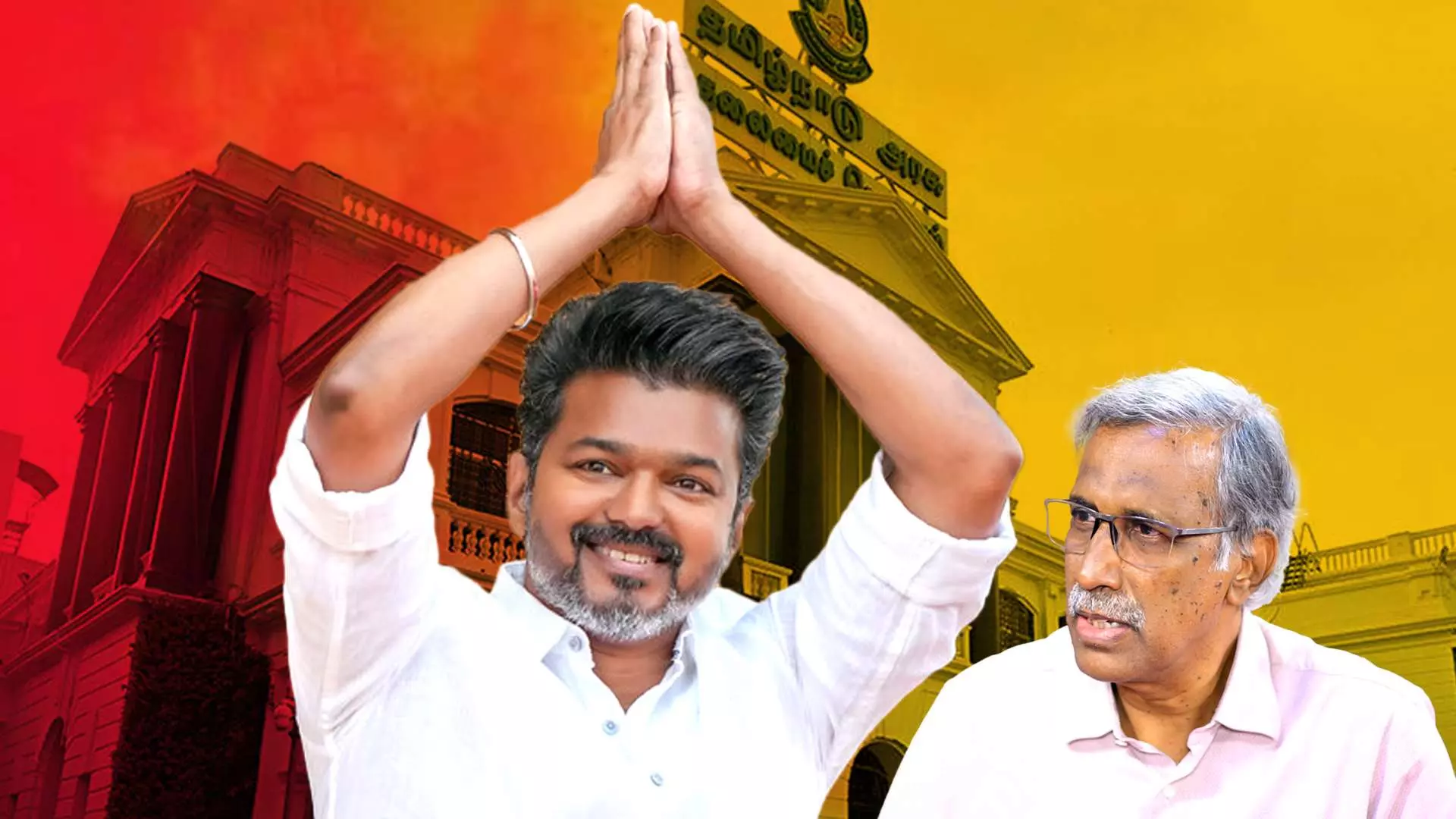
Will Vijay make it to the CM’s chair? Do others still have a chance?
As uncertainty continues over government formation in Tamil Nadu, constitutional process—not political claims—will ultimately decide who forms the government

The real test of numbers is not at Lok Bhavan, but on the floor of the Assembly. As uncertainty continues over government formation in Tamil Nadu after TVK emerged as the single largest party, constitutional process—not political claims—will ultimately decide who forms the government. The Federal's Editor-in-Chief S Srinivasan explains what happens next in a hung Assembly and where the Governor’s role begins and ends.
What does the law say about inviting a party to form the government in this situation?
It is a fast-moving political situation, so we have to be cautious. But we can go by established procedures. The Sarkaria Commission has clearly laid down the order of priority in a hung Assembly.
In this case, TVK has 108 seats. After one resignation, it comes down to 107, and with Congress support, the number goes up to 112. They have submitted a letter to the Governor.
At this stage, the Governor cannot start judging whether they have the numbers. Various judgments have made it clear that the real test must happen on the floor of the House.
What is the order of priority in such cases?
The first preference is a pre-poll alliance with a majority. In Tamil Nadu, there were two—DMK alliance and AIADMK alliance—but neither has the numbers.
The second option is the single largest party with support from others. That is where TVK stands now, with Congress backing.
Also read: Hung Assembly in Tamil Nadu: what the Governor can and cannot do
Even if they do not have the full numbers on paper, the actual test is on the floor of the House.
The third option is a post-poll alliance. If parties like DMK and AIADMK come together with others and claim a majority, the Governor may have to consider them as well.
Is a DMK-AIADMK alliance numerically possible?
On paper, yes. The DMK alliance has around 68 seats and AIADMK alliance about 53. Together, they cross the majority mark with 121 seats.
But politically, it is very difficult. Some parties in these alliances cannot be in the same camp. There are ideological and practical constraints.
Also, the mandate seems to be for change, and that factor will influence decisions.
If such a claim is made, what happens next?
Even then, the claim has to be tested on the floor of the House. If they prove their majority there, they can form the government.
Also read: Vijay doesn't have to 'prove' his majority since Constitution never asked him to
Everything depends on how the situation evolves in the next few days.
Is inviting the single largest party the standard practice?
Yes, that is the established order. The Governor calls the single largest party and asks them to prove their majority on the floor.
There are also scenarios where other parties do not immediately challenge. If they stay away or walk out during the vote, the government can still survive with those present and voting.
Can you explain how a floor test works in such cases?
There is no concept of a confidence vote in the Constitution. There is only a no-confidence motion.
During a floor test, if some members walk out and the remaining members support the government, it can still survive.
Also read: How Vijay glided effortlessly from Kodambakkam to Fort St George
We have seen such situations before. For example, the Narasimha Rao government at the Centre survived despite not having a clear majority because others walked out.
Are there similar precedents in states?
Yes. In Karnataka in 2018, BS Yediyurappa was invited as the leader of the single largest party. But a post-poll alliance had the numbers. Eventually, the government fell during the floor test.
In Goa, the Congress was the single largest party but did not stake claim. BJP quickly formed an alliance and proved majority on the floor.
So, there are many precedents, and the Governor has to act based on these.
Can the Governor delay inviting a party until clarity emerges?
If only one party has made a claim, the Governor will have to give them time—usually up to two weeks—to prove their majority.
Also read: Understanding the Vijay phenomenon in Tamil Nadu politics
At the same time, the Constitution says it should be done as soon as possible. So it depends on how the Governor interprets the situation.
Who runs the government until a new one is formed?
The outgoing Assembly has been dissolved, but the new one has not yet been convened.
In the meantime, the caretaker Chief Minister continues to handle the administration.
Is there a possibility of President’s Rule?
That is a last resort. If the Governor cannot arrive at a solution after exploring all options, he can recommend President’s Rule.
This could be based on concerns like instability or possible horse-trading. But courts have laid down strict conditions for such decisions.
At this stage, it is too early. We have to wait and see how the situation develops.
(The content above has been transcribed from video using a fine-tuned AI model. To ensure accuracy, quality, and editorial integrity, we employ a Human-In-The-Loop (HITL) process. While AI assists in creating the initial draft, our experienced editorial team carefully reviews, edits, and refines the content before publication. At The Federal, we combine the efficiency of AI with the expertise of human editors to deliver reliable and insightful journalism.)
