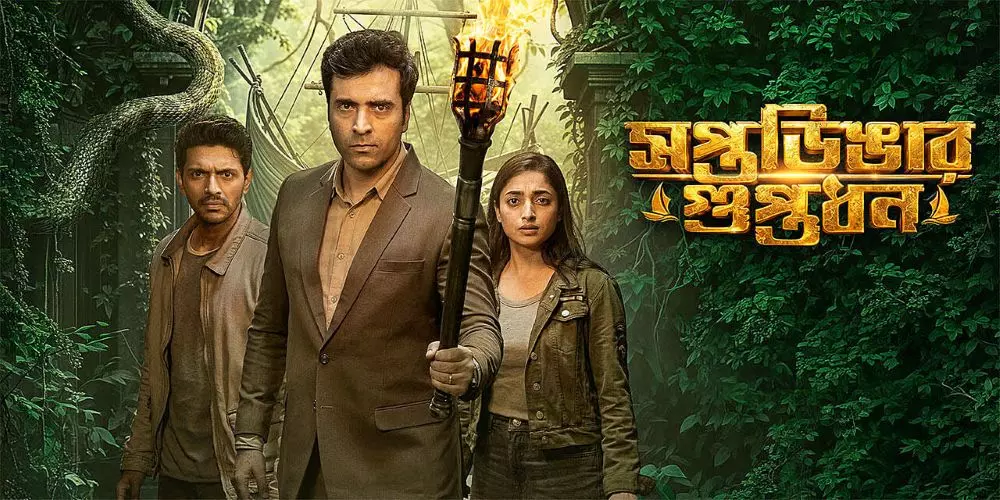
Abir Chatterjee, Arjun Chakrabarty and Ishaa Saha in Saptadingar Guptodhon
Why Bengali history-adventure ‘Sona Da’ film series seems to be losing its touch in its fourth outing
Saptadingar Guptodhon, the latest in the Guptodhon franchise, reunites actors Abir Chatterjee, Arjun Chakrabarty and Ishaa Saha with director Dhrubo Banerjee. The series follows Chatterjee, a professor of history, as he decodes folklore, riddles, and clues passed down generations, to unearth hidden treasures.

Bengali films’ current favourite detective actor Abir Chatterjee returns as ‘Sona da’, the history professor-cum-treasure hunter, in Saptadingar Guptodhon, the fourth film in the franchise directed by Dhrubo Banerjee, strategically released ahead of the school summer vacations.
Chatterjee is the only actor who has had the honour of essaying both of Bengali literature’s most famous sleuths (Byomkesh Bakshi and Feluda) and as Oxford-returned professor Subarna Sen — Sona Da to those around him — he uses his knowledge of history to decode folklore, clues handed down generations and riddles, to unearth ‘hidden treasures’.
In Saptadingar Guptodhon, the adventure takes Sona da, Abir (the lovable bumbling foodie nephew played by Arjun Chakraborty ) and Jhinuk , Abir’s fiancée (Ishaa Saha), to the Sundarbans for a mystery that links Raja Pratapaditya of Jessore (who ruled in the early 17th century) to the mythical story of sea merchant Chaand Saudagar and his son Lakhindar. Also making a comeback is the trio’s previous adversary, Dasanan Daw, admirably played by actor Rajatabha Dutta.
The plot thickens...
The action begins fairly early on and seems almost sudden, with the trio thrust into the adventure. There is no lulling the audience with montages of road trips and holidays here, as in the previous films of the series, but a meeting in Kolkata with a Cambridge returned Mr Chatterjee (played by Kaushik Ganguly), who mentions a lost diary and a history that links them to Pratapaditya and his hidden treasure.
An animated montage talks about Pratapaditya’s reign and ultimate loss to the Mughals. For the purpose of the film, the makers introduce the character of a kindly Brahmin in Benares, who nurses the fallen king and later cremates him after his death. The Brahmin is entrusted with a gold coin featuring the king’s seal and his ring, which would help him claim his reward from the king’s hidden treasure. Ganguly’s character claims to be the descendant of this Brahmin. His father had apparently unearthed the clue to where the riches were hidden, but died before he could tell his son.
Also read: From audio launch snub to becoming face of trailer: Trisha's Karuppu pivot
The clues were written in a diary, which is also artfully concealed, and Chatterjee is unable to find them without Sona Da. Stumbling around in the library leads Sona Da and his allies to this diary, but the trio leave, as Ganguly continues to contemplate his lost family heirlooms.
Sona da is in two minds about taking on the adventure since it’s time for the lovebirds Jhinuk and Abir to tie the knot, but as it turns out, fairly early on, this hesitation was unnecessary because the case is soon thrust upon them.
...But the tropes are same
In a bid to begin the action sooner, the exposition feels sudden. The lack of gradual storytelling with the history of the place was often what gave the series its charm. But here that begins with the tension of murders, kidnappings and the threat of “show me where the treasure is or else…”. On top of that are the other thrills of Sundarbans — tigers, crocodiles and snakes. At 150 minutes, this tautness of storyline is hard to pull off.
Perhaps because it is the fourth in the series, many of the typical “Guptodhon” plot devices are beginning to grate. The jokes about Abir and Jhinuk “getting practice” for their marital life, Abir’s eternal hunger, which used to be cute before, are beginning to sound like an elderly relative’s much-repeated digs.
Also read: Sai Pallavi’s Hindi an issue for playing Sita? But Aamir Khan calls her the best
In fact, by now, it looks not much like a trope but the laws of this specific cinematic universe. Law number one, most historical artefacts and statues are levers that, when pulled or pushed, lead you underground or reveal a hidden chamber. Law number two, there are always hidden clues and traps that will not be considered by the bad guys. Law number three, the said bad guys will be taken out by these traps. Law number four, all caves and underground hidden chambers come equipped with torches that just need a flame.
No need to check for ventilation or trapped gases, or even if the supposedly centuries-old trapped cave has viable breathable air. And even with viable breathable air, oxygen and moisture, nothing will ever rust.
But perhaps one nitpicks too much. A little voluntary suspension of disbelief is par for the course for a family entertainer.
Actors save the day
But there is voluntary suspension of disbelief, and there is an assumed infantilisation of the audience. It is as if the director assumes that the average Bengali film-watching audience no longer understands Bengali and needs some Bengali dialogues to be translated into simpler Bengali. Why does a Bengali film watching audience need to be told twice that honey gatherers in Sundarbans wear a mask on the back of their heads so that tigers don’t attack them? And are we to believe that a Cambridge-educated historian does not know how to pronounce stalagmite?
Also read: Cannes 2026: Social media accuses L'Oreal of sidelining Aishwarya for Alia
The actors, however, do fine in the roles they are given. Abir Chatterjee, by now, owns the character of any detective he plays, be it the Guptodhon series, Feluda, Byomkesh or even one of ‘Topshe’ (the protagonist in the 2025-release Joto Kando Kolkatate, named after Feluda’s cousin and ‘satellite’). Arjun, too, does okay as the lovable Bengali Jughead-like sidekick. As does Ishaa Saha. Rajatabha’s
Dasanan, with his Bengali gangsta talk and quips, manages to elicit belly laughs from the audience. Light-eyed and with no compunctions about using his facial features to emulate a kind of eerie malice, he has become as essential to the franchise as Sona da himself.
But the predictability of the tropes makes one wonder, is Bengali cinema’s Indiana Jones-esque treasure-hunt thriller franchise losing its touch?