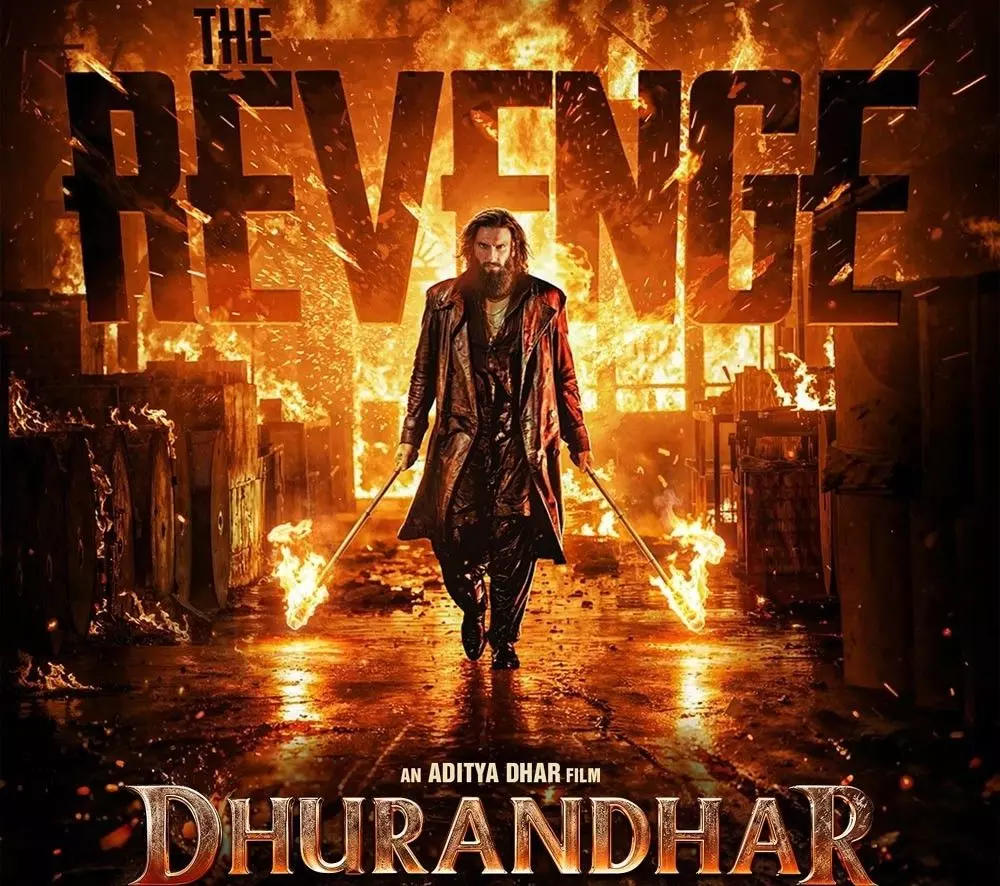
In Dhurandhar: The Revenge violence grows gratuitous to a level of titillation, conversations are made less subtle and a lot more jab-like to suit the ‘ghus ke jawaab’ stance.
Dhurandhar: The Revenge has a screenplay mired in clichés, but plays to the gallery
The second part of the Dhurandhar saga comes through as a long, gross account of appeasement. As in the first part, there is a kinetic rhythm to the film that emerges from the action choreography and camera work. Yet, what the film lacks is maturity and a clear-cut objective.

In an ideal world somewhere, Dhurandhar's editor Shivkumar V. Panicker and music composer Shashwat Sachdev are being profusely thanked by Aditya Dhar. The writer-director is perhaps confessing in full secrecy to the two that they managed to not only imbue his two-part saga with cohesion and vitality, but also make the nearly eight-hour-long, ultra-hyper gore fest ‘feel’ something like an experience. Dhar knows that if it wasn’t for Panicker’s efforts in making the flatline story exciting for an attention-deficient audience, and Sachdev’s in hyping up every plot point with (unnecessary) irony, Dhurandhar — both parts included — couldn’t have ever sustained its tall billing. The fact that many are wilfully dismissing its problematic politics for its technical finesse goes to confirm that cinema is, indeed, the luckiest art form on its day.
The question, then, is whether these embellishments make up for the storytelling that is full of over-smart pivots? Can the choice of splitting the bloated 229-minute runtime into six random chapters lend any girth to the underlying themes? Can the consistent incendiary claims made by the characters actually manage to reveal a nuanced and original worldview? Can humanism still show up in a revenge saga, one that promises to go after only the proponents of terrorism and not a country or community in general?
It might seem that Dhurandhar, as a collective idea, wasn’t expected to deliver these answers, but it is never irrational to expect a subject matter to carry its own set of philosophical undercurrents. Especially when Aditya Dhar’s makeshift world of reel and real offers many such possibilities. He has a protagonist who is both straddled with national duty and is emotionally fragile, with a personal past. He has the world of cross-border intelligence on offer, where no answer is readily available because of the vast communication vacuum. He has love, loss, rage, faith, loyalty, and so many more relatable sentiments to draw upon; so, all Dhar has to do is resist being trigger-happy.
Also read: Kennedy, Bandar: Why Anurag Kashyap the filmmaker needs to snap out of his creative funk phase
Instead, Dhurandhar: The Revenge, the second part of the Dhurandhar saga, comes through as a long, gross account of appeasement. In the film’s earlier sequences, a character feverishly looks for his sister, who has been kidnapped and brutally raped, but the moment of such gut-wrenching poignancy is underlined by a thumping rendition of Ari Ari… Teri Meri Ikk Jindri. In another scene, an actor playing an ex-Pakistani army man boldly says that despite all the money being pumped into Indian universities and other forums, the “wrong man ended up getting elected as the prime minister in 2014”. A major real-life event that took place in India in 2016 is given the backing of a "special" operation named ‘Green Leaf’ (the hint is in Green), just so that it looks like the prescribing government’s masterstroke.
Khalistani militants enter the fray to highlight Punjab’s issues with substance abuse, the Ayodhya temple issue is referred to, and arguably India’s biggest foe is introduced whimsically in the role of Bade Sahab. In the same vein, violence grows gratuitous to a level of titillation, conversations are made less subtle and a lot more jab-like to suit the ‘ghus ke jawaab’ (we will answer you in your stronghold) stance, and hyperboles of all sizes and statures are thrown in to please not just majoritarian parties, but also the majoritarian opinion of the film’s audience.
Infantile and unnatural
In fact, Dhar gets so lost in this self-assigned objective that he completely forgets to create interesting characters, especially to complement Ranveer Singh’s immensely committed dual act of warlord Hamza and humble army aspirant Jaskirat Singh Rangi. Sanjay Dutt’s SP Chaudhary Aslam remains monotonously diabolical, while Arjun Rampal bungles any chance of evoking dread and menace through his ISI officer Iqbal. The latter gets a subplot involving a wheelchair-bound father (played by Surinder Vicky) who severely emasculates his son for not yet managing to obliterate India — the writing here, full of profanity, is meant to startle the audience, but it only comes across as infantile and unnatural. It might feel like a small win for the makers of the film that, after all, no Pakistani man could pose a proper threat to Hamza.
At one point, R Madhavan’s Ajay Sanyal (the Indian intelligence chief) chooses to convince Jaskirat to go undercover with the “hum mard hai” (“we are men”) justification. Sanyal goes on to say that a man’s duty is to fight till his last breath, and it is perhaps because of this outlook that Dhurandhar: The Revenge opts to feature not more than a couple of women in its narrative. Sara Arjun’s Yalina gets very little agency despite the emotional heft of her character, and what should have been a complex thread about a marriage buried under deception is solved with all the convenience in the world.
Also read: How The Kerala Story franchise turns manufactured numbers into manufactured rage
Dhurandhar: The Revenge knowingly plays to the gallery, and Aditya Dhar’s staging is crafty enough to partially salvage a screenplay mired in cliché. As in the first part, there is a kinetic rhythm to the film that emerges from the action choreography and camera work. Yet, what the film lacks is maturity and a clear-cut objective. From quite early on, it stops trying to be a film of principle and conviction, and instead becomes a catering agent that wants to deliver as per demands: You want characters to suddenly flip personalities? Here you go. We gave you Rambha Ho the last time, would you like some Thamma Thamma Doge (or Rasputin, or Thirchi Topiwale) this time around? How about we make it rather too easy for the protagonist to get out of a deadly impasse, just so that we can all have a grand cheer?
One could say that this melange of momentary pleasures, of fanning our desires to see fictional versions of real-world people deliver a far more satisfying form of justice, is now the writer-director’s style. His debut film URI: The Surgical Strike (another crowd-pleasing reference in the new movie) ran on the same approach, and Dhurandhar is no different, even with its much-larger canvas. But how much of it is style and how much a tactical distraction through which instant gratification becomes the acceptable long-term solution, is the question begging to be answered.
In other words, does a movie like this suffice our quest for answers from the people of actual influence out there? The excuse of separating art from politics, of treating this version of wishful thinking as a genre in itself (like how Quentin Tarantino’s Inglorious Basterds popularised alternative histories), also doesn’t apply here because this film has received glorious political and ideological sponsorship, like few others.