Sivakarthikeyan's Parasakthi review: When nuance gives way to slogans
While the film strives to articulate the systemic oppression of marginalised voices, it is the disclaimers that communicate it more effectively than the narrative itself

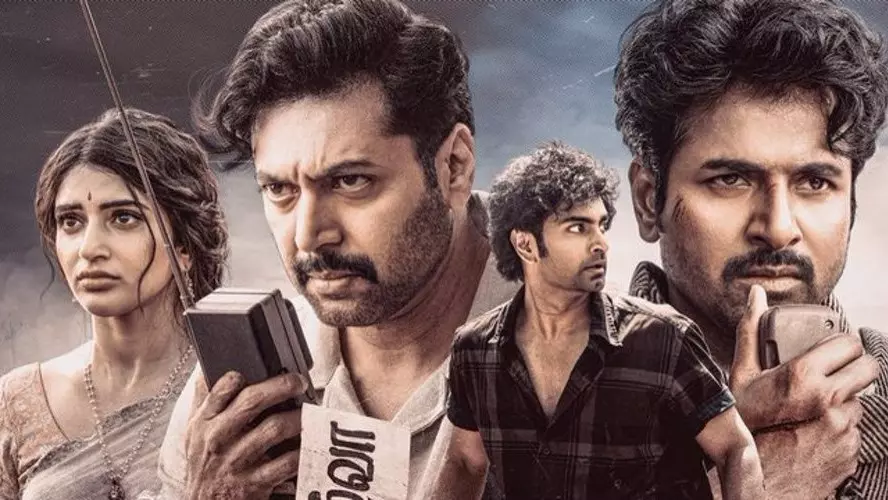
Sezhiyan (Sivakarthikeyan) faces two interviewers in Delhi, who deliver the bad news that he is not getting the Ticket Checker (TC) job. He has to remain a ‘kari porukki’, a friendly mockery of his job as a train fireman by his girlfriend Rathna Maala (Sreeleela) back in Madurai. Though meant affectionately, the jibe hurts Sezhiyan, who had strived to learn basic Hindi in six months for the job. Yet, it isn’t good enough according to his interviewer Gupta, who pronounces his name Seziyan instead of Se’zh’iyan.
The scene would have had a much greater impact had director Sudha Kongara let it be. It would have spoken for itself. It would have eloquently stated that people who can’t even pronounce a Tamil name right, expect the whole state to be fluent in Hindi. But no. Kongara feels the need to stress it, and thus we have Sezhiyan calling it out. That need arises from a belief that the ‘message’ must reach the lowest common denominator. That’s the overarching problem with Parasakthi. It constantly strives to stress something that can be sold at face value. It consistently trades nuance and finesse for message-driven reductionism.
Anti-Hindi imposition student movement
The film, loosely based on the anti-Hindi agitation of the 1950s, kicks off in 1959 with an engaging setup involving an act of arson with a train by the Puranaanooru Padai, an anti-Hindi imposition student movement rebelling against the language being made the country’s official tongue. The sequence also introduces the antagonist Thirunaadan (Jayam Ravi), a KGB-trained intelligence officer. A half-Tamilian, Thiru detests his mother for choosing a Tamilian as her husband. While interesting on the surface, his characterisation doesn’t get any deeper than that. His self-loathing manifests as hatred for Puranaanooru Padai. Added to this is the loss of his right-hand fingers in a fight with the masked Sezhiyan during the opening sequence. His mission then becomes the annihilation of both the movement and Sezhiyan.
Also read: Prabhas' Raaja Saab review: Another nail in the coffin of Indian horror comedy genre
However, Sezhiyan himself halts the activities of his group after the train arson claims the life of one of his friends. He embraces non-violence and becomes a fireman to take care of his brother Durai (Atharvaa), an engineering student. Despite knowing his brother’s secret identity, Durai gets inspired by Puranaanooru Padai and begins rebelling against Hindi imposition. Despite Sezhiyan’s constant resistance, Durai continues the movement to a point of no return.
Atharvaa does a fair job
While the setup of Parasakthi is on point, the film slowly loses both finesse and steam. Though it follows a familiar anti-establishment template – one we’ve seen recently in films like Captain Miller – a few moments save the first half from becoming the drabness the second half eventually sinks into. It doesn’t take much to predict Durai’s fate. He is the chicken for slaughter from the get-go. His death is meant to fuel Sezhiyan’s revenge arc, but Kongara manages to make it sympathetic through moments that win us over. Be it the friendly scuffle between the brothers on the streets, Sezhiyan’s “Indha Anna solradhayum kelu” (At least listen to what this elder brother is saying), or Durai trying to help Sezhiyan’s romance, the writing does enough to make him more than a mere plot device. Atharvaa, in turn, does a fair job as the affable yet rebellious younger brother.
Also read: Ikkis review: Dharmendra’s final bow, Agastya Nanda lift Sriram Raghavan’s anti-war film
The romance, too, adds to the film’s early strengths. Rathna Maala, the headstrong daughter of a ruling MP who uses her privilege to help the movement, may be convenient on paper but comes through effectively. She belongs to a Telugu-speaking family involved in Durai’s cause, even as she romances his elder brother. I particularly liked how a romantic number is woven into the narrative. After Sezhiyan reveals his true identity, Maala is disappointed that he kept the secret from her. To win her back, he sings in Telugu, and it works. Throughout the film, language functions as virtue and rebellion; here, it also becomes a medium of love. This sensitivity to writing is lost in the third act, which reduces to a generic pan-Indian spectacle in which heroes from other states walk in for applause.
Arrival of Malayalam superstar
Once the film becomes fully about the anti-Hindi agitation, Parasakthi begins ‘talking’ to the audience rather than trusting its images. It wants applause from every region, and to our disbelief, even offers a vote of thanks to prominent languages. A Bengali woman recites a poem. A Telugu actor proclaims “Hail Telugu”. A Malayalam superstar arrives to save the day. What remains is disappointment at seeing even filmmakers attempting something different succumbing to the very low-hanging fruits they once seemed determined to avoid.
While the film strives to articulate the systemic oppression of marginalised voices, it is the disclaimers that communicate it more effectively than the narrative itself. Each time a character is punished for not knowing Hindi, a clumsy disclaimer flashes on screen claiming the scenes are ‘sitharikapattavai’ (fictitious). The redundancy is almost comical, thirai sithiram already means cinema. Yet, this insistence, reportedly enforced by the censor board, turns the disclaimer into an act of oppression in its own right. In trying to pre-empt discomfort, the certification process ends up mirroring the very silencing that the film sets out to critique.