








Weekly cinema round up: AR Rahman row, Mammootty Adoor reunion, Raaja Saab fallout
Vijay's Jana Nayagan suspense continues, Ajith Kumar's Mankatha retains cult status, Prabhas's Raja Saab failure sparks debate on need for pan-India releases

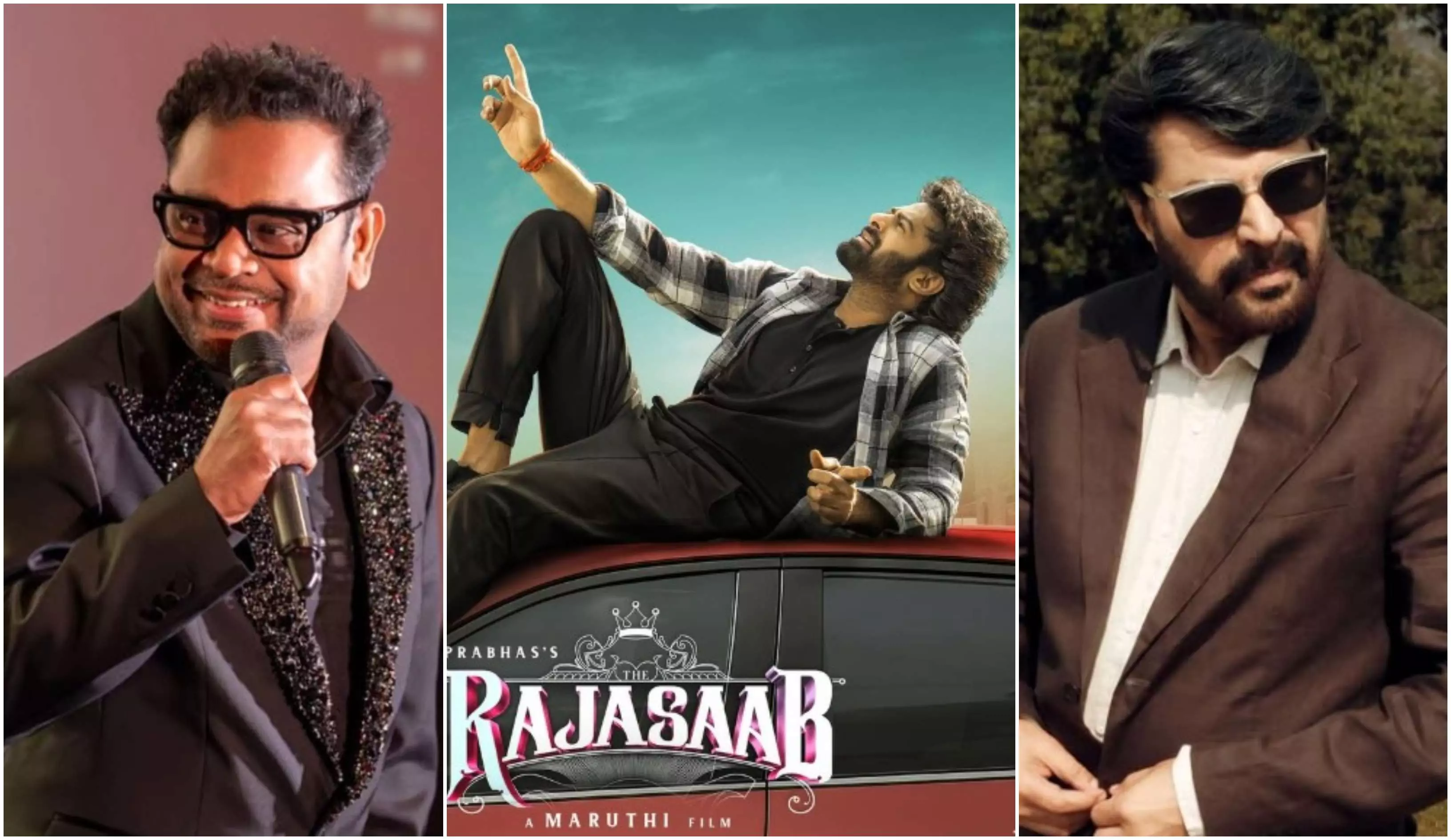
From industry debates to long-awaited reunions to sobering box-office setbacks, South cinema made headlines this week.
Vijay’s Jana Nayagan continues to remain in a precarious situation as the film is yet to see the light of the day amid an ongoing censor dispute. The Madras High Court, which had reserved its order in the matter on January 20, is now set to pronounce its final verdict on January 27.
Directed by H Vinoth, Jana Nayagan was slated for a January 9 Pongal release and is being seen as Vijay’s final film before his full-fledged political entry. However, days before its release, the Central Board of Film Certification (CBFC) informed the makers that the film had been referred to a revising committee by its chairperson, triggering a legal challenge.
The producers moved the Madras High Court, where a single judge initially directed the CBFC to grant the film a U/A 16+ certificate. That relief was short-lived, as the order was stayed by a division bench following an urgent mention by the CBFC. With the stay continuing, the fate of Jana Nayagan now hinges on the High Court’s verdict later this month.
Mammootty–Adoor Gopalakrishnan reunion
Superstar Mammootty has begun work on Padayaatra, marking a long-awaited reunion with legendary filmmaker Adoor Gopalakrishnan after nearly three decades. The film was formally launched with a puja ceremony held on Friday in the presence of Mammootty, Adoor Gopalakrishnan and the crew.
Also Read: Shaji N. Karun: Cinematographer-auteur who introduced a new visual poetics to Indian Cinema
Produced under the banner of Mammootty Kompany, Padayaatra brings together one of Malayalam cinema’s most celebrated actor–director pairings. The production team shared visuals from the ceremony, announcing the start of the shoot and seeking support from audiences.
Mammootty and Adoor Gopalakrishnan last collaborated on Vidheyan and have previously worked together on acclaimed films such as Anantaram and Mathilukal. Mammootty won the National Award for his performance in Mathilukal, further cementing the significance of their partnership. Fans are now eagerly awaiting Padayaatra, their fourth collaboration.
Mankatha re-release furthers trend
The re-release of Ajith’s Mankatha furthers the trends of re-releases in Kollywood as the reports suggests, the film has minted over 1.87 crore from across the world, according to Sanilk. The film’s success is celebrated by fans to an extent that theatre owners have complained of damages of properties during the screening.
Directed by Venkat Prabhu and co-starring Arjun Sarja and Trisha Krishnan, the heist drama returned to theatres on January 23 and opened to encouraging box-office numbers.
The re-release of Mankatha coincided with several other films, including Draupathi 2, Hot Spot 2 Much and Border 2. Despite the competition, the Ajith Kumar headliner has managed to maintain momentum, underlining its cult status and sustained fan interest even years after its original release, which was back in 2011.
Debate over Raja Saab failure
The commercial failure of Prabhas’s The Raja Saab, released on January 12, has reignited a wider debate in the Telugu film industry over whether big stars need to recalibrate their choices and return to more grounded, narrative-driven cinema instead of chasing pan-India scale. The film’s underwhelming box-office performance has prompted introspection on how inflated budgets and shifting creative priorities are impacting mainstream filmmaking.
Maruthi, director of The Raja Saab, has defended his film by placing part of the responsibility on audience expectations. “Viewers watched The Raja Saab in a festive mood, expecting light entertainment. This may have stopped them from fully connecting with the deeper layers of the narrative,” he wrote on a note shared on social media. He also argued that timing played a role, suggesting that the film’s climax may have been better received if released during a different period. “Time always brings clarity, and honest work eventually finds its place-even if it takes longer than expected,” Maruthi added.
Veteran filmmaker Thammareddy Bharadwaja, who spoke about the issue, however, traced the problem to the film’s evolving scale. He said The Raja Saab was initially conceived as a modest Telugu film and questioned why the makers moved away from that vision. According to him, the decision to rework it as a pan-India project led to prolonged production, reshoots and rising costs. “Whenever the makers try to add ‘pan-India’ elements, a film deviates from its purpose,” Bharadwaja told SumanTV.
Also Read: Prabhas' Raaja Saab review: Another nail in the coffin of Indian horror comedy genre
Although not commenting on The Raja Saab directly, director Anil Ravipudi’s recent remarks have added fuel to the debate. Speaking to Great Andhra, he observed that pan-India ambition has dramatically widened budgets and expectations. “Heroes now have global exposure, and that creates a dilemma when it comes to doing smaller films,” he said, adding that higher budgets and visual standards often make it harder for stars to return to regional-scale projects.
Together, these reactions underline a growing industry concern: that the pursuit of pan-India success may be coming at the cost of creative clarity. The Raja Saab is a simple film that belongs to the dated genre of horror comedy, which was mounted on a huge scale. The wafer-thin plot failed to hold the film's budget leading to a flat but flashy film.
Sinners makes history
The Academy of Motion Picture Arts and Sciences on Thursday announced the final nominations for the 98th Academy Awards, unveiling the list during a live-streamed event hosted by actors Danielle Brooks and Lewis Pullman. The announcement marked the formal start of the awards season countdown for the 2026 Oscars.
Also Read: How Ryan Coogler’s Sinners, with 16 Oscar nods, marks a turning point for Black-led cinema
Director Ryan Coogler’s Sinners emerged as the biggest winner in the nominations race, securing a record-breaking 16 nods--the highest in Oscar history. The film overtook long-standing records held by James Cameron’s Titanic and Joseph L. Mankiewicz’s All About Eve, which had previously led with 14 nominations each.
Josh Safdie’s Marty Supreme and Paul Thomas Anderson’s One Battle After Another also made a strong showing, earning 10 and 12 nominations respectively. However, Indian filmmaker Neeraj Ghaywan’s Homebound, which had generated significant buzz and support, failed to make it to the final list of nominees.
Mixed reactions to AR Rahman's remarks
Oscar-winning composer AR Rahman’s recent remarks about alleged changing power structures in the film industry have triggered a wave of reactions from fellow artists, prompting both criticism and support. Speaking to the BBC Asian Network, Rahman suggested that a “power shift” over the past eight years had led to non-creative people holding influence, adding that it “might be a communal thing also,” though he said it was not something he experienced directly.
The comments quickly drew attention on social media, following which Rahman issued a clarification, expressing deep affection for the country. “India is my inspiration, my teacher and my home,” he said, adding that his intention was never to cause hurt and that he remained grateful to the nation.
Also Read: After 'communal' claim, AR Rahman says new generation gaslit him into doubting his work
Lyricist Manoj Muntashir, speaking to India Today, cautioned public figures about the impact of their words. Drawing an analogy between speech and water, he said that when either crosses limits, the result can be “destruction,” and urged celebrities to weigh their words carefully, given their influence on society.
Singer Sona Mohapatra, in an interview with The Indian Express, questioned the idea of Rahman being marginalised, pointing out that he continues to score music for major projects such as Chhaava and Ramayana, while remaining active on the global stage.
Filmmaker Ram Gopal Varma, appearing on Faridoon Shahryar’s podcast, dismissed the notion of communal bias in the industry, arguing that commercial success alone determines opportunities. “They don’t care about your caste, religion, or where you’re from,” he said.
Director Imtiaz Ali also rejected the idea of communal bias, telling India Today that he had never encountered such discrimination and describing Rahman as “one of the brightest figures” in the industry. He added that Rahman’s comments may have been misconstrued, further fuelling the controversy.