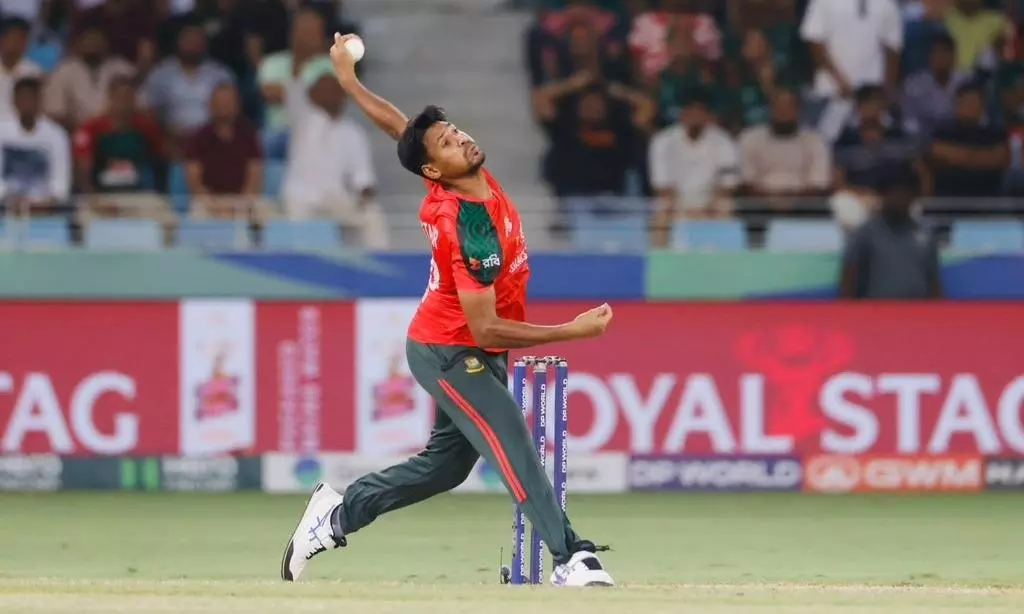
Mustafizur row | From ‘secular religion’ to political flashpoint: cricket’s new reality
The Mustafizur case also raises uncomfortable questions about accountability. Franchise leagues have transformed the sport and improved player livelihoods, but their influence now extends far beyond cricketing outcomes

Mustafizur Rahman’s removal from the Indian Premier League (IPL) was never received as a routine cricketing decision. In Bangladesh, it was quickly read as something far more serious. The timing of the move, amid heightened political tension and reports of unrest in the country, meant that what should have remained a franchise-level call was interpreted through a national and political lens. This episode is not an isolated controversy. It is a revealing moment about how power now operates in global cricket!
What followed underlined just how far the game has travelled from the idea that sport can remain insulated from larger realities. The Bangladesh government ordered an indefinite ban on the broadcast and promotion of the IPL. Soon after, the Bangladesh Cricket Board (BCB) formally approached the International Cricket Council (ICC), raising concerns about sending its team to India for the upcoming T20 World Cup. A domestic league decision had now escalated into an international governance issue, barely weeks before a global tournament.
IPL’s enormous global influence
Initially, much of the discussion treated these events separately. Mustafizur’s exclusion was framed as a franchise matter, while Bangladesh’s response was dismissed in some quarters as a political overreaction. Seen together, however, they point to a deeper issue. Modern cricket now operates in an ecosystem where domestic leagues, especially the IPL, hold enormous influence but carry little responsibility for the consequences of their actions.
Also read: Bangladesh bans IPL telecast over Mustafizur Rahman’s exit from KKR
The IPL is officially described as a domestic tournament, but in practice, it functions as a global power centre. It shapes annual schedules, affects workloads, and influences national selection priorities. Its financial strength has created a hierarchy in which participation is vital not just for players, but for boards that rely on the league’s visibility and economic impact. When a league of this scale makes a decision that is perceived as political, the fallout cannot be contained within cricket.
For boards like Bangladesh, this creates a difficult imbalance. They are expected to cooperate with franchise demands, release players, and adjust calendars, yet they have almost no voice within the league’s decision-making structures. There is no formal mechanism to question or challenge decisions that affect their players, even when those decisions appear to extend beyond sporting reasons. That sense of vulnerability was central to what followed.
This is why Bangladesh’s appeal to the ICC should be understood less as escalation and more as institutional helplessness. When the ICC declined to shift T20 World Cup venues, citing the absence of any credible security threat, the BCB did not issue ultimatums. Instead, it clarified that it remained open to “constructive engagement”, even as it insisted that its concerns had not been fully acknowledged. The message was clear that the board was seeking reassurance and leverage in a system where it otherwise has very little.
Immediate consequences
In the short term, this episode has created a significant organisational challenge for the ICC. With the T20 World Cup approaching, even the possibility of a participating nation expressing reluctance introduces instability. The ICC has been forced into a reactive role, mediating a situation that originated outside its direct authority.
Also read: Cricketers, filmstars and the games they have to play
The immediate consequences also affect all three stakeholders differently. For Bangladesh, the situation has created domestic pressure, with public sentiment closely tied to perceptions of fairness and respect. For the Board of Control for Cricket in India (BCCI), the controversy risks complicating the hosting of a global event at a time when India positions itself as cricket’s most reliable organiser. For the ICC, it exposes the limits of its power in a landscape increasingly shaped by leagues rather than boards.
Beyond the World Cup, the longer-term consequences could be more damaging if these patterns continue. The IPL has a significant following in Bangladesh, one of its largest markets outside India. Any sustained disengagement would hurt the league’s commercial reach. Bilateral cricket between India and Bangladesh, including future series, could also become more fragile in an environment where trust has been strained.
This episode highlights a growing governance dilemma in global cricket. Smaller boards across the world have long struggled to balance participation in lucrative leagues with maintaining autonomy. West Indies cricket has repeatedly faced conflicts between national duty and franchise priorities. Sri Lanka and South Africa have endured phases where players gravitated towards leagues offering financial security that their boards could not match. In each case, the power balance has tilted steadily toward market-driven structures.
Also read: Bangladesh pull out of T20 World Cup matches in India citing security concerns
What makes the current moment different is how quickly these tensions now spill into international relations. This marks a clear shift from an earlier era when cricket often acted as a stabilising force in South Asia. Despite wars and political hostility, India and Pakistan continued cricketing engagement in the 1970s and 1980s, despite the 1971 war, leading thinkers like Ashis Nandy to describe cricket as a “secular religion” capable of absorbing conflict rather than amplifying it.
What cricket administrators need to do
That buffering role has steadily weakened. Neutral venues have become routine. Sporting disengagement is no longer shocking. Against this backdrop, the India-Bangladesh episode feels less like an isolated controversy and more like part of a wider pattern where cricket increasingly reflects geopolitical fault lines instead of easing them.
The Mustafizur case also raises uncomfortable questions about accountability. Franchise leagues have transformed the sport and improved player livelihoods, but their influence now extends far beyond cricketing outcomes. Decisions taken in auction rooms and board offices can affect international tournaments and national sentiment without any clear framework for responsibility.
This is not an argument against franchise cricket. It is an argument for recognising the power it now holds. When domestic leagues begin to shape international relations, governance structures must evolve to match that reality.
In the short term, the priority is clear: ensuring that the T20 World Cup proceeds smoothly, without uncertainty or disruption. In the longer term, cricket’s administrators must confront a harder question, how to balance commercial dominance with collective responsibility. Until that balance is addressed, episodes like this will continue to surface as symptoms of a game still struggling to adapt to its own power shift!