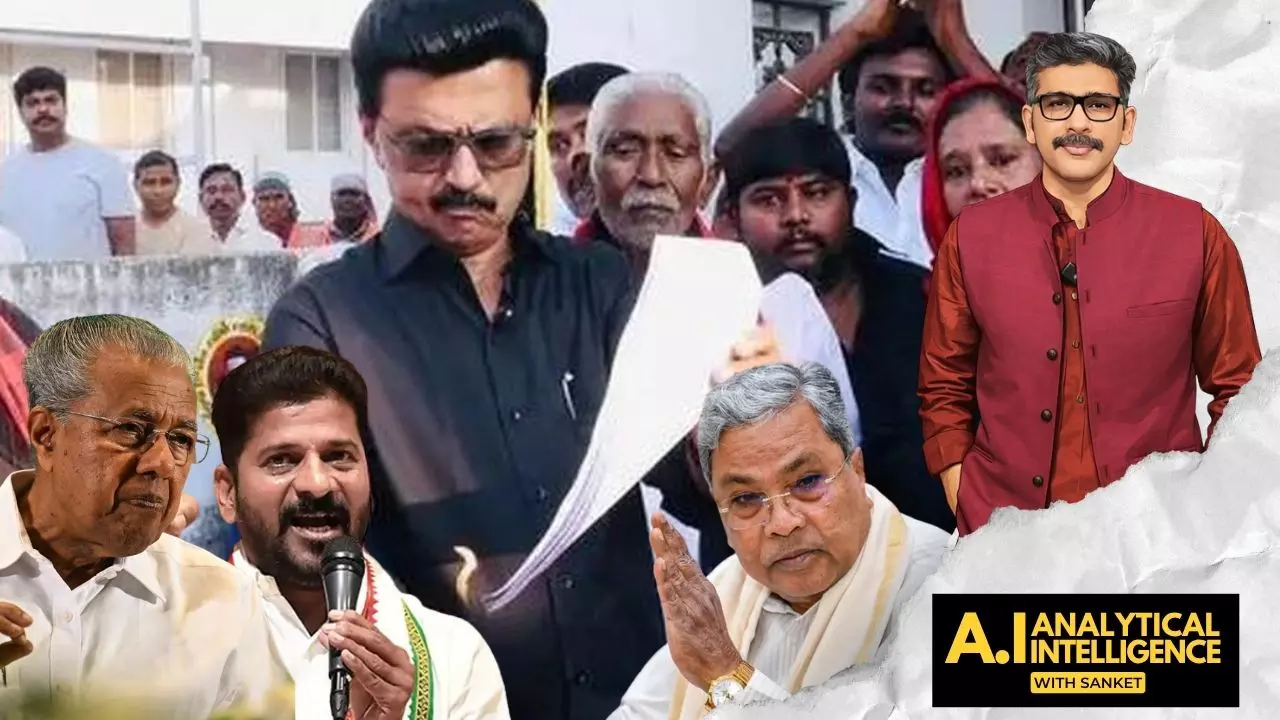
Reporters Take: How Southern states are reacting to delimitation debate | AI With Sanket
From protests in Tamil Nadu to Andhra’s support, southern states divided politically amid public confusion and concerns over representation and federal balance

As the Centre pushes forward discussions on three bills to facilitate delimitation, southern states are witnessing a mix of political resistance, public confusion, and strategic silence. The Federal spoke to Pramila Krishnan (Tamil Nadu), Naveen Ammembala (Karnataka), Rachana Srungavarapu (Andhra Pradesh and Telangana), and KJ Jacob (Kerala) to understand how the proposed exercise is being received across the South.
Tamil Nadu flashpoint
In Tamil Nadu, delimitation has quickly become a major political flashpoint, especially in the run-up to elections. According to Pramila Krishnan, while public awareness remains limited, political mobilisation is intense.
“On the ground, people are not fully aware of what delimitation means or how it affects them,” she said. “But politically, it has given a big push to the DMK to campaign on state rights and autonomy.”
The ruling DMK has actively protested the move, including symbolic acts like burning copies of the bill. The party argues that the proposed framework unfairly penalises southern states for successfully controlling population growth.
Also read: Women’s quota and delimitation: Experts flag lack of consultation | Capital Beat
Two key narratives dominate the campaign: that the calculation method itself is flawed, and that the South is being punished for better governance outcomes.
Kerala consensus
Kerala presents a relatively unified political front against the proposal. KJ Jacob of Deccan Chronicle noted that both the ruling Left Democratic Front and the Opposition, United Democratic Front, share similar concerns.
“Whether it is the CPI(M) or the Congress, both believe this will negatively impact southern states,” he said.
Kerala currently holds 20 Lok Sabha seats, and while the total number may increase marginally under delimitation, Jacob warned that the state’s proportional representation would decline.
He pointed out that the core issue lies in the criteria used. “If population becomes the sole basis, southern states will lose out. But at the same time, ignoring population entirely would also be unfair,” he added.
Also read: Three grounds on which delimitation laws may be challenged in court
Jacob also criticised the Centre for not building political consensus before introducing the proposal, calling the approach “undemocratic.”
Telugu divide
The sharpest contrast emerges between Telangana and Andhra Pradesh, despite their shared linguistic and cultural roots.
Rachana Srungavarapu highlighted that Telangana has mounted strong and unified opposition. Chief Minister Revanth Reddy has even proposed a hybrid model—suggesting that seat allocation be based 50 per cent on population and 50 per cent on economic contribution.
“This is a fight where progress should not be punished,” she said, noting that multiple parties and civil society groups in Telangana are actively protesting.
In Andhra Pradesh, however, the political response is markedly different. Both the ruling alliance led by Chandrababu Naidu and Opposition leader YS Jagan Mohan Reddy have supported the move.
Also read: What is gerrymandering, and why is everyone suddenly talking about it?
“They are focusing on the increase in seats rather than the long-term proportional loss,” Rachana explained.
Interestingly, Congress leader YS Sharmila remains the lone major voice opposing the bill in Andhra, arguing that the state’s share in national representation could decline despite an increase in absolute seats.
Karnataka concerns
In Karnataka, public awareness remains limited, but political and civil society discussions are gaining momentum, said Naveen Ammembala.
“Among the general public, there is not much understanding yet, but civil rights groups and students are actively debating the issue,” he noted.
The Congress-led state government has opposed the proposal, and even within the BJP, there are internal reservations. According to Ammembala, some leaders fear that Karnataka’s representation could shrink proportionally.
Also read: Is BJP electoral juggernaut deciding the shape of women’s quota, delimitation bills?
Currently contributing over 5.5 per cent representation in Parliament, the state could see this drop to around 4.2 per cent under certain delimitation scenarios.
Economic concerns are also central. “Karnataka is a major tax contributor but feels it is not getting its fair share in return,” he said, linking delimitation fears to broader grievances over fiscal federalism.
Political strategy
Beyond state-level reactions, the panel also explored the Centre’s possible motivations behind pushing the bill.
Pramila Krishnan noted that in Tamil Nadu, there is a strong belief that the bill will eventually pass, despite opposition. “People feel previous bills were also passed without meaningful debate,” she said.
Rachana Srungavarapu offered a different perspective, suggesting the move may be more strategic than legislative.
“It could be a way to test political alignments or even instil fear among southern leaders,” she said, adding that the Centre might be signalling its dominance rather than expecting immediate passage.
She also pointed out that in states like Andhra Pradesh, political loyalties to the Centre could make resistance unlikely, regardless of public sentiment.
Federal tensions
A recurring theme across the discussion was the growing perception of imbalance between North and South.
KJ Jacob observed that while economic disparities have long been debated, political disparities could prove more contentious.
Also read: Why delimitation Bills appear more ominous than originally thought
“Southern states may accept sharing economic resources, but not a reduction in political power,” he warned.
He also highlighted rising discontent among youth, who increasingly perceive discrimination in areas like job access, language requirements, and infrastructure allocation.
Southern unity?
The possibility of a united southern response also came up during the discussion. Naveen Ammembala revealed that Karnataka leaders have initiated conversations with counterparts in other states to build a collective stance.
“They are thinking about forming a coordinated response, similar to regional groupings seen elsewhere,” he said.
Also read: Delimitation will divide North and South India, says Congress
However, leadership ambitions and political differences could complicate such efforts. Previous attempts at coordination, including a southern states conference in Chennai, have not yet translated into sustained action.
Uncertain road ahead
As the delimitation debate unfolds, the disconnect between political narratives and public awareness remains stark. While politicians across southern states are actively framing the issue, large sections of the electorate are still grappling with its implications.
What is clear, however, is that delimitation has reignited deeper questions about federalism, representation, and regional equity—issues that could shape political discourse well beyond this bill.
(The content above has been transcribed using a fine-tuned AI model. To ensure accuracy, quality, and editorial integrity, we employ a Human-In-The-Loop (HITL) process. While AI assists in creating the initial draft, our experienced editorial team carefully reviews, edits, and refines the content before publication. At The Federal, we combine the efficiency of AI with the expertise of human editors to deliver reliable and insightful journalism.)