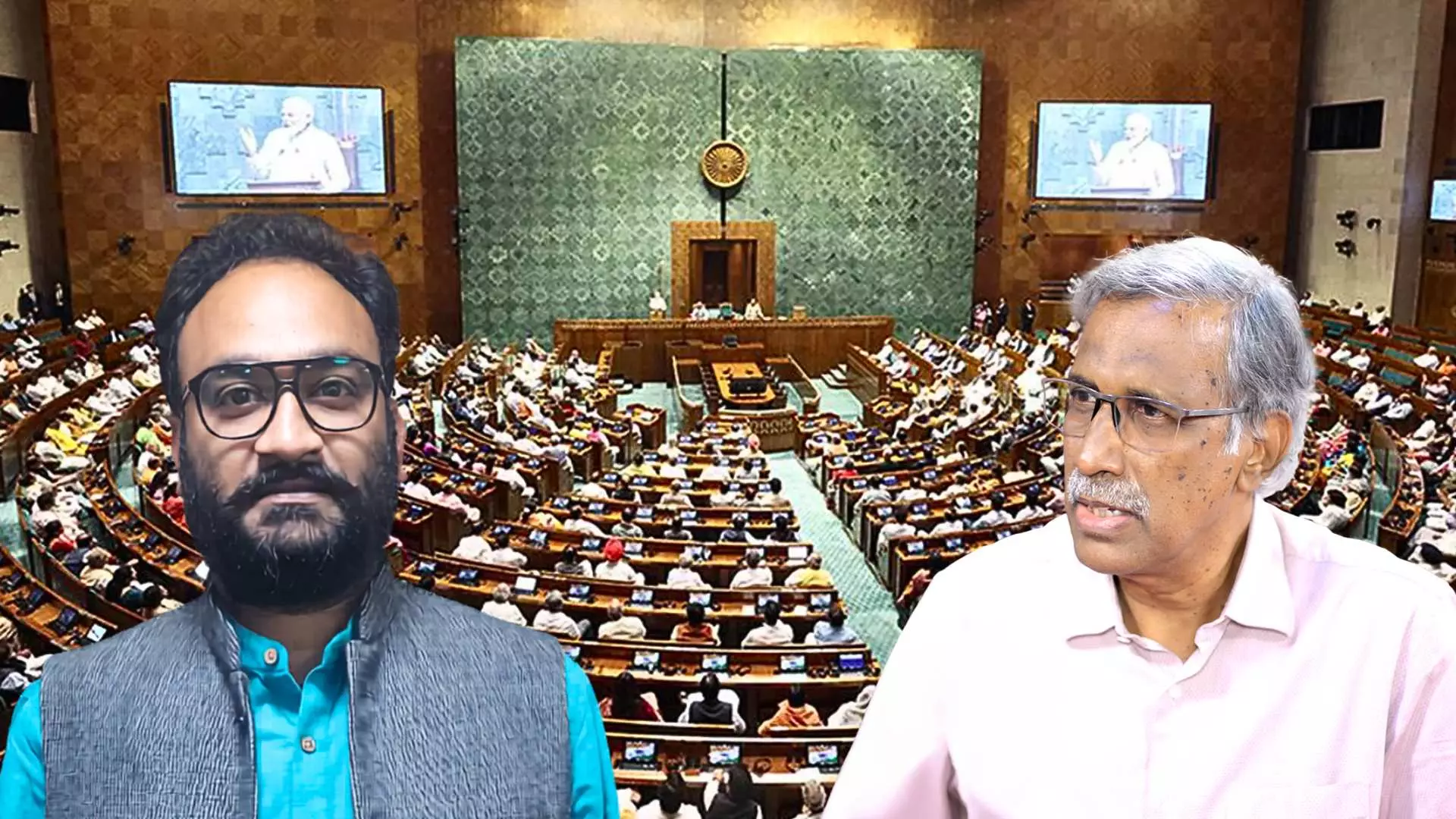
Is BJP electoral juggernaut deciding the shape of women’s quota, delimitation bills?
Parliament debates women’s reservation and delimitation together, raising concerns over political balance. Is the government pushing delimitation unilaterally?

Is the Centre’s latest push for women’s reservation a cover to fast-track delimitation — a move that could significantly alter the political balance in favour of northern states? The Centre’s decision to introduce three draft bills in a hurried special session has sparked sharp opposition, with critics questioning both timing and intent. The Federal spoke to its Political Editor, Puneet Nicholas Yadav, to unpack the politics, implications, and concerns surrounding the proposed changes.
Why has the Centre hurriedly introduced these bills now?
This move creates a situation of complete disarray within the Opposition. The Centre’s justification is that it is committed to a timeline announced in September 2023 during the passage of the women’s reservation Bill, and any delay would push implementation beyond the 2029 Lok Sabha elections.
But that argument is quite specious. The controversy since 2023 has been that the women’s reservation law had no clear timeline. If the government allowed it to remain in limbo for 30 months, what difference would 15 more days make?
The Opposition had asked the Centre to hold an all-party meeting after April 29, once polling in West Bengal concludes. They said discussions could happen immediately after that, without even waiting for results. The issue is not women’s reservation — everyone supports it — but the attempt to bring delimitation under its garb.
Also read: Stalin issues a ‘final warning from Tamil Nadu’ to Modi on delimitation
The government likely believes the Opposition is too preoccupied with elections in states like Tamil Nadu and West Bengal. The bills were shared only recently, despite Parliament being in session since January. They could have been introduced earlier for wider consultation, but that opportunity was not used.
How is the Opposition trying to separate women’s reservation from delimitation?
This is the biggest challenge before the Opposition. No political party can afford to oppose women’s reservation — it concerns half the electorate. That is perhaps why the government has moved now, hoping to leverage it politically in ongoing elections.
At the same time, the Opposition strongly opposes delimitation in its current form. The government has cleverly tethered the two issues together, making it difficult to oppose one without affecting the other.
The Opposition argues that it has always supported women’s reservation — historically tracing back to earlier legislative efforts — and even helped pass the law. Their concern is about how delimitation could impact the representation of southern and smaller states.
In theory, separating the two issues is easy. In Parliament, where they are part of the same constitutional amendment, it becomes extremely difficult.
Can the Opposition block the bill if it unites?
There is a meeting of Opposition leaders to discuss precisely this — whether they can evolve a consensus strategy. The challenge is whether they can oppose provisions related to delimitation while supporting women’s reservation within the same legislation.
Also read: Why delimitation Bills appear more ominous than originally thought
If they oppose the bill, the reservation component also fails, and they will have to explain that politically. That’s a significant risk.
Is there a political risk for the BJP as well, especially in Tamil Nadu and West Bengal?
Possibly, but the BJP’s gains are more immediate. The Opposition, however, has to think beyond these two states. They must consider elections across multiple states leading up to 2029.
If they are seen as blocking women’s reservation, it could hurt them in states like Uttar Pradesh, Gujarat, or Madhya Pradesh. So, while regional parties like DMK or Trinamool Congress may take strong positions locally, a unified national strategy becomes much more complex.
What are the key concerns around the delimitation formula?
The bill itself does not clearly specify 2011 as the reference census in its main text — it only appears in the statement of objects. This means any government could choose any census as the basis in future.
Earlier assurances — such as maintaining the current proportional representation of states or guaranteeing a uniform 50 per cent increase in seats — are missing from the bill.
Also read: 'Degressive proportionality', 'unscientific exercise', 'punishment to TN' | Delimitation Bill
If delimitation is based purely on population, southern states and smaller states are likely to lose out, while northern states gain significantly. This raises concerns about fairness and federal balance.
How does the new delimitation framework differ from earlier processes?
The Opposition is worried about how the bills are worded. The process is heavily tilted in favour of the executive.
The government will decide which census to use. The Delimitation Commission — headed by a Supreme Court judge and including election commissioners — will prepare its report. But concerns have been raised about institutional independence.
Once the Commission submits its report and it is published in the Gazette, it cannot be challenged in court. Earlier, such reports required parliamentary approval. That safeguard appears to have been removed.
Also, delimitation is no longer strictly tied to periodic census exercises. It can now be ordered at any time, which raises concerns about potential misuse.
What about women’s reservation specifics like rotation and quota within quota?
The reservation is to be implemented on a rotational basis and will remain in force for 15 years, extendable by Parliament.
Also read: Opposition backs women’s quota, opposes delimitation move: Kharge
The exact number of seats reserved will depend on how many total seats the Delimitation Commission ultimately recommends — whether closer to 650, 750, or the upper cap of 850.
As for quota within quota, especially for OBCs, that seems unlikely. The caste census data required for that will only be available after the next census cycle, which is not being considered for this exercise.
Is this part of a larger political strategy by the BJP?
It needs to be seen in a broader pattern. Over the past year and a half, we have seen changes in the process of appointing the Chief Election Commissioner, electoral roll revisions, and now delimitation linked with women’s reservation.
Delimitation does not just change the number of seats — it alters constituency boundaries and demographics. That can significantly reshape electoral outcomes.
These moves may be aimed at preventing a repeat of setbacks like those seen in the 2024 elections, especially in states like Uttar Pradesh and Maharashtra.
Why is the Opposition reacting strongly now, despite earlier signals?
There were clear signs — including the construction of the new Parliament building with expanded capacity — that delimitation was coming. The Opposition did raise concerns earlier.
Also read: Women’s reservation a smokescreen for delimitation, warns activist Anjali Bhardwaj
However, they lacked details. Until recently, even they did not know what specific changes the government would propose. Without clarity, it is difficult to mobilise public opinion effectively.
The challenge for the Opposition is not just protesting, but presenting a clear alternative — and doing so consistently amid multiple competing political issues.
(The content above has been transcribed from video using a fine-tuned AI model. To ensure accuracy, quality, and editorial integrity, we employ a Human-In-The-Loop (HITL) process. While AI assists in creating the initial draft, our experienced editorial team carefully reviews, edits, and refines the content before publication. At The Federal, we combine the efficiency of AI with the expertise of human editors to deliver reliable and insightful journalism.)