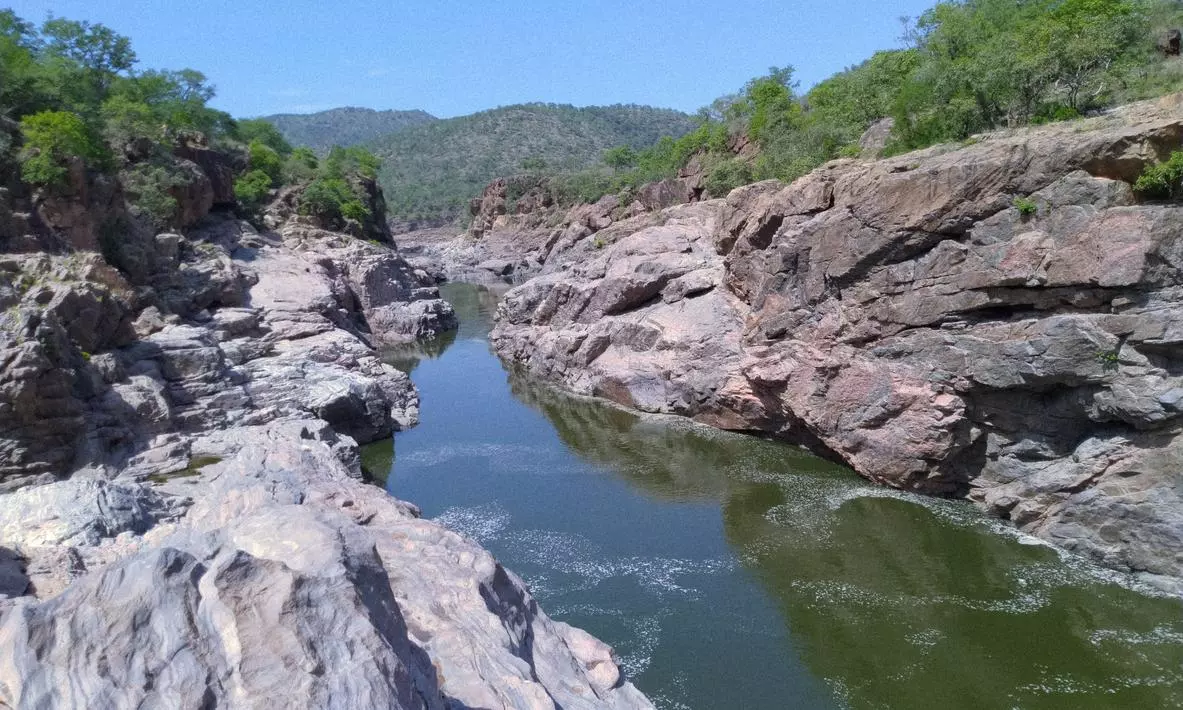
Karnataka seeks to take on TN with revised Mekedatu dam plan
Karnataka’s revised DPR restricts Mekedatu reservoir to drinking water use only, in a move calculated to neutralise Tamil Nadu’s long-standing legal opposition

Karnataka has filed a revised Detailed Project Report (DPR) with the Central Water Commission (CWC) for the Mekedatu balancing reservoir on the Cauvery — and this time, the state has deliberately drafted it to pull the rug from under Tamil Nadu's feet. A few important points have been added that would effectively prevent Tamil Nadu from filing a dispute application again.
The report, submitted on February 2, explicitly limits the reservoir's use to the drinking water supply alone. Legal experts say this single clause could effectively shut the door on any fresh challenge Tamil Nadu might mount. The Supreme Court had dismissed Tamil Nadu's earlier petition against the project in November 2025, and Karnataka is now moving swiftly to secure central clearance before its neighbour finds another foothold.
Also read: Siddaramaiah defends Mekedatu project, says Tamil Nadu won’t be affected
"The Mekedatu reservoir is being constructed exclusively for drinking water supply to Bengaluru for the next 50 years. Under no circumstances will the water be used for any other purpose," the DPR states, according to source who spoke to The Federal Karnataka.
The report also guarantees that Tamil Nadu's allocated share of Cauvery water will not be reduced by even a drop — a direct response to the downstream state's central argument. The dam site, located approximately 2 km from the confluence of the Cauvery and its tributary Arkavathi near Kanakapura, has been chosen to ensure minimal disruption to flows into Tamil Nadu.
Tamil Nadu's fears
Tamil Nadu has opposed the Mekedatu project for years, arguing that any new dam on the Cauvery upstream would reduce water flows — particularly in drought years — to its farmers in the Mettur reservoir command area and the delta region. The state has consistently maintained that the project violates the 2007 Cauvery Water Disputes Tribunal award and the Supreme Court's 2018 ruling, both of which bind Karnataka to releasing a fixed quantum of water annually.
Also read: Why water woes dog Nandi Hills region though 5 rivers originate there
But Karnataka counters that it is entitled to store the surplus water that currently flows unused into Tamil Nadu during the monsoon. The Cauvery catchment below the KRS reservoir spans 23,231 sq km with no major storage infrastructure, meaning Karnataka loses a significant portion of its 270+14 TMC tribunal allocation every year. Bengaluru, a city of 1.5 crore people, has repeatedly faced acute drinking water shortages in summer as a result.
A calculated revision
Karnataka's revision of the DPR is as much a legal strategy as it is an engineering exercise. By limiting the project's stated purpose to drinking water — dropping any reference to irrigation — the state narrows the grounds on which Tamil Nadu can object. Drinking water projects enjoy greater legal protection under Indian water law, making it harder for a downstream state to block them.
The project cost, however, has spiralled. From an initial estimate of Rs 4,500 crore in 2019, it rose to Rs 9,000 crore in 2024 and is now projected to exceed Rs 14,000 crore. Irrigation officials warn costs will climb further with every year of delay.
Clearances awaited
The project still needs approval from the Union Ministry of Environment, Forest and Climate Change, as around 4,800 acres of forestland — including parts of the Cauvery Wildlife Sanctuary — will be submerged. The 99-metre-tall dam will have a storage capacity of 67.16 TMC and submerge 5,173 hectares in total, with minimal impact on human settlements.
Also read: Karnataka’s water battles: State tussles with 17 inter-state river disputes before courts
Deputy Chief Minister DK Shivakumar, in whose Kanakapura constituency the dam falls, has staked considerable political capital on the project. He led a 130-km padayatra in 2022 demanding its construction and has since made it a signature promise of the Congress government. "The moment the Centre gives its go-ahead, the project will be implemented," he said.
The Mekedatu idea dates back to 1948, making this one of India's longest-running infrastructure proposals. Whether Karnataka can finally turn it into concrete — before Tamil Nadu finds a new legal angle — remains to be seen.
(The article was originally published in The Federal Karnataka.)