Centre push to scrap Kerala paddy bonus triggers federal backlash
Farmers and experts warn that the one-nation-one-MSP move could hit incomes, weaken food security and ignore Kerala’s unique agrarian and ecological realities

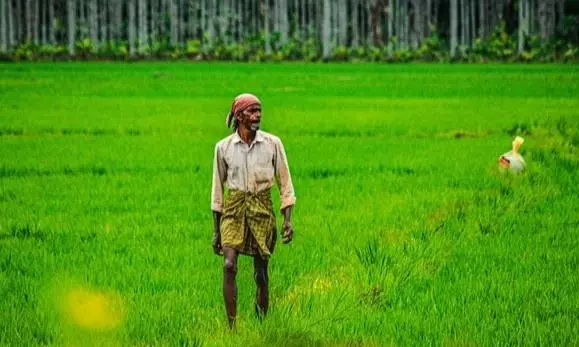
A recent communication from the Union government asking Kerala to review and withdraw the additional bonus it provides for paddy procurement has triggered fresh debate over Centre-state federal relations, fiscal autonomy, agricultural priorities, and environmental issues.
The issue surfaced after a letter from Union Expenditure Secretary Vumlunmang Vualnam to Kerala Chief Secretary A Jayathilak flagged concerns over state-level incentives that go beyond the Minimum Support Price (MSP), specifically citing Kerala’s paddy procurement bonus.
Additional bonus
If the additional bonus is indeed withdrawn, it could cut the price received by paddy farmers in Kerala by at least Rs 6.31 per kilogram, triggering fears of a sharp hit to farm incomes and the overall viability of paddy cultivation in the state. At present, the Centre pays Rs 23.69 per kg for paddy procurement, while Kerala provides an additional bonus of Rs 6.31 per kg, revised upward from Rs 5.20 last October.
The Union government’s environmental argument reflects a national policy shift that prioritises sustainability and crop diversification.
“Such a reduction could discourage farmers from continuing with rice farming, accelerate the shift away from paddy fields, and weaken local procurement systems that support food security and rural livelihoods. It may also have ripple effects on Kerala’s public distribution network and allied sectors that depend on a stable paddy economy,” observed Mohammed Lathif, a Thrissur-based cultivator and mill owner.
Also read: Should Punjab quit rice farming? Agri scientist Lather explains
Researchers and policy observers see the move as significant not merely for its administrative implications but for what it signals about the Centre’s approach to agriculture, food security and federal decision-making. Some who have already raised concerns argue that the suggestion must be read as a targeted intervention affecting Kerala’s long-standing procurement policy.
“The Union government has asked that the additional bonus given by the state for paddy procurement be reviewed and withdrawn. It must be seen as a direction pointed specifically at Kerala,” noted Gopakumar Mukundan, an adjunct faculty member of the Centre for Socio-economic and Environmental Studies (CSES), pointing to the copy of the official communication sent to the state.
Support to farmers
Kerala has for years offered an additional procurement bonus above MSP to sustain paddy cultivation in a state where agricultural costs are high, land availability is limited, and farmers face intense competition from urbanisation and real estate.
Why Kerala is giving a pushback
♦ Paddy cultivation is declining, not expanding, in Kerala
♦ Bonus sustains local food security and public distribution
♦ High costs make farming unviable without state support
♦ Paddy fields provide flood control and ecological benefits
♦ State autonomy over agriculture is being curtailed
The policy has been framed as both an economic support mechanism and a food security measure, ensuring local production feeds into the public distribution system (PDS) while preserving agricultural livelihoods.
Also read: TN paddy farmers unlearn traditional practices as climate change takes a toll
The Union government’s reasoning, as conveyed in the letter, reflects a broader policy argument. Incentives beyond MSP, it suggests, may artificially stimulate production of water-intensive crops such as paddy and wheat. This could lead to procurement levels exceeding buffer stock requirements, placing a financial burden on the public exchequer and complicating storage and distribution systems.
Environmental concerns are also flagged: groundwater depletion, higher fertiliser use and the ecological impact of crop residue burning are cited as risks linked to excessive cultivation of such crops.
In place of these incentives, the Union government has reportedly encouraged a shift towards millets and oilseeds, crops that require less water and align with national efforts to diversify agricultural production.
Safeguard measure
However, critics argue that applying this logic to Kerala ignores regional realities. Unlike the large agrarian states of North India, Kerala’s paddy cultivation has been shrinking for decades due to rising labour costs, fragmentation of land, and the conversion of fields for non-agricultural use. In that context, state incentives are seen not as drivers of surplus but as safeguards against total collapse of local production.
Also read: How a group of farmers in a Kerala village brought paddy back to unused fields
Gopakumar emphasised this contradiction, arguing that the logic of overproduction does not hold in Kerala’s case. “Providing a bonus above the MSP encourages paddy cultivation and increases production. The claim is that production beyond what is needed for public distribution and buffer norms becomes a burden. But the situation in Kerala is entirely different,” he said, pointing to the state’s dependence on imports of food grains from other regions.
Financial burden
Financial dimensions also complicate the debate. Over the past five years, Kerala is estimated to have spent around Rs 2,000 crore through additional bonuses and handling charges paid to farmers as part of its procurement policy. At the same time, the state reportedly has significant dues pending from the Union government under paddy procurement reimbursement mechanisms. According to Gopakumar, arrears of roughly Rs 1,300 crore remain unsettled.
States like Kerala argue that centrally designed frameworks often fail to accommodate regional diversity in agriculture. A uniform push against bonuses could affect states where farming survives largely due to targeted subsidies.
He warned that the new directive could effectively nullify those claims. “Kerala has at least Rs 1,300 crore pending in paddy procurement dues. There are signs that this could simply be written off or treated as a penalty,” he said, framing the move as both fiscal pressure and political signalling.
Centre-state friction
The political undertone is hard to ignore. Agricultural policy, particularly procurement and MSP-linked incentives, has long been a contested space between the Centre and states. While MSP is fixed centrally, states retain flexibility to offer bonuses or supplementary payments. Kerala has used this leeway to maintain paddy cultivation even as production costs outstrip returns.
The Union government’s environmental argument, meanwhile, reflects a national policy shift that prioritises sustainability and crop diversification. Promoting millets has been a flagship agenda, including global campaigns and policy incentives. Yet, critics note that environmental framing can sometimes be selectively deployed, especially when fiscal considerations and political alignments intersect.
Also read: Why the rice bowl in Kerala is shrinking
In Kerala’s case, paddy fields also serve ecological functions beyond food production. They act as flood buffers, groundwater recharge zones and biodiversity habitats. The decline of paddy cultivation has already been linked to increased flooding and ecological vulnerability in several parts of the state. Any policy move that discourages cultivation, analysts say, must account for these local environmental dynamics rather than rely solely on national metrics.
Federal balance
There is also the question of federal balance. States like Kerala have repeatedly argued that centrally designed frameworks often fail to accommodate regional diversity in agriculture. A uniform push against MSP-linked bonuses could disproportionately affect states where farming survives largely due to targeted subsidies.
"The Union government must also clarify whether this is a first step towards opening the market to American agricultural products as part of the Indo-US trade agreement. Such a move is being pushed even as the Union’s share of support due to paddy farmers is not being released on time" he added.
Fiscal control
The controversy also arises amid ongoing friction over fiscal transfers, pending reimbursements and borrowing limits imposed on Kerala. State officials have previously accused the Union government of constraining welfare and development spending through tighter fiscal controls, while the Centre has defended its stance as necessary for macroeconomic discipline.
Also read: TN govt to procure grade 'A' paddy at Rs 2,545 per quintal: Minister
For farmers, however, the debate is less ideological and more immediate. The additional bonus often determines whether paddy cultivation remains viable. Without it, many may shift permanently away from rice farming, accelerating trends that have already reduced the state’s cultivated paddy area over the past two decades.
Future of paddy cultivation
The outcome of this policy tug-of-war will likely shape not only procurement practices but also the future of paddy cultivation in the state. If incentives are curtailed without alternative support systems, the consequences could extend beyond farmers to the state’s food systems, environment and rural economy.
For now, the directive has opened a fresh chapter in the ongoing Centre–state debate over who decides how India farms, and at what cost