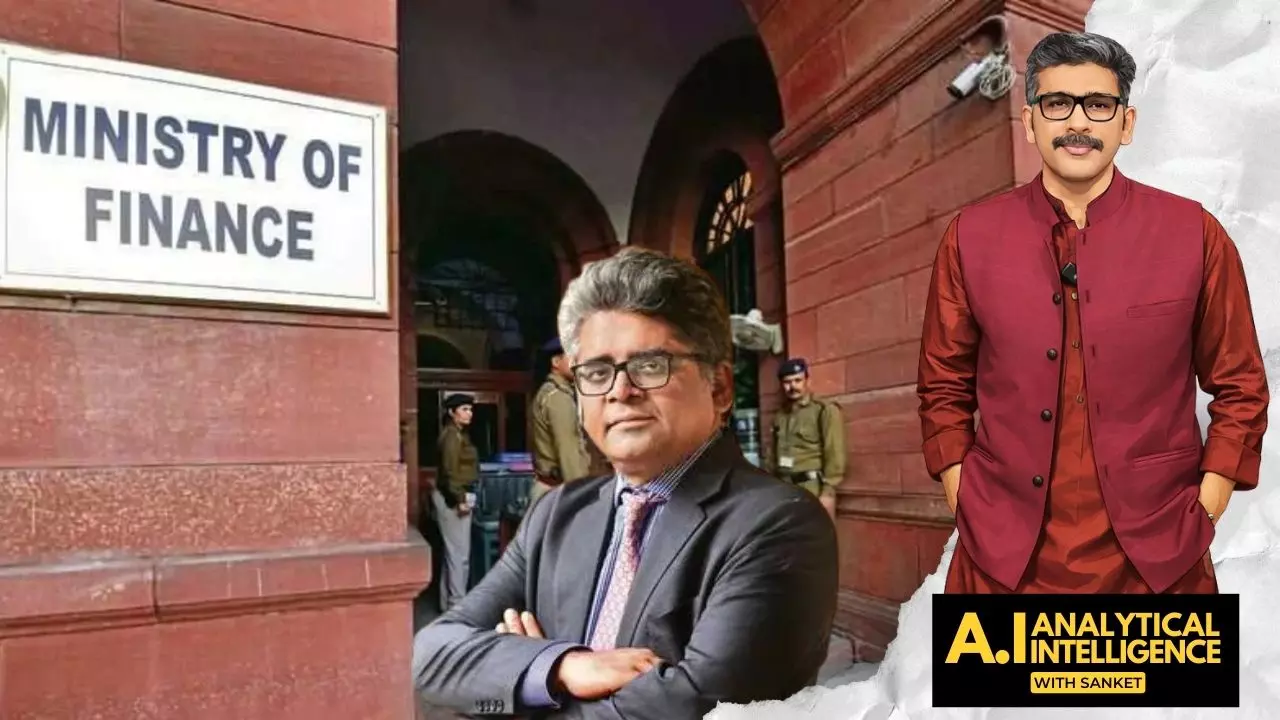
North-South divide goes far beyond fiscal formulas: Economist Rathin Roy
Economist speaks about the formation and duties of Finance Commissions, the 16th Commision report, and whether southern states have been shortchanged

India is facing an “existential political problem” as economic power lies in the South and West while political power is concentrated in the North and East, according to economist Rathin Roy. The latest Finance Commission has failed to even acknowledge this deeper imbalance, said Roy in an exclusive interview with The Federal.
Roy, a former member of the Prime Minister’s Economic Advisory Council, also spoke about what the Commission does, whether southern states have been shortchanged, and why the North–South divide now goes far beyond fiscal formulas.
Edited excerpts:
What exactly is the Finance Commission and what does it do?
The Finance Commission is an institution that is absolutely unique to India. I have seen nothing equivalent to it anywhere in the world. It is a constitutional body. It derives its legitimacy from Article 280 of the Constitution.
On a certain day, the government constitutes a technical body called the Finance Commission and gives it terms of reference. Constitutionally, its minimum job is to decide the disposition of what is called the divisible pool.
All major taxes—personal income tax, corporate income tax, GST, customs duties—belong to a pool called the divisible pool of taxes. These are available to both the Union and the states. Every five years, the Finance Commission decides how much the Centre should get and how much the states should get. Then, from the states’ share, it decides how much each state should get based on a formula it devises. That is its core function.
South Indians should ask themselves why, when labour is cheaper in North India, they do not invest there.
It also decides whether states should receive grants for specific purposes. The most important grant has been the revenue deficit grant. This is meant for states that genuinely do not have a fiscal base that allows them to provide basic services such as law and order, teachers, and doctors.
For example, Kerala has often received a revenue deficit grant because a large chunk of its income comes from remittances, which cannot be taxed. So Kerala may be rich, but the government does not benefit from that income.
Who collects these taxes and who is the custodian of the money?
It is not all taxes. It is all taxes that are constitutionally collected by the central government. For instance, in GST, there is central GST and state GST. State GST is collected by states and is not the business of the Finance Commission.
Income tax is collected by the Central government. In the Union Budget, you will see gross tax revenue—total taxes collected by the Centre—then ‘less share of states’, and the remainder is net tax revenue to the Centre. The money is dispatched from the central treasury to the states on a monthly basis.
Is the Finance Commission accountable to anyone?
The magic in this is that it exists only for five years. Once it submits its report—say on November 30—and it is tabled in Parliament, the Commission ceases to exist. The next day, there is no Finance Commission. So, neither the Centre nor the states can hold it to account because it no longer exists. It only recommends. The Centre can accept or reject parts of it. So far, the main recommendations on tax devolution have been accepted.
How are members appointed? Do states have a say?
The members are appointed by the President of India, which effectively means the Prime Minister and the Cabinet. The states have no say. Normally, the chairman is either a politician or an economist. We have had KC Neogy, KC Pant, YB Chavan, and several economists such as YV Reddy, Vijay Kelkar, NK Singh, and Arvind Panagariya.
Earlier, commissions ensured some regional balance. The 15th Commission had no member from southern or western India. This time too, the only representation from the South was a bureaucrat from Kerala who spent her career in the central government. I am not saying they favour the North, but optically it has not been healthy.
Has the 16th Finance Commission favoured the North over high-performing southern states like Tamil Nadu?
That depends on your political point of view. On vertical devolution, the states get 41% of total tax revenue; the Centre keeps 59%. At the same time, the Centre increasingly imposes cesses and surcharges—which it does not share with states. These were meant for exceptional purposes but have become permanent. For example, the Swachh Bharat cess, education cess, health cess. This reduces the effective share of states.
In addition, centrally sponsored schemes now require states to contribute more. Earlier, the Centre might pay 90% and states 10%. Now it is often 60% Centre, 40% states. So, all states have lost out to the Centre.
On horizontal devolution, three main components matter: inverse per capita income, area, and population. Inverse per capita income means poorer states get more. Population weightage shifted from the 1971 Census to the 2011 Census, which benefits northern and eastern states.
To balance that, a fertility indicator was introduced. This time, a contribution-to-GDP indicator was added to partly offset the inverse per capita income criterion.
As a result, the relative ranking remains the same—Uttar Pradesh and Bihar get the most—but they get slightly less than before. Kerala, Karnataka, Telangana, and Andhra Pradesh have gained slightly. Tamil Nadu’s share has remained constant.
But this Commission has abolished all grants to state governments. So in net terms, Tamil Nadu has lost. Others have partially gained in formula share but lost grants. Overall, southern states have lost, though less than under the previous Commission.
Is Tamil Nadu being punished for performing well? Is there a better way to distribute taxes?
This cannot be viewed purely as a technocratic question. If you believe in one person, one vote, then today we are doing an injustice to northern and eastern India because parliamentary seats are frozen based on older population figures. If delimitation happens, Uttar Pradesh and Bihar will have far greater political power.
The majority of India’s population lives in the North and East, and those regions are four times poorer than the South and West. Economic power lies in the South and West; political power lies in the North and East.
Earlier, there was a grand political bargain: the South benefited economically but accepted that resources would be transferred to the poorer North and East. Now, if delimitation gives permanent political dominance to the North and East, southern states are asking why they should continue to cross-subsidise.
Is this imbalance sustainable?
In my research, there have been only two countries in the 20th century where majority-population regions were significantly poorer than minority regions with economic power: the former USSR and the former Yugoslavia. Neither exists today. This is an existential question for India, not a squabble about fairness.
I was hoping the Finance Commission would pose this larger political problem and suggest possible pathways—like linking political delimitation to economic convergence. It did not. I believe it failed in its historic responsibility to even pose the problem.
Should such a political issue even be the mandate of the Finance Commission?
It cannot solve the problem. But technical bodies in public service must look at political reality. As a constitutional body, it had the responsibility to at least raise the central question troubling the Union today. It has not failed to solve the problem; it has failed to even pose it.
What should southern states reflect on?
South Indians should not worry only about the North. They should ask themselves why, when labour is cheaper in North India, they do not invest there. When people from Uttar Pradesh or Bihar come to southern states, they are called migrant labour and confined to informal jobs. Why are they not being absorbed in ways that raise productivity?
If you are going to live in a federation, inclusive and egalitarian growth across India is in everyone’s interest. Simply saying ‘I collect more taxes’ will not solve your problem. They have more political power. You will have to buy that off harmoniously.
The content above has been transcribed from video using a fine-tuned AI model. To ensure accuracy, quality, and editorial integrity, we employ a Human-In-The-Loop (HITL) process. While AI assists in creating the initial draft, our experienced editorial team carefully reviews, edits, and refines the content before publication. At The Federal, we combine the efficiency of AI with the expertise of human editors to deliver reliable and insightful journalism.