








South’s economic weight must match its political voice: Shivakumar at CMs’ meet
Karnataka, Keralam, Andhra CM attend Southern Zonal Council; Puducherry CM skips Tamil Nadu-hosted event

The 31st meeting of the Southern Zonal Council that kicked off on Thursday (August 20) under the chairmanship of Union Home Minister Amit Shah brings together leaders from southern states and Union territories, with key deliberations expected on long-running problems that cut across borders, from river water shares to drug smuggling and law-and-order coordination.
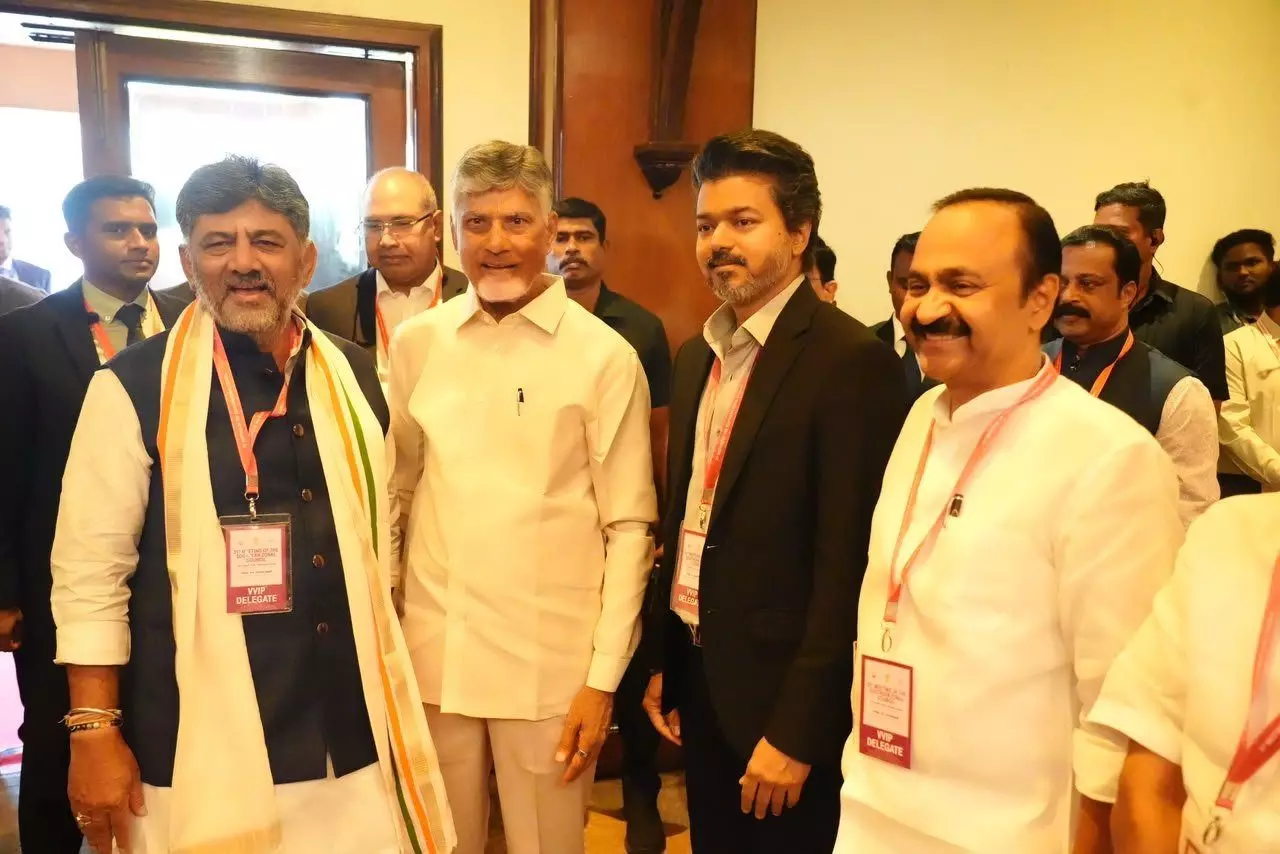
Tamil Nadu Chief Minister C Joseph Vijay, who is acting as vice-chairman for the meeting, welcomed Shah, his southern counterparts and senior officials. Vijay and Karnataka Chief Minister DK Shivakumar sat side by side during the talks. The full group later shared lunch with the home minister at the hotel.
Karnataka, Keralam, Andhra CM attend event
Besides Shivakumar, chief ministers of Keralam VD Satheesan and Andhra Pradesh N Chandrababu Naidu are also attending the event. Telangana’s Deputy Chief Minister Mallu Bhatti Vikramarka is representing the state as Chief Minister A Revanth Reddy is visiting Delhi.
Also read: Vijay positions himself as voice of South after TN Assembly's anti-delimitation move
Officials from the Andaman and Nicobar Islands and Lakshadweep are also attending the event.
Puducherry Chief Minister N Rangasamy skipped the meeting. The territory’s Lieutenant Governor Kailashnathan is attending the event. Rangasamy’s boycott is linked to ongoing friction over power-sharing and portfolios in his alliance with the BJP, and the long-standing demand for full statehood for Puducherry.
DSK seeks more central funds, delimitation assurance
Stressing that Karnataka is the second-largest contributor to India’s GST, Chief Minister Shivakumar urged the Centre to incentive its competent growth and revenue generating capacity by restoring the state’s full share of central grant to 4.7 per cent.
He also called upon the Union government to do justice to the state through “additional central projects like the Bengaluru-Mumbai high-speed rail project, STRR South, AIIMS for Raichur and a special package for Kalyana Karnataka.”
Shivakumar also urged the Centre to assure the southern states that the delimitation of parliamentary constituencies will not eat into their seats.
Also read: Reporters Take: How Southern states are reacting to delimitation debate | AI With Sanket
“The South answered the nation's call and controlled its population with discipline and success. That success must never become the reason to make our voice smaller. Our economic weight must be matched with political voice. Our share of representation cannot be reduced, in absolute numbers or in proportion,” he said.
The issue of delimitation is a major concern shared by southern states which have kept their population growth lower through family planning. They fear that future seat adjustments based purely on population numbers could reduce their voice in Parliament relative to northern states. Leaders want assurances that the process will not penalise them for better population control.
Why did Nehru push for southern collective?
Last night, Vijay met Shah for about five minutes in Chennai. Officials described the short conversation as a positive exchange of views ahead of Thursday’s discussions.
The Southern Zonal Council is one of five such bodies created under the States Reorganisation Act of 1956. India’s first prime minister, Jawaharlal Nehru, pushed for these councils after states were redrawn largely along language lines. The idea was simple: give neighbouring states a regular place to talk, settle disputes and work together on common problems so regional tensions would not grow.
Also read/watch: Will South lose political power with delimitation? | The Perspective
The Southern Council covers Andhra Pradesh, Karnataka, Keralam, Tamil Nadu and Telangana, plus the Union territories of Puducherry, Andaman and Nicobar Islands and Lakshadweep. The Union home minister chairs every meeting. The host state’s chief minister serves as vice-chairman on a rotating basis. Recommendations from the council are advisory, but the forum has helped resolve many practical issues over the years.
Last conclave resolved 9 issues
Earlier meetings followed a similar pattern. The 27th was held in Thiruvananthapuram, Keralam, on December 28, 2016. The 28th took place in Bengaluru on September 18, 2018. The 29th was in Tirupati, Andhra Pradesh, on November 14, 2021. The 30th returned to Thiruvananthapuram on September 3, 2022, also chaired by Shah. In the last meeting, leaders discussed 26 issues; nine were settled and the rest were kept for further talks, including several linked to the division of Andhra Pradesh and Telangana.Talks on Cauvery, Andhra division likely
River water remains the most sensitive topic. Tamil Nadu and Karnataka have clashed for decades over the Cauvery river water. Court rulings and a special authority set the annual shares, but shortages during dry years still lead to arguments.
Karnataka wants to build a balancing reservoir at Mekedatu to store water for Bengaluru’s drinking needs and to manage releases better. Tamil Nadu strongly opposes the project, saying it could reduce the flow of water that its farmers depend on downstream. Vijay is expected to raise both the Cauvery sharing formula and the Mekedatu issue in his welcome remarks, pointing to existing court judgments.
Also read: Delimitation explained: Will 2029 Lok Sabha elections tilt against southern states?
Andhra Pradesh Chief Minister Naidu plans to highlight unfinished business from the 2014 split of the old Andhra Pradesh into two states. These include the division of government institutions, assets, liabilities and pending money matters, plus funding for projects such as ports, metro lines and railway links promised under the reorganisation law.
Tamil Nadu is also seeking seven ready-to-use “plug-and-play” industrial parks under a central scheme so factories can start operations quickly. The state wants more central money for metro rail and other big development projects. Cooperation against drug trafficking and better coordination on law and order are other items expected to be discussed. Southern states share long coastlines and borders, making joint action against smuggling networks especially important.
The meeting is scheduled to last around four hours. After the talks, Shah is expected to visit the Shore Temple in Mamallapuram.