








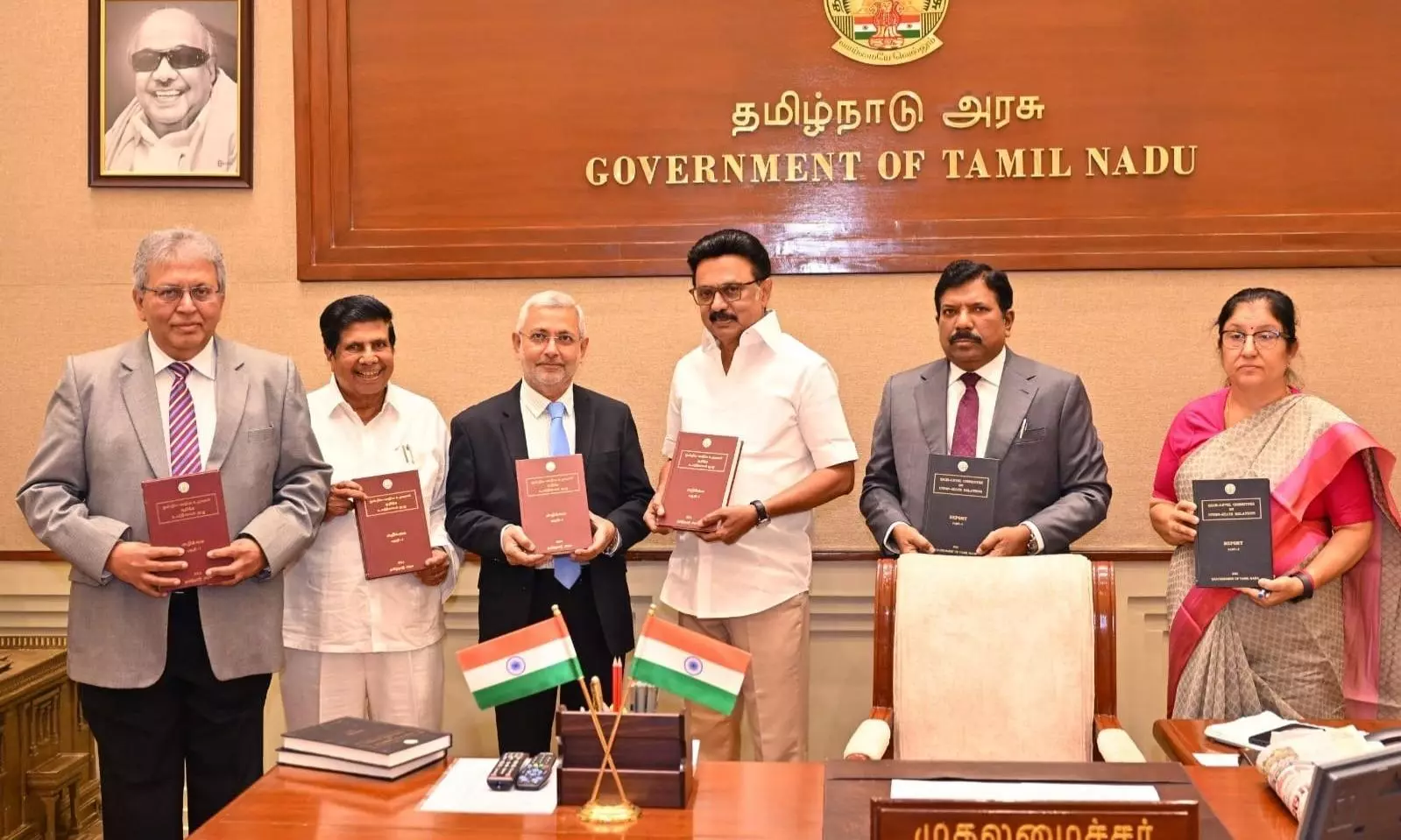
Stalin demands federal overhaul, pushes for constitutional reforms
Tamil Nadu CM tables landmark report in state Assembly, calling for constitutional amendments to restore state autonomy and rebalance India's power structure

Tamil Nadu Chief Minister MK Stalin on Wednesday (February 18) tabled a report in the state Assembly demanding sweeping constitutional amendments, and a fundamental reboot of how power is shared between New Delhi and the states.
Presenting the first part of a report submitted by a high-level committee on Centre-State relations, Stalin said such reforms are needed to restore “true federalism” and grant greater autonomy to states. He accused the Union government of adopting an “autocratic mindset”, disregarding state governments and forcing them to depend on Central benevolence for funds and approvals.
Stalin stressed that federalism is not a concession but a protective shield for the nation. He urged open-minded debate on the report to restore balance in Centre-State relations.
The high-level committee, headed by retired Supreme Court Justice Kurian Joseph and including former IAS officer Ashok Vardhan Shetty and former State Planning Commission Vice-Chairman Prof M Naganathan, submitted its report on Monday. The panel had been constituted by the Stalin government last April to examine Union-state relations and recommend measures to secure the autonomy of states.
Also read | Centre's debts, interest soar even as it deflects blame onto states
The 387-page report touches on 10 issues, including the role of the Governor, language policy, elections, delimitation, healthcare, GST reforms, and education.
Power struggle
“How long must states remain in the position of begging?” he asked in the Assembly today, amid thumping of desks by ruling party members. He declared that the only lasting solution to the erosion of state rights is enhanced state autonomy, achievable solely through amendments to the Constitution.
Stalin emphasised that the Union government currently holds disproportionate power, progressively shifting subjects from the State List to the Concurrent List and using financial levers to compel compliance. He alleged inadequate devolution of funds to progressive states, imposition of Hindi, delays in disaster relief, and threats of delimitation as examples of central overreach.
“The only medicine for the crises Tamil Nadu is facing from GST to financial strangulation is state autonomy,” he declared.
Stalin further stressed that strong states make a strong union and that federalism is not a concession but a protective shield for the nation. He urged open-minded debate on the report to restore balance in Centre-State relations.
Funding as leverage
Political analysts and commentators welcomed the move as timely. Writer Aazhi Senthilnathan said genuine federalism is indispensable for India’s democratic growth, pointing out that the Centre often encroaches on state subjects and uses funding as leverage.
Watch/Read | North-South divide goes far beyond fiscal formulas: Economist Rathin Roy
“Each state must have the right to frame laws and schemes suited to its people. Protecting the soil is the Centre’s duty; protecting the people is the state’s duty,” he said, quoting Dravidian icon and former Tamil Nadu Chief Minister CN Annadurai.
VCK MP D Ravikumar noted that state powers have been steadily eroded by both Congress and BJP governments over 75 years. He cited the shifting of education to the Concurrent List under Indira Gandhi and recent attempts to link education funding to the acceptance of Hindi. He urged legal action in the Supreme Court and pressure on national parties, especially the Congress, to commit to returning subjects like education to the State List.
State-local body relations
Senior BJP leader Tamilisai Soundararajan criticised Stalin, accusing him of hypocrisy for delaying rural local body elections in 27 districts for over a year while speaking of autonomy. She claimed the DMK raises the issue only when facing electoral setbacks and alleged that the Centre treats all states equitably.
The 387-page report touches on 10 issues, including the role of the Governor, language policy, elections, delimitation, healthcare, GST reforms, and education.
Meanwhile, Tamil Nadu Congress president Selvaperunthagai welcomed Stalin's statement, calling it “essential for the present times”. Observers viewed this as a sign that the DMK-Congress alliance remains intact despite recent strains.
Decades-long push
The demand for greater state autonomy has been a cornerstone of Tamil Nadu’s political discourse since the 1960s. In 1963, Annadurai raised the issue forcefully in Parliament. In 1969, then Chief Minister M Karunanidhi, Stalin's father, constituted the Rajamannar Committee comprising retired Justice PV Rajamannar, A Lakshmanaswami Mudaliar and P Chandra Reddy, to examine Centre-State relations.
Also read | Centre push to scrap Kerala paddy bonus triggers federal backlash
The committee submitted its landmark report in 1971, recommending significant devolution of powers. Subsequent central commissions — Sarkaria (1983), Venkatachaliah (2000) and Punchhi (2004) — made recommendations, but little substantive change followed.
Stalin’s initiative revives this decades-old struggle in the context of what the DMK sees as unprecedented centralisation under the present BJP-led government. Today, he thanked the committee members and announced that copies of the report would be sent to political parties across India to build broader support for constitutional reform.
