Danam Nagender case: What SC’s refusal to intervene means for Telangana defections
Ruling clarifies when a legislator can be disqualified for voluntarily giving up party membership and when courts can step in after a Speaker’s decision

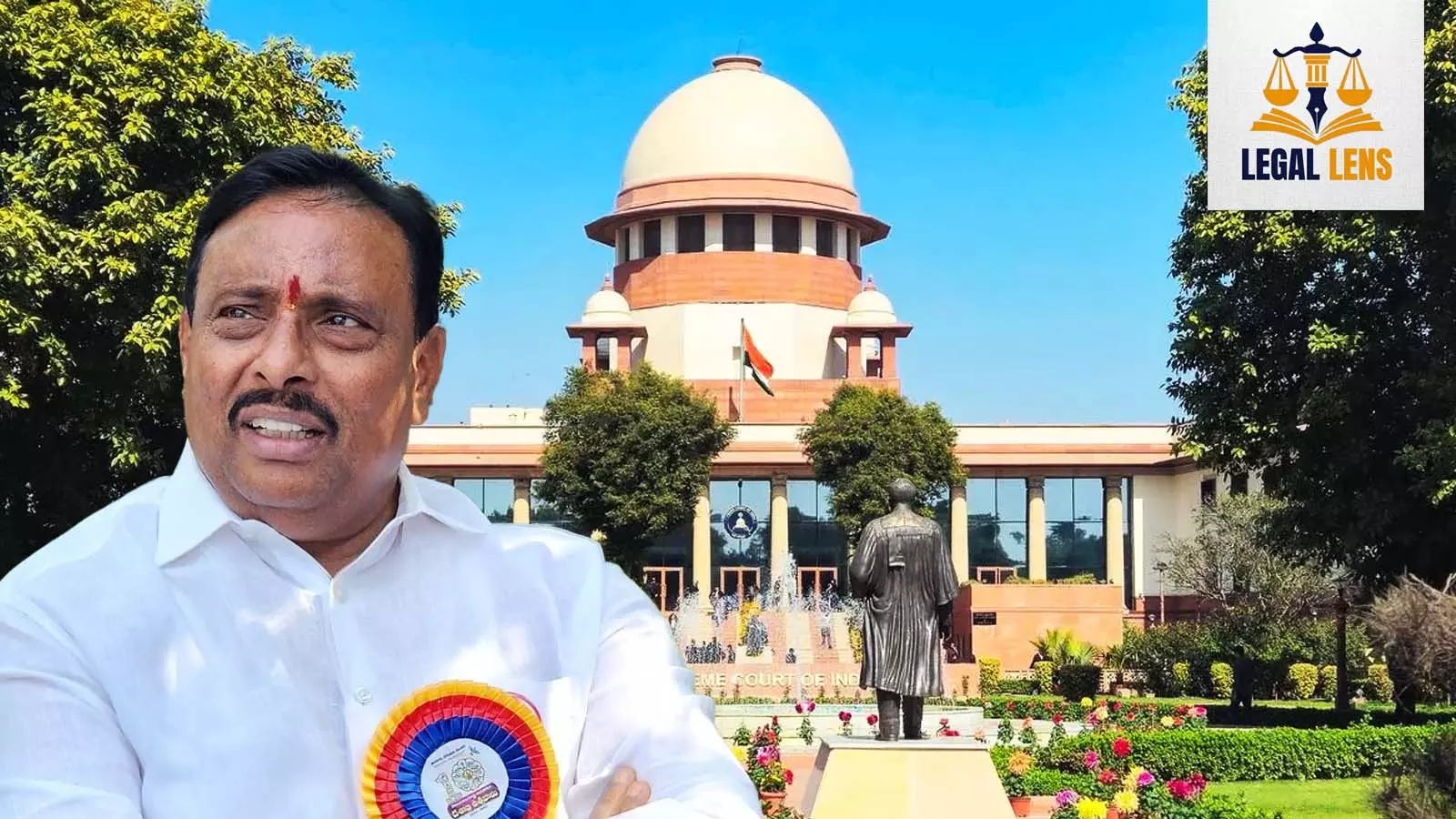
The Supreme Court’s refusal to interfere leaves intact a ruling that says contesting an election on another party’s ticket can trigger disqualification. (Inset) Danam Nagender
The Supreme Court’s September 24 refusal to interfere with Danam Nagender’s disqualification has left intact a Telangana High Court ruling that goes beyond the fate of one legislator. It clarifies the difference between defying a party whip and abandoning the party itself, and shows how far judicial review can travel once a Speaker has actually decided an anti-defection case.
Nagender was elected from Khairatabad in December 2023 as a Bharat Rashtra Samithi (BRS) Member of the Legislative Assembly (MLA).
On April 23, 2024, while retaining that seat, he filed his nomination to contest the Secunderabad Lok Sabha constituency as a Congress candidate.
Also read: Telangana Speaker’s actions test anti-defection law’s evidentiary limits
Speaker Gaddam Prasad Kumar rejected two petitions seeking his disqualification on March 11, 2026. On September 18, a Division Bench of the Telangana High Court comprising Chief Justice Aparesh Kumar Singh and Justice GM Mohiuddin set aside the Speaker’s decision and declared Nagender disqualified from April 23, 2024, holding the Khairatabad seat vacant.
Nagender challenged that ruling in the Supreme Court. A three-judge Bench led by Chief Justice of India Surya Kant, with Justices Joymalya Bagchi and V Mohana, dismissed his Special Leave Petition on September 24, saying during the hearing that it saw no ground to interfere.
Why was Nagender’s case clear?
Paragraph 2(1)(a) of the Tenth Schedule disqualifies a legislator who “voluntarily gives up” membership of the political party on whose ticket he or she was elected. A resignation letter is unnecessary because abandonment of membership may be inferred from conduct.
Nagender’s case required relatively little inference. His statutory Form 26 affidavit and official election records showed that he had contested the 2024 Lok Sabha election as a Congress candidate while holding an Assembly seat won on a BRS ticket. He did not dispute those facts. The High Court called the Form 26 affidavit “unimpeachable evidence” and held that contesting as the Congress candidate was sufficient to attract Paragraph 2(1)(a).
Also read: Telangana: BRS to move SC over rising defections to Congress
The Court relied on Dr Mahachandra Prasad Singh v Chairman, Bihar Legislative Council (2004). There, a Congress member of the Bihar Legislative Council contested a Lok Sabha election as an independent candidate. The Supreme Court upheld his disqualification, recognising that such conduct could amount to voluntarily giving up party membership even without a formal resignation.
This was important because the Speaker had reasoned, among other things, that Nagender’s political conduct outside the Assembly did not by itself trigger disqualification. The High Court rejected that approach. Paragraph 2(1)(a) asks whether the legislator’s conduct shows voluntary abandonment of the original party; it is not confined to conduct on the floor of the House.
‘Return to BRS’ argument
A new argument surfaced prominently in the Supreme Court. Senior advocate Mukul Rohatgi, appearing for Nagender, said that Nagender had subsequently joined back the BRS and relied on the Tenth Schedule’s provision permitting a political party to condone certain conduct.
That factual claim was disputed. The BRS side told the Court that Nagender’s assertion that he had rejoined the party was “factually incorrect”. P Mohith Rao, advocate-on-record for BRS MLA Padi Kaushik Reddy, had filed a caveat seeking a hearing before any relief was granted to Nagender. Senior advocate Mahesh Jethmalani appeared for BJP MLA Alleti Maheshwar Reddy, the other petitioner who had challenged the Speaker’s decision.
The High Court record itself does not identify a formal date on which Nagender rejoined the BRS. Instead, it records material placed by the petitioners showing that as late as December 24 and December 26, 2025, he had publicly said that he continued to remain in the Congress. In January 2026, Nagender’s defence before the Speaker was that he had never legally given up BRS membership.
Also read: How the anti-defection law lost its bite, and why Tamil Nadu will prove it
The Supreme Court, therefore, did not need to decide when, or even whether, he had actually returned. It addressed the legal consequence of the argument. The Bench pointed out that the 15-day condonation provision appears in Paragraph 2(1)(b), which concerns voting or abstaining contrary to a party direction. Paragraph 2(1)(a), dealing with voluntarily giving up party membership, contains no comparable route to cure the disqualification.
Justice Mohana summed up the distinction in an oral observation: “Back to the party. Not to the Assembly.” A party may politically readmit a legislator, but that act does not by itself restore membership of the House if disqualification under Paragraph 2(1)(a) had already been incurred.
Why did the High Court disqualify him itself?
Once the High Court found the Speaker’s decision unsustainable, it could have sent the case back for reconsideration. It declined to do so. The disqualification proceedings had already lasted more than a year and a half, and almost three years of the Assembly’s five-year term had elapsed.
Relying on Rajendra Singh Rana v Swami Prasad Maurya (2007), the High Court held that another remand would prolong a dispute whose decisive facts were already established. It therefore declared Nagender disqualified from April 23, 2024.
Also read: Tamil Nadu bypolls will put political defections to the voter test
This gives the Telangana litigation an unusual sequence. In Padi Kaushik Reddy v State of Telangana (2025), the Supreme Court had declined to decide the disqualification petitions in the first instance. It held that the Speaker should make the initial determination and directed him to do so within three months. The Speaker eventually ruled in Nagender’s favour. The High Court then reviewed that completed decision, set it aside and substituted the result. The Supreme Court has now declined to interfere.
The immediate consequence is clear: the High Court ruling stands and Nagender remains disqualified from April 23, 2024.
What does it mean for the other Telangana cases?
Nagender’s case had unusually strong documentary evidence. Other legislators accused of crossing over may present harder questions because their cases can depend on photographs, public appearances, campaign activity, statements and other conduct from which a change of allegiance must be inferred.
The High Court ruling nevertheless supplies a significant framework. Conduct outside the Assembly can establish voluntary abandonment under Paragraph 2(1)(a); a formal resignation is unnecessary; later conduct by the original party cannot undo a disqualification already incurred; and courts can, in an appropriate case, substitute the Speaker’s decision rather than prolong the dispute through another remand.
The larger institutional issue also survives. In Padi Kaushik Reddy (2025), the Supreme Court noted that Parliament had entrusted defection disputes to Speakers partly because it wanted speedy decisions, and asked Parliament to consider whether that arrangement was still serving the purpose of effectively combating political defections.
Telangana illustrates the concern in two stages. Courts first intervened because the Speaker had not decided the petitions. They then reviewed what he eventually decided. In Nagender’s case, the High Court supplied its own answer and the Supreme Court has left that result in place.
The remaining cases will show how far the same reasoning travels when the evidence of changing political allegiance is less formal than filing a nomination paper on another party’s ticket.