Appointment dispute and internal dissent: EC faces a checks-and-balances question
As the Supreme Court weighs checks on appointments, internal dissent within the EC raises a parallel question: Who checks power once Commissioners take office?

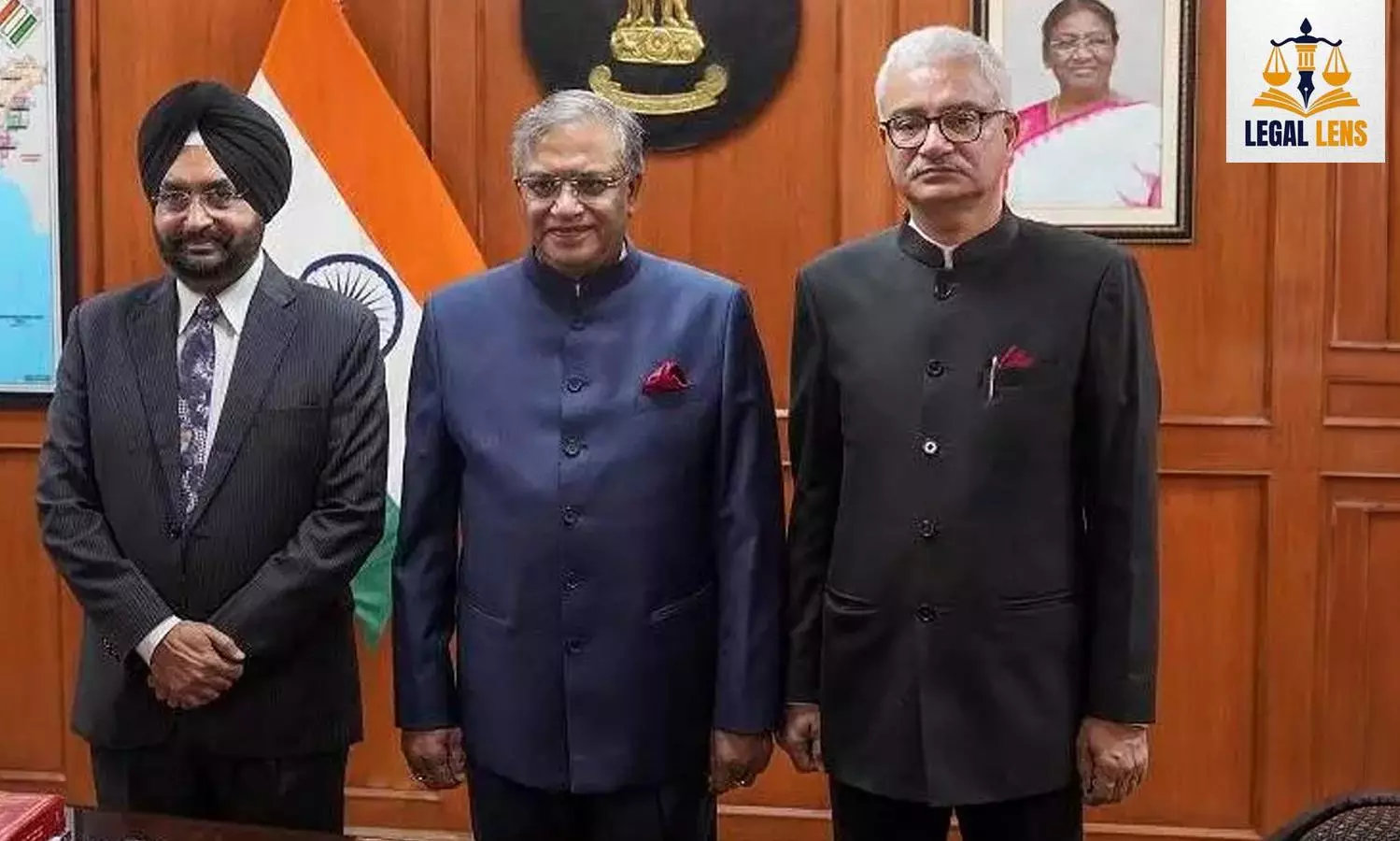
Two developments on Wednesday (September 23) raised the same underlying question about the Election Commission of India (EC) from different directions: What checks are needed to prevent power over elections from becoming concentrated?
In the Supreme Court, Justices Dipankar Datta and Satish Chandra Sharma disagreed over whether the challenge to the 2023 law governing appointments of the Chief Election Commissioner (CEC) and Election Commissioners required a five-judge Constitution Bench. Because of that split, they jointly sent the papers to Chief Justice of India (CJI) Surya Kant to consider constituting a Constitution Bench rather than first sending the case to three judges. They said an intermediate reference would only delay a decision on the larger issue.
On the same day, an Indian Express investigation reported that Election Commissioners Sukhbir Singh Sandhu and Vivek Joshi had recorded objections at least 14 times over 10 months to actions that, according to their notes, were taken without their knowledge or contrary to their views. The disagreements concerned voter registration and deletion, electoral-roll software and other matters at the heart of the Commission’s work.
The two controversies are legally separate but institutionally connected. The Supreme Court case concerns the check on executive influence when Commissioners are chosen. The reported disagreements concern the checks operating inside the three-member EC after they have been appointed.
Is the SC case really about keeping CJI on selection panel?
The uploaded judgement shows why the issue is more complicated.
In Anoop Baranwal v Union of India in 2023, a five-judge Constitution Bench directed that until Parliament enacted a law, the CEC and ECs should be selected by a committee comprising the Prime Minister, Leader of the Opposition in the Lok Sabha, and the CJI.
Parliament subsequently enacted the Chief Election Commissioner and Other Election Commissioners (Appointment, Conditions of Service and Term of Office) Act, 2023. Its selection committee comprises the Prime Minister, the Leader of the Opposition, and a Union Cabinet Minister nominated by the Prime Minister. The CJI, therefore, disappeared from the selection process.
Also read: EC SIR row: INDIA bloc gets ammunition, but Modi govt may brazen it out
Justice Datta’s opinion makes an important distinction. He accepted, at least prima facie, that Parliament was free to depart from the precise arrangement created in Anoop Baranwal. The three-member committee including the CJI was an interim measure meant to last only until Parliament legislated.
But another part of Anoop Baranwal, he said, continues to bind: The EC’s independence is integral to free and fair elections and the appointments process must be insulated from exclusive executive control. The real question, therefore, becomes whether the mechanism Parliament chose satisfies that constitutional standard.
This shifts the focus away from the identity of the third selector. The Constitutional concern is whether the selection process contains an effective check on the government of the day.
Why did Justice Datta question the present system?
The Prime Minister occupies one place on the selection committee and nominates the Cabinet minister who occupies another. The Leader of the Opposition holds the third seat.
Justice Datta questioned how much of a counterweight the second executive member can provide. A Cabinet minister, he reasoned, is bound by the principle of collective responsibility and could hardly be expected to oppose the Prime Minister who nominated him to the committee.
Also read: EC’s 'Detect, Delete, Deport' SIR exercise lands India in a quagmire
The result, according to his prima facie view, is that the Cabinet minister may merely echo the Prime Minister, leaving the Leader of the Opposition’s presence largely “ornamental”. At this preliminary stage, Justice Datta found substance in the argument that giving the executive two of the three seats on the selection committee leaves no effective independent counterweight and could undermine public confidence in the EC’s independence. His concern was that even if the Commissioners eventually appointed are independent and persons of integrity, a selection process dominated by the executive may still fail to inspire public confidence because it lacks a genuinely neutral third member.
Justice Datta saw no need for a larger Bench to decide the issue, but Justice Sharma took the opposite view and held that the challenge should be heard by a Constitution Bench. He said whether Parliament was justified in creating a selection committee without a neutral selector was itself an important constitutional question that the Supreme Court had never authoritatively decided. That, in his view, required a Constitution Bench under Article 145(3).
Where does the rift within the EC fit in?
The Indian Express investigation concerns a different stage of institutional independence.
It reported that Sandhu and Joshi objected to steps involving changes to Form 6 for new voters, centralised control over electoral-roll systems, voter deletion and restoration, and other aspects of the Special Intensive Revision (SIR) of electoral rolls. In one instance concerning Form 6, the two Commissioners reportedly called a change “illegal” and “unauthorised” and sought its immediate removal.
The EC has responded that individual members routinely make observations and suggestions during deliberations and that all its final decisions, including those relating to the SIR, were unanimous. It described such exchanges as part of the internal checks and balances of a multi-member constitutional body.
Also read: SC flags ‘mechanical’ SIR notices in Delhi, asks Election Commission to add safeguards
That response makes the distinction between disagreement and decision-making important.
The law itself anticipates disagreement among Commissioners. Section 18 of the 2023 Act says that the procedure for transacting business and the allocation of business among the CEC and ECs must be decided unanimously. Other business should, as far as possible, also be unanimous, but where the Commissioners differ, the majority decides.
In a three-member EC, therefore, dissent can be part of normal institutional functioning. The more significant question raised by the Indian Express documents is whether matters on which the Commissioners objected were properly brought into that collective decision-making process before action was taken.
The EC maintains that its final decisions were unanimous. The internal notes reported by the Indian Express raise questions about what happened before some of those final decisions. Establishing the position in individual cases would require examining the relevant files, approvals and chronology.
Does internal rift prove anything about appointments law?
It actually introduces a complication.
Sandhu and Joshi themselves entered the EC through the appointment system now under Constitutional challenge. Yet the documents reported by the Indian Express indicate that they were prepared to disagree and place their objections on record.
That makes it difficult to draw a straight line from the method of appointment to the conduct of individual Commissioners.
Also read: Mass voter deletions during SIR: ‘Not voters’ responsibility to prove they are voters’
The more useful distinction is between independence at appointment and independence in functioning.
The first concerns whether those conducting elections are selected through a process containing sufficient distance from the government that contests those elections.
The second concerns how the institution works after its members take office: whether Commissioners receive the same information, whether consequential matters reach all three of them, how responsibilities are allocated, whether dissent is recorded and whether disagreements are ultimately resolved by the EC as a collective body.
One safeguard cannot substitute entirely for the other.
Why do the two developments matter together?
Justice Datta repeatedly returns in his opinion to the need for checks on power. Drawing on BR Ambedkar’s description of democracy as requiring a “veto” on authority, he examines whether the appointment mechanism contains an adequate counterweight to the executive.
The reported disagreements within the EC bring a similar question into its internal functioning. A three-member EC itself creates a form of institutional check because the CEC does not exercise the EC’s powers alone. Section 18 reinforces that structure by providing for collective decision-making and, where necessary, majority rule.
Also read: Why SY Quraishi has questions on basic premise and legal standing of SIR
This is where Wednesday’s two stories meet.
The case heading towards a larger Bench will examine the architecture outside Nirvachan Sadan—who should have how much influence over choosing the electoral referees. The controversy within Nirvachan Sadan concerns the architecture inside it: Whether authority is actually shared among the three people chosen to perform that role.
The appointment process and internal functioning raise distinct legal questions, but both ultimately concern the same constitutional objective: Ensuring that an institution with enormous power over elections has effective checks on the concentration of authority.