Election Commission's transfer puzzle: Is India's federalism at risk?
Legal Lens | As the SC declines to halt mass transfers in Bengal, it leaves open a vital constitutional question: Can the EC overturn state cadre without consulting the local govt?

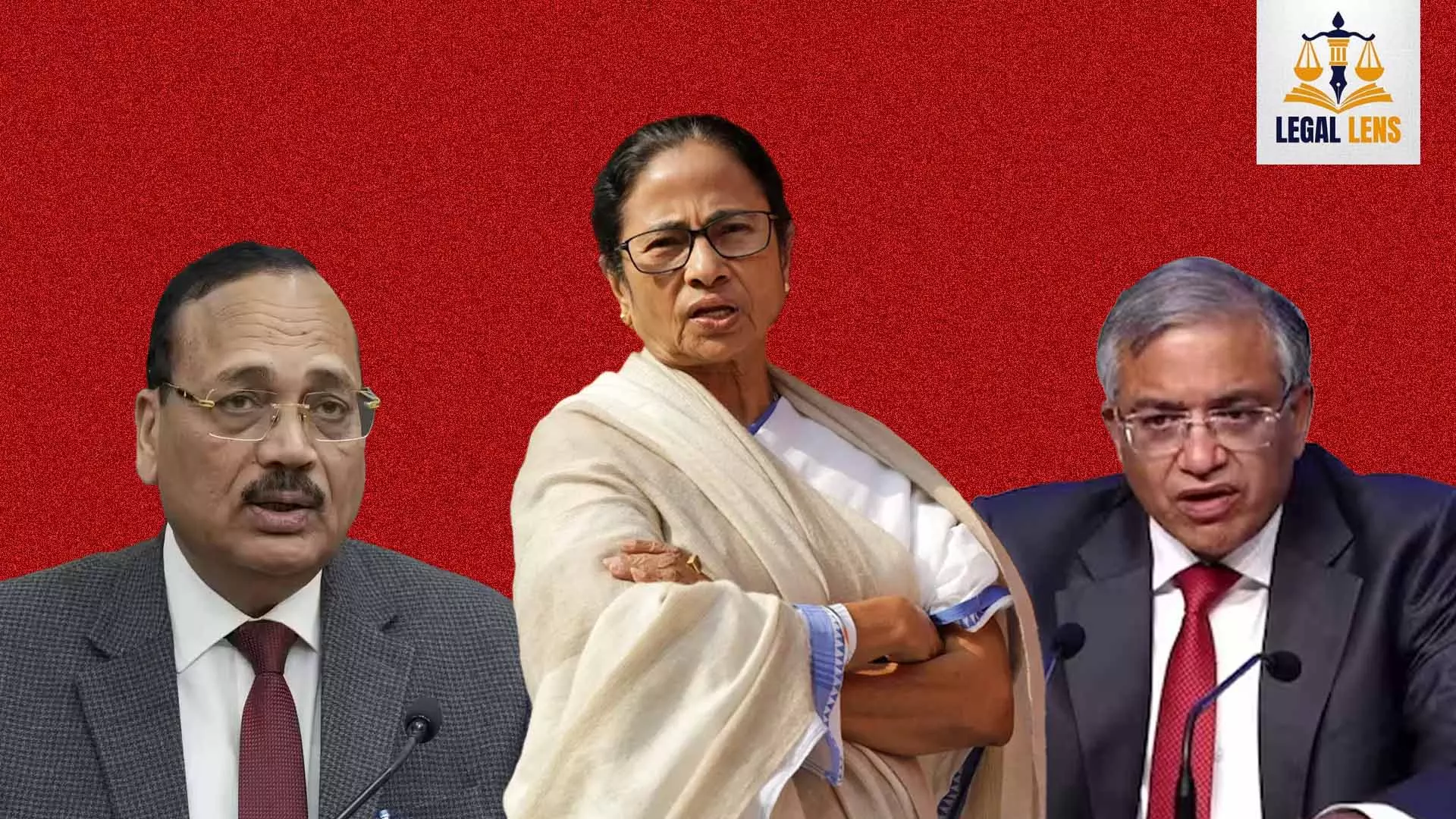
The Supreme Court has moved cautiously as the West Bengal government and the Election Commission fought fiercely over several issues ahead of the state's 2026 elections.
On April 16, Chief Justice Surya Kant, with Justices Joymalya Bagchi and Vipul Pancholi, dismissed advocate Arka Kumar Nag's appeal, which challenged the mass transfer of IAS and IPS officers in West Bengal by the Election Commission (EC).
The Bench refused to interfere on the eve of polling. But it expressly kept open a larger question. Can the EC, relying on Article 324 of the Indian Constitution, overturn a state cadre without consulting the state government?
Also read: Why the rejection of motion against CEC Gyanesh Kumar is problematic
The answer will matter far beyond Bengal. Tamil Nadu, Kerala, Assam and Puducherry are also at the polls. Telangana and Karnataka will follow. Each will inherit the fault line the Bench left unhealed.
The scale of the exercise in Bengal is unusual. The EC announced the Assembly schedule on March 15. Since then, it has ordered the transfer of the chief secretary, the director general of police (DGP), the home secretary and the Kolkata Police commissioner. Several district magistrates, superintendents of police and more than 1,000 other officers have followed.
Hindustan Times reported that Bengal's figure was roughly 21 times the combined total for Assam, Kerala and Tamil Nadu. In 2021, only 15 officers were shifted in that state. The comparison is the evidentiary heart of the petitioner's case.
Calcutta HC refuses to intervene
The Calcutta High Court had refused to interfere on March 31. Chief Justice Sujoy Paul and Justice Partha Sarathi Sen held that no public injury had been shown. They read the petitioner's own pleadings as conceding the EC's power to transfer officers after a poll notification.
Individual officers could move their own forum, the Bench said. But a public interest litigation required demonstrable harm.
The state suspects every officer posted by the EC. The EC suspects every officer retained by the state. Between these suspicions, the neutral civil service becomes an orphan.
That framing controlled the Supreme Court's reasoning too. CJI Kant remarked that such transfers were common and routine. An observer from outside the state, he added, was always the ideal. Senior advocate Kalyan Banerjee, appearing for Nag, said he was not pressing for a stay of the polls. He asked only that the question of law be preserved.
The Bench agreed.
The question, stripped of rhetoric, is narrow and important. Article 324 of the Constitution vests in the EC the superintendence, direction and control of elections. In Mohinder Singh Gill v Chief Election Commissioner (1978), Justice V R Krishna Iyer described this as a "reservoir of power".
Also read: Women's reservation is finally coming, but the formula carries its own tension
But he also built a dam. The reservoir, the court held, operates only where Parliament or a state legislature has not legislated. Where a law is in force, the EC must act in conformity with it. Unchecked power, Krishna Iyer wrote, is alien to our constitutional scheme.
Transfers of All India Services officers are not an unlegislated field. Article 312 of the Constitution created the All India Services. The Indian Administrative Service (Cadre) Rules 1954 and their IPS counterparts govern deputation.
An officer may be deputed outside the cadre only with the concurrence of the state government. The state is the employer for disciplinary and posting purposes. The Union is the cadre-controlling authority. Neither can act unilaterally without consulting the other.
The Representation of the People Act, 1950, and its 1951 companion occupy the adjacent statutory ground. Section 13CC of the 1950 Act covers the electoral roll machinery. Section 28A of the 1951 Act covers returning, presiding and polling officers. Both provisions deem specified officers to be on deputation to the EC for the election period.
Each presumes a prior act of placement on election duty. Neither converts the EC into a cadre-controlling authority for the state's administrative machinery at large.
Banerjee's submission rested on this architecture. The EC cannot, in the exercise of superintendence, override the Cadre Rules. If consultation with the state is the default rule, the EC must show why consultation was not possible. The CJI conceded that the argument had some substance. He declined to examine it only because the polls were imminent.
A mutual trust deficit
A devil's advocate will object that federalism cuts the other way. The states most aggrieved by EC transfers are those ruled by a party opposed to the Union. A duty to consult such governments, the objection runs, would freeze into obstruction. The CJI hinted at this when he spoke of a trust deficit on both sides. He also lamented that the court was now deploying judicial officers to oversee electoral roll revision in Bengal.
The objection is real but not fatal. Consultation is not veto. The Cadre Rules already contemplate disagreement and vest the final word in the Union. Applied to the EC, a duty to consult would require only a reasoned record.
Also read: Prashant Bhushan interview: 'SIR exercise is illegal, targets Muslims'
The commission would have to say why an officer is perceived as partisan. It would have to show why replacement, rather than supervision, is the appropriate remedy. No such record exists.
The commission's letters are terse and peremptory. The absence of statutory process is the real problem. Neither the 1950 Act nor the 1951 Act expressly authorises the EC to shift a chief secretary or a DGP. The commission's template invokes Article 324. But Krishna Iyer's ruling requires that the reservoir be tapped only where the legislative field is empty. The field here is not empty. It is densely occupied by cadre rules that the ECI has begun to treat as suggestions.
Political and constitutional effects
The consequences are political as well as constitutional. The CJI observed that the very object of the All-India Services was being frustrated. Officers, he said, surrender their independence in pursuit of plum postings. The state suspects every officer posted by the EC. The latter suspects every officer retained by the state. Between these suspicions, the neutral civil service becomes an orphan. The institution Sardar Patel defended as the steel frame of the Union loses its alloy.
Also read: Does blocking EC impeachment signal shrinking space for Opposition in new India?
The Bengal order is therefore a provisional peace, not a settlement. The EC has its way for the polls on April 23 and 29. The petitioner has his point of law on reserve. The next aggrieved state will arrive before long. The court will then have to choose. One path recognises state concurrence as the default. The other treats Article 324 as a standing writ of administrative supremacy.
The CJI's reference to misfortune is a word worth holding. It belongs not only to officers transferred overnight. It belongs to a constitutional design that assumed cooperation between the commission and state governments. That assumption is wearing thin. A future Bench, with more time and a less urgent calendar, will be asked to mend it.