Lessons from Ukraine to Op Sindoor: How the new CDS must rebuild India’s war machine
To counter a fused China-Pakistan threat, NS Raja Subramani must prioritise drone capacity, integrated rocket forces, and a long-overdue National Security Strategy

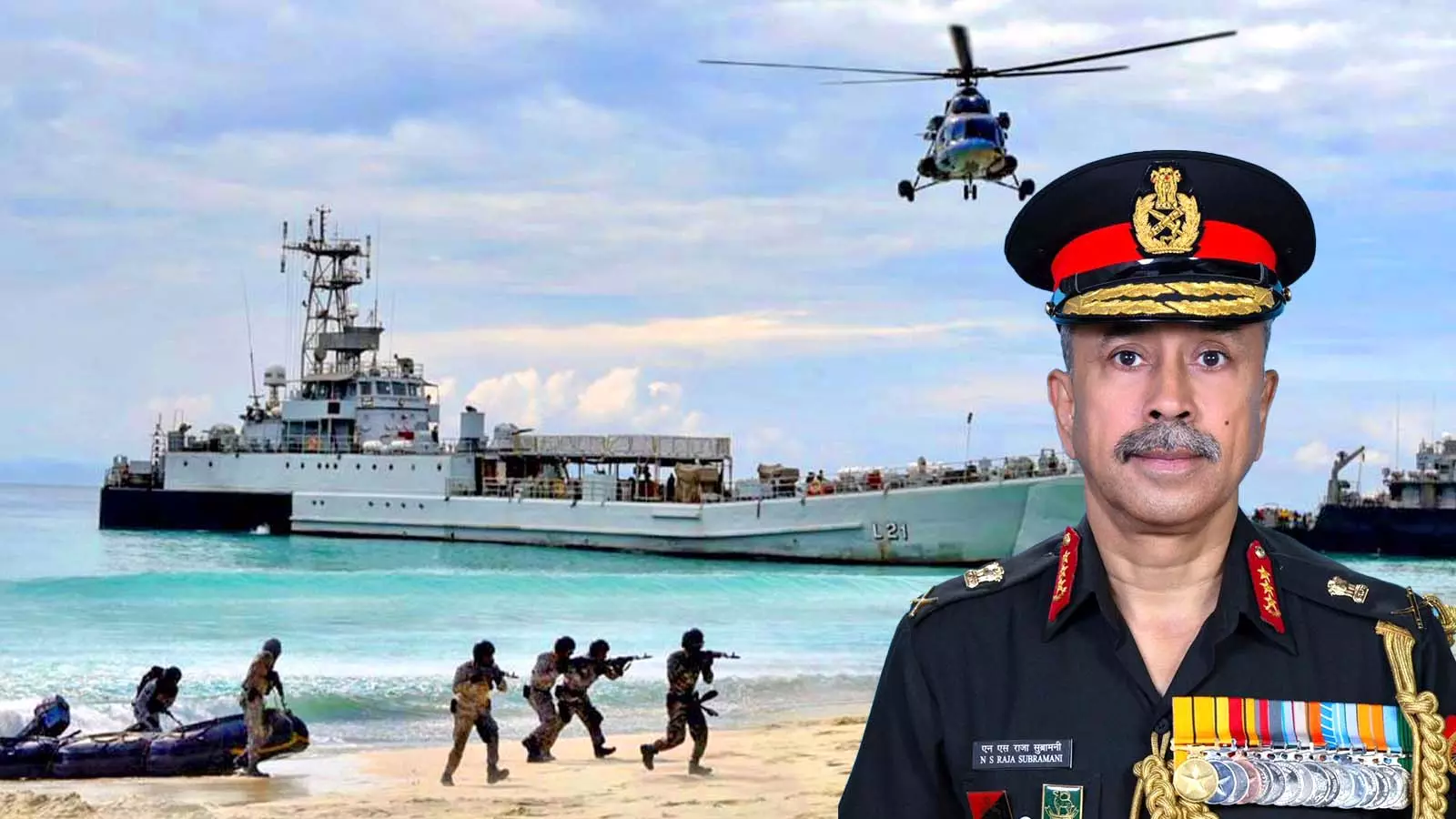
With many military doctrines and tactics upended by the ongoing long-drawn Russia-Ukraine war, the attack on Iran by the US and Israel, and India’s own brief conflict with Pakistan under Operation Sindoor last year, the country’s new chief of defence staff (CDS) will have to take the bull by the horns on several fronts.
New CDS's primary task
The primary task for General NS Raja Subramani, who takes over as the third CDS from Gen Anil Chauhan over this weekend for a three-year term, will be to ensure India systematically builds an integrated, multi-domain warfighting machinery cost-effectively to counter the collusive, and now well-fused, challenge from China and Pakistan.
Also read: Agnipath needs urgent correction to protect India and her armed forces
For starters, India urgently needs an overarching National Security Strategy (NSS) to define its long-term national and geopolitical objectives amid myriad security challenges and formulate a clear-cut, broad roadmap to achieve them.
For too long, ad-hoc decision-making and the lack of strategic planning have hobbled national security matters.
CDS and the ITC question
While the CDS can only advise the government on the necessity of an NSS, he will directly have to spearhead the creation of integrated theatre commands (ITCs), which will place assets and manpower of the Army, Navy and Air Force under single operational commanders for specific geographical regions or missions.
Subramani will need to strike a careful balance between the aggressive top-down approach of the first CDS, the late Gen Bipin Rawat, and the consensual bottom-up strategy of Gen Anil Chauhan
The blueprint for this restructuring — the most radical overhaul of the 1.4-million-strong armed forces since Independence —is finally ready. Once approved by the PM-led Cabinet Committee on Security, with the political leadership belatedly taking ownership of the systemic reform, it will take at least 12-18 months for the ITCs to take concrete shape on the ground.
The prolonged, friction-ridden debate on “theaterisation” must now end. The ultimate goal, after all, is to significantly enhance the nation’s overall combat capability through genuine synergy and jointness among the armed forces.
Concurrently, India can no longer delay setting up full-fledged commands to handle the crucial space and cyber domains. Deploying orbital assets for real-time surveillance, intelligence-gathering and secure communications — if not actual warfare — is vital to shorten the OODA (observe, orient, decide, act) loop for the armed forces.
Potent cyberwarfare capabilities, in turn, are essential, given their power to wreak havoc on infrastructure before the actual kinetic action even begins.
Also read: Army Chief flags fractured world order, pushes defence transformation
Recent conflicts have driven home the need for rapid technology infusion, stretching from AI-driven sensors and weapons to unmanned systems, secure connectivity and directed energy weapons.
India must also augment and consolidate its conventional (non-nuclear) long-range precision-strike weapons through an integrated rocket force (IRF) of cruise and ballistic missiles, guided rocket munitions and other vectors.
While fighter jets remain crucial for operational flexibility, cheaper standoff firepower has become equally critical for hitting targets deep inside enemy territory.
Designing and manufacturing drones
Furthermore, India must itself design and manufacture all kinds of drones, ranging from low cross-section loitering munitions and swarm drones to FPV (first-person view) drones and UCAVs (unmanned combat aerial vehicles). It should no longer rely on exorbitant foreign imports or equally expensive domestic “screwdriver assembly” facilities.
Conversely, a much more robust and multi-layered air and missile defence (AMD) network, capable of thwarting saturation attacks by hostile drones, loitering munitions and missiles, will also have to be systematically built indigenously in a cost-effective manner.
Achieving all this will require concrete integrated capability development plans, hugely scaled-up defence production capacities and resilient supply chains for sustaining major wars of attrition like the Russia-Ukraine one.
It must be remembered that Operation Sindoor was just a limited conflict that saw 88 hours of restricted cross-border hostilities. Modern wars prove that surge capacity and deep war wastage reserves are non-negotiable.
Filling critical gaps
The CDS must also prioritise plugging critical operational gaps, from night-fighting capabilities and advanced diesel-electric submarines equipped with air-independent propulsion for greater underwater endurance to fifth- generation stealth fighter jets and light utility helicopters.
Cadre reviews as well as trimming non-operational flab are equally important. The new CDS must advocate for urgent tweaks in the controversial Agnipath scheme of 2022, under which 75 per cent of the Agniveers recruited for four-year tenures will begin to be demobilised from this year-end onwards. The retention rate of Agniveers, for one, should be hiked to at least 50 per cent, if not more.
The NFU challenge
There is also considerable heartburn among military officers over the government’s continuing refusal to grant them non-functional upgrade (NFU) — basically, salary upgrades for those denied promotions due to lack of vacancies — at par with the civil services and central armed police forces.
The lack of military representation in the 8th Central Pay Commission has stoked similar fears of being shortchanged.
Also read: Why India must honour IPKF’s forgotten war heroes in Sri Lanka
To fund this military modernisation and operational sustenance, as well as payment of salary and pension bills, the CDS should also push for earmarking at least 2.5 per cent of the GDP for the defence budget, instead of letting it languish at just about 1.9 per cent.
As the “first among the equals” alongside the Army, Air Force and Navy chiefs, as well as the secretary of the department of military affairs and principal military advisor to the political leadership, Gen Subramani will certainly have a lot on his plate.
He will need to strike a careful balance between the aggressive top-down approach of the first CDS, the late Gen Bipin Rawat, and the consensual bottom-up strategy of Gen Anil Chauhan. His task to build a future-ready military, geared for both symmetric and asymmetric warfare, is clearly defined.