How sarkari job dreams turn into a long, costly wait for Indian youth
For youngsters from Hindi belt, government job dream comes at steep cost as paper leaks, exam delays, scarce vacancies and alleged irregularities derail careers

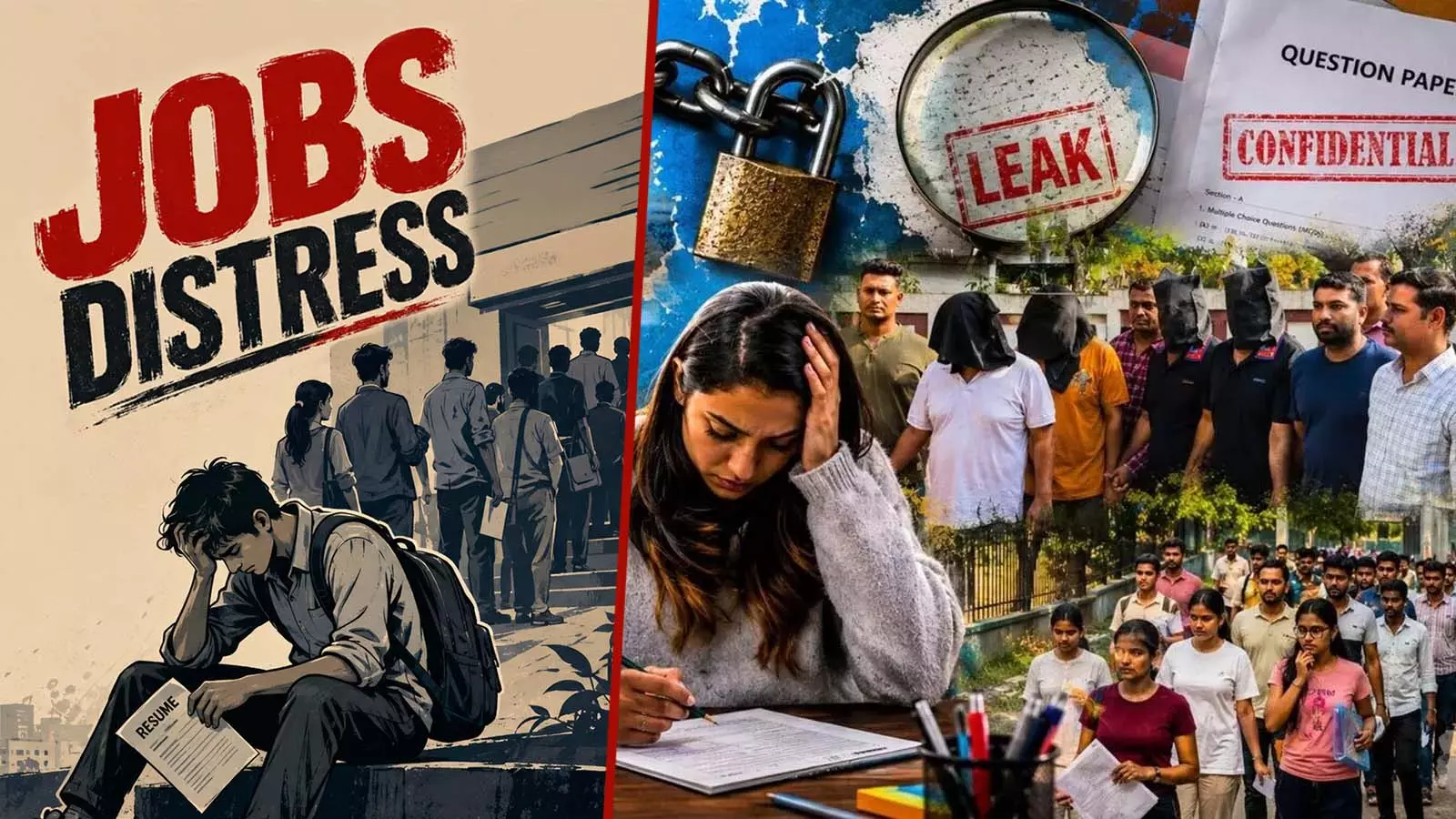
In part nine of The Federal's Jobs Distress series, we try to make sense of the desire for government employment among a large section of the youth in the Hindi belt, and what comes between them and their dream job. Catch up on Parts 1, 2, 3, 4, 5, 6, 7 and 8 of the series here.
In the 80th year of Independence, a sarkari naukri, or a government job, remains the dream of crores of Indians — perhaps a colonial legacy, when working for the Crown represented stability and bounty. It's more than just the job or the salary it entails. A government job is seen to offer stability, security, social status — and better marriage prospects.
Despite the growth in corporate, IT and private-sector jobs, along with the government's push for self-employment and self-reliance, the desire for sarkari naukri has not lost its sheen.
With a growing population and a declining number of government job posts, competition has intensified, especially in the Hindi belt, where demand has traditionally been high. Meanwhile, systemic problems such as delayed exams and results, cheating and paper leaks, and lack of posts have eaten into the recruitment system over the years, triggering a huge jobs crisis.
Dilli chalo
The Federal Desh spoke to some students from the Hindi belt, caught in the eddy of finding government jobs. They left their rural and semi-urban homes to come to Delhi to prepare for government recruitment exams, only to find their journey stymied and laid waste by cheating and paper leaks.
Also read: Legal twists, endless wait: How Bengal failed a generation of job seekers
In Delhi, Mukherjee Nagar and Old Rajinder Nagar are considered major hubs for government-job preparation. Young people from across the country enrol in expensive and reputed coaching institutes and take boarding in rented rooms nearby. These are long days and even longer nights, spent in endless preparation for exams that could make or break their lives.
There appears to be level of optimism among UPSC (Union Public Service Commission) aspirants. There has, till date, been no major issue with UPSC exams, they pointed out in an interaction with The Federal Desh. Such problems are more common in state-level examinations, they pointed out.
A costly affair
Shivani from Kanpur, sitting outside a tea stall, is firm on one thing — no photos, no full name. A post graduate in Public Administration, Shivani came to Delhi in 2023 to prepare for the UPSC exam. Her father works at the Uttar Pradesh State Road Development Corporation, and she has two sisters and two brothers.
Also read: Why Karnataka's 2-4-6 recruitment formula is running into multiple hurdles
Once she landed in Delhi, Shivani enrolled at a coaching centre, shelling out a fee of Rs 1.66 lakh a year. Asked why she chose Delhi when Kanpur is also a big city, Shivani said while coaching centres are available there, the quality of faculty in Delhi is far better.
Over three years, success eluded her, and she has now turned to self-study. But that doesn't come cheap, either. She spends Rs 20,000–25,000 a month, including a PG (paying guest) rent of Rs 15,000 a month and library expenses of Rs 2,400.
Bihar exam debacle
This year, Shivani appeared for the Bihar Assistant Education Development Officer examination, held on April 17 and 18. For 935 vacancies, around 11 lakh candidates had applied. For the first time, candidates who cleared the written examination were to be appointed directly.
The exam centre was at Dumraha in Buxar district. Shivani took a train from Delhi to the Bihar centre, while her mother came there directly from Kanpur to keep her company. The two-day exam entailed a room rent of Rs 4,500, an additional burden for the family.
The first day’s paper was held, but the second day’s was cancelled. It was an entire exercise in vain — the ticket cost, the boarding and lodging, the time spent, and all the effort that went into preparing for and attending the exam. But the exam was cancelled and there is no clarity yet on a re-exam.
But Shivani is not losing hope. Age is still on her side, and her family continues to support her to the extent possible.
The government should ensure greater transparency and take serious steps to prevent paper leaks and cheating so that no young person is wronged, she emphasised. “It's not just the student who suffers; the entire family is affected,” she said.
From Purvanchal, with hope
Kuldeep Pandey and two of his friends from Azamgarh, Uttar Pradesh were sharing snacks at a roadside eatery. They have rented a room at Gopalpur village near Mukherjee Nagar to prepare for competitive examinations.
Also read: Karnataka's age relaxation for govt jobs: A lifeline too little, too late?
Kuldeep, holds an MA in geography and a B.Ed degree as well. He came to Delhi from his village in 2021, in search of the dream sarkari naukri. His father is a farmer, while his mother teaches at a private school in Azamgarh. His elder brother lives in Delhi and works in the private sector.
For Kuldeep and others in Uttar Pradesh's Purvanchal region, government employment carries enormous prestige. “In our Purvanchal region, the influence of government jobs is huge. There isn't much else. Everyone dreams of somehow securing a good government job,” he said.
The 25-year-old studies on his own. He could have prepared from his village, but said the demands of rural life made it difficult to focus. Watching his father work and helping care for the livestock often left him with little space to focus on his exam preparation. Thus Delhi.
A cycle of exams, leaks and delays
In 2023, Kuldeep appeared for the Uttar Pradesh Review Officer (RO) examination. There were 435 posts and 10.76 lakh applications. Around 4.5 lakh candidates appeared for the examination, with centres across 65 districts.
The examination was cancelled after allegations of paper leaks and cheating triggered protests. It was later conducted again after the pattern was changed, with all candidates taking the examination on the same day and in the same shift.
However, the vacancies remain stuck. The issue is pending before the Allahabad High Court because of a dispute over reservation and migration. The government maintains that reservation benefits can be availed of either in the preliminary or the main examination, while reserved-category candidates want the benefit in both. The dispute has reached court.
Also read: Tamil Nadu’s MBBS graduates caught between scarce jobs and low pay
Kuldeep said candidates continue to prepare in the hope that such systemic flaws will eventually be resolved and that they will succeed.
'The will is lacking'
Kuldeep’s roommate Devendra Dubey (26), from Prayagraj, came to Delhi in 2022 and spent Rs 85,000 on coaching. His father runs a shop back home. Devendra now shares a room with Kuldeep, paying Rs 6,000 a month, and also relies on self-study. He, too, appeared for the RO examination in 2023, only to be met with the same fate.
Devendra believes paper leaks can be prevented, but there's little governmental will to do this. Why are private printing presses used to print exam papers, he asked. After all, leaks tend to occur either at the paper-setting stage or at the printing press.
Officials or politicians may allow such irregularities to benefit people close to them, he surmised.
'It's war time'
The third friend, Rakesh (25), from Govardhan in Mathura, is preparing for the Staff Selection Commission (SSC) and railway examinations and has been living in Delhi for around two years.
Also read: Why Andhra’s govt job crisis is escalating despite CM Naidu's push
The SSC examination system has become so difficult that it's like preparing for war, rued Rakesh. Earlier, the conduct of the exam was outsourced to technology major TCS. Around two years ago the contract was given to another company, Eduquity.
Rakesh believes the new third-party contractor may have offered to conduct the examination at a lower cost, but students have been paying the price. He gives an example: when he applied for the SSC examination in 2025 from Delhi, his centre was initially allotted in the Andaman and Nicobar Islands. He had to raise the issue before the centre was hurriedly shifted to Delhi.
But then again, during the exam, the computer systems were not functioning properly, Rakesh said. When students demanded additional time, they were confined inside the exam centre and beaten up by bouncers, he alleged. The students were allowed to leave only late at night, he added.
He also claimed that reports had emerged of examination centres being located in cowsheds or underneath seedy hotels. Students have protested at several places over these issues, he said.
'System is playing with our future'
At another tea stall in Mukherjee Nagar, The Federal Desh met Pankaj Kumar from Azamgarh. The 28-year-old came to Delhi five years ago to prepare for the SSC, railway exams and UPSC.
After paying Rs 1 lakh in coaching fee, Pankaj has taken to self-study. His father is a farmer and his brother was recently appointed as a junior engineer with Uttar Pradesh Power Corporation Ltd, becoming the first in his family to secure a government job.
The SSC exams have repeatedly been delayed, said an evidently worried Pankaj. The SSC exam process has deteriorated since the contract was moved from TCS to Eduquity, he claimed. The exam schedule was expected in March but is yet to be released.
Railway examinations have also faced prolonged delays. An exam for vacancies advertised in 2019 was held only in 2022. Students had to stage protests before the calendar was finally released and the exam process moved forward.
Young people work hard every day for employment and for the future of themselves and their families, but government processes continue to jeopardise that future, Pankaj noted.
He pointed to the UPSSSC PET examination, which is supposed to be conducted twice a year, but often is not. He also alleged irregularities in the EWS (Economically Weaker Section) quota in the UPSC examination, claiming that some financially well-off candidates obtain fraudulent EWS certificates to benefit from the quota. He urged the UPSC to investigate such cases strictly.