London's Wembley sees red as paan stains plague 'Gujarati neighbourhood'
Brent Council puts up Gujarati placards, cracks down on public spitting with fines and patrols as residents raise concerns over hygiene, littering

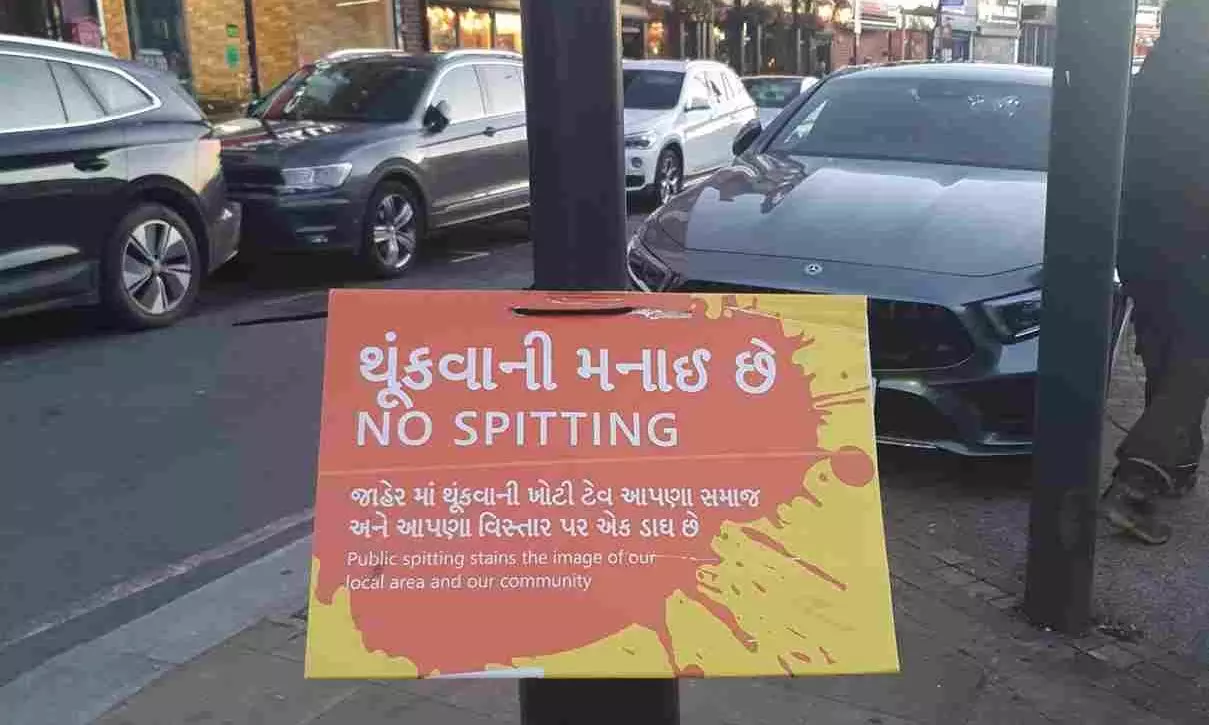
“Thukwani manai che” (no spitting) in large Gujarati letters is written on a small placard. Below it is the sentence, again in Gujarati, “The bad habit of spitting in public is a stain on our community and our locality”.
The placard is not tied to a lamppost in Ahmedabad, Gandhinagar or Vadodara, but on a pole on the high street in Kingsbury, northwest London – an area which has a large Gujarati population.
The notice is aimed not just at Indians who have the disgusting habit of spitting in public but more at those who chew tobacco-laced paan or paan masala and then spray pavements and buildings with their reddish-brown saliva.
Zero-tolerance approach
While this placard has been put up by civic-minded residents of the area, the problem has become so bad that the local government, Brent Council, has flagged the repulsive practice and imposed a spot fine of GBP 100 (approx Rs 12,000) for anyone caught spitting on the streets.
Fed up with spending a whopping GBP 30,000 (approx Rs 36 lakh) a year on cleaning the stains off pavements and buildings in their borough, Brent Council has brought in the fine and pledged a “zero-tolerance approach”. It has identified three “hotspots” and put up banners stating – "Don't mess with Brent, because we will catch you and fine you," with “no spitting” written in Gujarati.
Also read: UK’s new immigration rules: Indians face longer waits; possible visa ban
Brent Council has complained that “even high-powered cleaning jets” cannot completely remove some of the stubborn paan stains from the streets, and the only option is to paint over them, which is an additional cost. The Labour party-run local authority has promised to increase the number of enforcement officers patrolling the streets to catch the perpetrators.
Paan-spitting epidemic
The once upmarket suburb of Wembley, home to the iconic Wembley Football Stadium, the national stadium of England, has now become a down-market Gujarati ghetto. It is also the area worst affected by the spitting menace in the London Borough of Brent. Buildings, lamp posts, street furniture and even flower beds are stained with paan stains.
Ealing Road in Wembley, home to scores of Gujarati shops selling sarees, groceries, cooked food and, more recently, a huge temple, also has a string of paan shops. It is one of the main trouble spots, according to the Council, which has gone to the extent of spray-painting “no paan spitting” signs even on the pavements.
Wembley, and particularly the area around Ealing Road, has had Gujarati-origin British citizens living there since the 1970s, but there has never been such a spitting epidemic before this.
Uganda Gujaratis
Initially, the few Gujaratis living there were immigrants from India, but the numbers shot up drastically when Gujarati refugees from Uganda decided to make Wembley their new home. Grateful and law-abiding, the East-African Indians, as they preferred to call themselves, made every attempt to assimilate into their new homeland.
By the millennium, the second-generation immigrants had grown up, become professionals and began moving out to more affluent middle-class areas of London, leaving Wembley to the new batches of Gujarati migrants from India. The white English families had already moved out of the area earlier.
Many of the old family homes have now been turned into low-rent shared accommodation, housing three to four persons to a room, attracting low-skilled migrants and even illegal migrants who can find a place to live here without questions being asked about their legal status and disappear into the cash-in-hand economy.
'Small-town Gujarat'
As the numbers of these migrants increased, particularly in the last decade and more and more ‘fresh off the boat’ Gujaratis came to live in Wembley, the civic health and cleanliness of the area deteriorated. In recent years, Ealing Road has begun to resemble small-town Gujarat rather than even a ‘Little Ahmedabad’.
Also read: Why South Asians, especially Sikhs, are living in constant fear in the UK
The grocery and vegetable shops have encroached the pavements to display their wares, the chaat and farsaan (snacks) stalls are a hub for litter, entitled youngsters talk loudly on their mobile phones in public, and delivery boys scoot around on two-wheelers dangerously, ignoring all traffic rules. And, there is the spitting on the streets.
Paan-chewing is prevalent among Bangladeshis too, but they seem to have better civic sense than Gujaratis, which is borne out by the fact that Brick Lane or the East End of London, famous for its high British-Bangladeshi population, is not spattered with paan stains. Nor have the local councils had to put up banners or impose fines.
Stain on community
Ironically, in 2011, the Gujarat government then headed by Narendra Modi had banned the buying and selling of gutka and tobacco or nicotine-laced paan masala in the state. However, it is the recent immigrants from that very state, who are making a nuisance of themselves with the revolting habit in northwest London.
Also read: UK doubles residency visa wait for migrants to 10 years; Indians to be hit
After Brent Council announced its campaign, the Right-wing activist Tommy Robinson posted on X: “Import the Third World. Become the Third World. Not only are we to pay them to breed like rabbits, we’re paying to clean up their spit”. While his remarks raked up a storm, with people calling him a racist, there were others, including some British-Indians, who supported him on this instance.
Paan-spitting or even normal spitting on the streets is a health hazard and is considered anti-social behaviour worldwide.