ONOE panel and SC judges: Why the cancelled meeting matters
The proposed informal discussion over simultaneous elections has revived questions about Parliament consulting judges on legislation that could reach the court

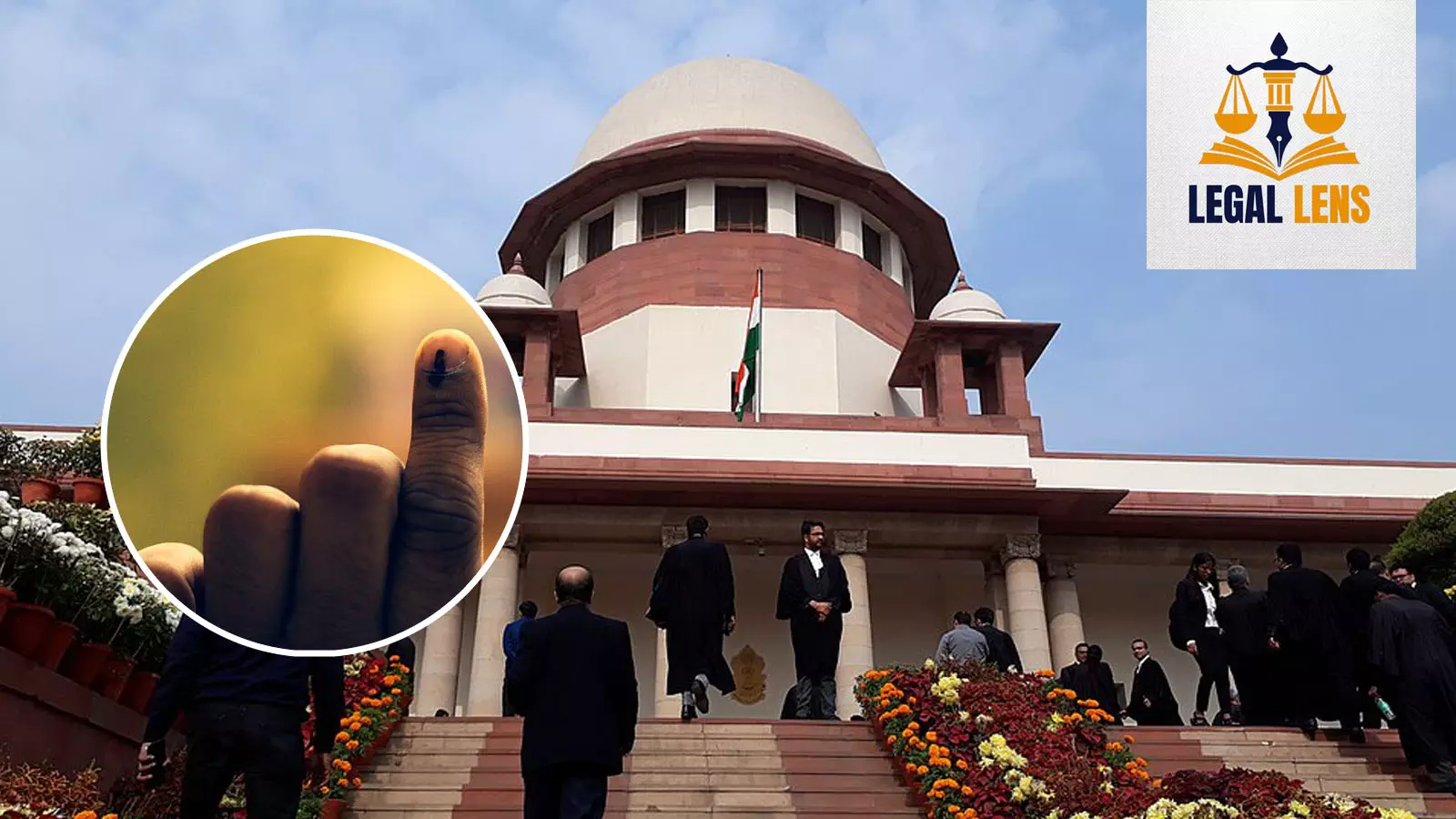
A proposed informal discussion with sitting Supreme Court judges on simultaneous elections to the Lok Sabha and state assemblies was dropped after concerns that it was an attempt to influence the judiciary.
A proposed meeting between the parliamentary committee examining the “One Nation, One Election” (ONOE) Bills and sitting judges of the Supreme Court has been called off after it triggered an unusual debate over the boundary between Parliament and the judiciary.
The Joint Committee of Parliament, headed by BJP MP PP Chaudhary, had reportedly scheduled a “local study visit” to the Supreme Court on October 6, with its programme referring to an “informal discussion” with the Chief Justice of India (CJI) and other judges on the proposed legislation to hold simultaneous elections to Lok Sabha and state assemblies.
Independent Rajya Sabha MP and senior advocate Kapil Sibal disclosed the proposed interaction at a press conference on Thursday (October 1) and questioned whether sitting judges should discuss proposed legislation which could subsequently come before them for constitutional review.
By Thursday evening, the Lok Sabha Secretariat had informed members that the visit was cancelled, without giving a reason.
Also read: 'One Nation, One Election' in 2029 possible if Constitution amended: Panel chief
LiveLaw reported, citing sources, that the Supreme Court had declined the committee’s proposal. Chaudhary, for his part, told PTI that the visit had been put off because the dates of committee members did not match, adding that he too had other commitments.
According to Chaudhary, the visit was intended to familiarise MPs with the Supreme Court, including its library, rather than discuss the Bill. That explanation differs from the circulated agenda’s description of a discussion on simultaneous elections.
Sibal’s objection
Sibal’s objection went beyond his opposition to simultaneous elections. He argued that Parliament and the judiciary perform different constitutional functions: Parliament considers and enacts legislation, while the Supreme Court may subsequently be asked to decide whether the resulting law conforms to the Constitution.
Sibal described the proposed interaction as “unconstitutional” and contrary to the separation of powers. He said that in his legal career he had never encountered a parliamentary group meeting Supreme Court judges to discuss proposed legislation that could subsequently be challenged before the same court.
ONOE before court
The government-appointed Ram Nath Kovind-led High-Level Committee, constituted in 2023, recommended a framework for simultaneous elections in March 2024, whereas the Joint Committee was constituted by Parliament after the Bills were introduced in December 2024 to scrutinise their provisions.
Also read: Explained: Why One Nation, One Election is seen as anti-federal
The Constitution (One Hundred and Twenty-Ninth Amendment) Bill, 2024 proposes a new Article 82A and amendments to Articles 83, 172 and 327. It would create a framework under which elections to the Lok Sabha and state assemblies are synchronised.
The President could bring Article 82A into force through a notification issued on the date of the first sitting of the Lok Sabha after a general election. Assemblies elected between that “appointed date” and the expiry of the Lok Sabha’s full term would have their terms end with it.
The accompanying Union Territories Laws (Amendment) Bill, 2024 proposes corresponding changes to the laws governing the legislatures of Puducherry, Delhi and Jammu and Kashmir, aligning their electoral cycles with the Lok Sabha.
These changes have generated disagreements over federalism, the tenure of elected state assemblies and the powers proposed for the Election Commission. Any constitutional amendment ultimately enacted by Parliament can be challenged before the Supreme Court on the ground that it damages the Constitution’s basic structure, the foundational features that even an amendment must preserve.
Former judges
The parliamentary committee has extensively consulted legal experts, including former members of the higher judiciary.
Former Chief Justices DY Chandrachud and JS Khehar appeared before it in July 2025 and reportedly considered simultaneous elections compatible with the Constitution’s basic structure, while questioning some provisions, particularly the proposed powers of the Election Commission.
Also read: Ex-CJIs oppose ONOE and EC’s full power | Constitution expert Sanjay Hegde explains
Former CJI BR Gavai appeared before the committee in February 2026. Chaudhary said afterwards that all six former CJIs consulted had considered the Bills constitutionally permissible. The reported reservations over individual provisions show that agreement on the idea can coexist with concerns about its design.
The former judges were consulted as legal experts drawing on their judicial experience. Serving judges have a continuing responsibility to decide disputes impartially, including any challenge to legislation on which they are asked for their views.
The Restatement of Values of Judicial Life, adopted by the Supreme Court’s Full Court on May 7, 1997, addresses that responsibility. Paragraph 8 cautions judges against publicly expressing views on political matters or questions pending, or likely to arise, for judicial determination. Its express focus is public comment; paragraph 1 sets out the broader duty to preserve confidence in judicial impartiality through conduct in both official and personal capacities.
Separation of powers
India’s constitutional system combines interaction between institutions with a division of their responsibilities.
The Supreme Court reiterated this position in Ashwini Kumar Upadhyay v Union of India (2026) which sought directions to the Government to curb hate speeches. The Court held that although India does not follow an absolutely rigid separation of powers, the functions of the different organs remain sufficiently demarcated, with each required to respect the essential functions assigned to the others.
Also read: EC's SIR in Bihar a precursor to One Nation, One Election? Talking Sense With Srini
The principle goes back to Rai Sahib Ram Jawaya Kapur v State of Punjab (1955) and acquired greater constitutional significance through Kesavananda Bharati v State of Kerala (1973), which established the basic-structure doctrine.
Article 143
Article 143 of the Constitution permits the President to refer to the Supreme Court a question of law or fact of sufficient public importance which has arisen or is likely to arise. The President initiates the reference, and the Court determines the hearing it considers appropriate; under Article 143(1), it also has discretion whether to answer.
The relevant precedent is In Re: The Special Courts Bill, 1978 (1978), in which the then President Neelam Sanjiva Reddy referred the proposed legislation to the Court on August 1, 1978, asking whether it would be constitutionally invalid if enacted. Ram Jethmalani introduced it as a private member’s Bill in the Lok Sabha on August 4, 1978. It proposed special courts for alleged offences by holders of high political or public office during and immediately before the Emergency.
A seven-judge bench headed by CJI YV Chandrachud delivered its opinion on December 1, 1978, after the Bill had been introduced in Parliament. The Court had issued notices to the Union and the states, invited applications to intervene and heard competing arguments.
One objection was that the Court was being asked to act like a parliamentary joint select committee. The Court nevertheless held that examining the Bill’s constitutionality fell within its advisory jurisdiction even while Parliament was considering it, leaving the legislative decision to Parliament.
According to the programme disclosed by Sibal, the proposed ONOE interaction was to be an informal discussion. What questions would have been put to the judges, whether their responses would have been recorded and how any observations would have figured in the committee’s eventual report remain unclear.
Lack of confidence
Sibal’s allegation that the government intended to brief judges on the merits of the Bills raises a further question about how their responses might have been used. Favourable observations, subsequently cited in Parliament as evidence of the Supreme Court’s support, could have given the government an argument against the Bills’ opponents. Such a claim would, however, invite the criticism that an informal consultation was being used as a shortcut to judicial endorsement, bypassing the examination of defined questions through the Article 143 process.
A formal reference would also expose the proposed legislation to an answer the government might find inconvenient. Although advisory, the Court’s opinion would place its constitutional reasoning, including any objections, publicly on record.
The Special Courts Bill reference illustrates that possibility: the Court identified procedural provisions that violated Article 21, and the government undertook to propose amendments to the pending Bill in light of the Court’s advisory opinion. Not doing so would have dented the Government’s credibility. The abortive informal consultation, therefore, throws more light on the Government’s lack of confidence in securing the formal backing of the Court to the pending Bills under Article 143.