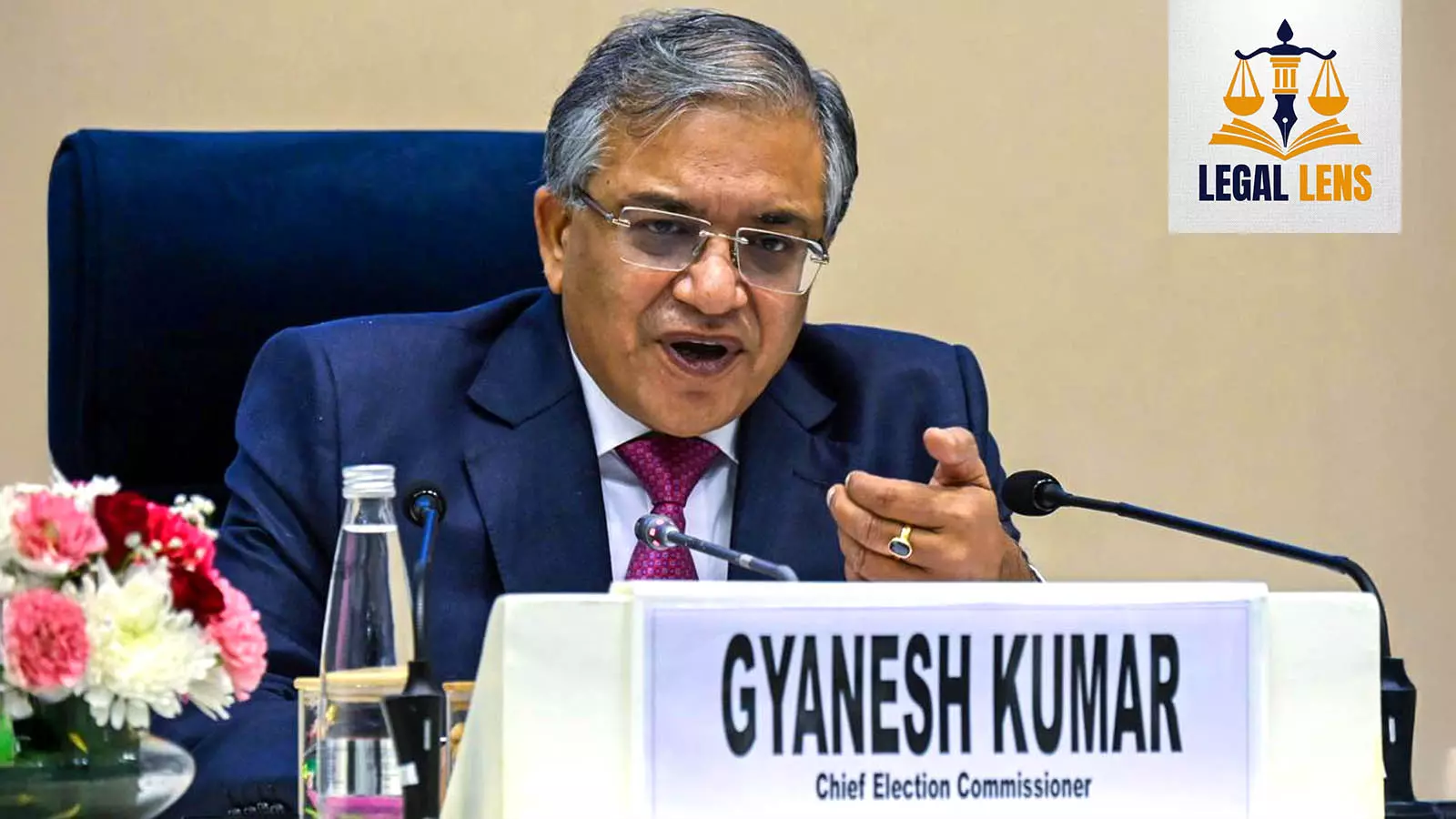
A motion to remove Chief Election Commissioner Gyanesh Kumar, moved in both houses of parliament and signed by 193 MPs, was rejected recently
Why the rejection of motion against CEC Gyanesh Kumar is problematic
Did the presiding officers apply, at admission, a standard meant only for the inquiry committee?

On April 6, 2026, two orders ended the Opposition's motion against Chief Election Commissioner Gyanesh Kumar. The Rajya Sabha Chairman and the Lok Sabha Speaker each issued a reasoned order of more than fifteen pages. Neither order is in the public domain. Copies were circulated to the members who signed the motions. Journalists have since then seen the Chairman's order and quoted from it. The Speaker's order has been summarised. The account that follows draws on that reporting.
The rejection raises a constitutional question. How far may a presiding officer go, at the admission stage, in weighing the merits of a removal motion? The Judges (Inquiry) Act, 1968, gives him the power to admit or refuse. It does not say in what spirit. His gate is the only one between a constitutional office-holder and the inquiry committee.
A comparison helps. In April 2018, Vice-President M Venkaiah Naidu, then-Chairman of the Rajya Sabha, rejected a removal motion against Chief Justice Dipak Misra. His ten-page order remains the only prior precedent under the 1968 Act of a presiding officer refusing admission at the threshold. It drew sharp criticism. The Opposition briefly moved the Supreme Court and withdrew. The April 6 orders now tread the same path.
A threshold, not a trial
The Judges (Inquiry) Act, 1968 lays out a four-stage process. Stage one: a notice signed by 100 Lok Sabha or 50 Rajya Sabha members. Stage two: the presiding officer's decision to admit or refuse. Stage three: a three-member committee of two judges and a jurist. It hears witnesses and delivers findings. Stage four: a two-thirds parliamentary address in each House. Each stage does its own work. The admission stage is a threshold filter, not a trial.
Naidu's order exposed a problem the April 6 order has now inherited. He framed admission as a mini-inquiry. He would assume every statement in the notice to be true. He would then ask whether it would amount to proved-misbehaviour under Article 124(4). He found it would not. He called the charges suspicion, conjecture, and assumption. He rejected the motion.
Also Read: Does blocking EC impeachment signal shrinking space for Opposition in new India?
The difficulty is straightforward. Proof beyond reasonable doubt is a criminal-trial standard. It belongs at the committee stage, not the gate. The admission stage has a narrower job. It confirms the numbers and that the charges, read at face value, fall within the constitutional category of misbehaviour.
Section 3(1) empowers the Chairman to decide “after considering such materials, if any, as may be available to him”. That phrase contemplates external material. The Chairman considered none.
The same template, eight years later
The April 6 order applies the same test in nearly the same vocabulary. The Chairman says the charges lack the proof necessary to constitute misbehaviour. They do not meet a high constitutional bar. The charge about the nationwide expansion of the Special Intensive Revision is speculative. A removal motion cannot rest on vague apprehensions.
Each formulation does the work Naidu's beyond-reasonable-doubt standard did in 2018.
What the April 6 order adds
The April 6 order goes further than Naidu's in two ways. The first is a sub judice filter. Several charges concerned the Special Intensive Revision of electoral rolls in Bihar and the handling of machine-readable voter data. The Chairman says these matters are before the Supreme Court. Treating them as evidence of misbehaviour, the order adds, would be inappropriate. Non-compliance with court directions belongs to contempt jurisdiction, not removal.
Also Read: Oppn notices on motion to remove CEC rejected by RS Chairman, LS Speaker
The reasoning sounds tidy. It sets a trap. If the courts have not yet ruled, the charges are premature. If they have ruled against the CEC, the remedy is contempt. If they have ruled in his favour, he is vindicated. On every branch, Parliament's power of removal disappears.
The second innovation addresses the tainted-appointment charge. The Chief Election Commissioner and Other Election Commissioners Act 2023 replaced the selection committee contemplated in Anoop Baranwal vs Union of India with one giving the ruling party two of three votes. That Act is under Supreme Court challenge. The Chairman says the pendency of a challenge cannot amount to misbehaviour.
Two paradoxes
Consider the Om Birla paradox. On July 21, 2025, notices for the removal of Justice Yashwant Varma were moved in both Houses on the same day. That simultaneity triggered the first proviso to Section 3(2) of the 1968 Act, which contemplates joint action by the Speaker and the Chairman. Chairman Jagdeep Dhankhar resigned the same day. Speaker Om Birla did not wait for the new Chairman. He constituted the three-member inquiry committee on his own. The Deputy Chairman later refused admission of the Rajya Sabha notice, after the Speaker had already acted.
Justice Varma challenged the committee in the Supreme Court. At the December 16, 2025 hearing, a bench of Justices Dipankar Datta and AG Masih queried the Speaker's conduct. It asked whether legal advice had been sought before he acted alone.
On January 16, 2026, a bench of Justices Datta and SC Sharma dismissed the writ. The sixty-page judgement, authored by Justice Datta, acknowledged infirmity in the Speaker's failure to wait for a new Chairman. It held that infirmity not grave enough to quash the committee. The Court's deeper unease was expressed separately. It observed that the Secretary-General of the Rajya Sabha had conducted a 'substantive scrutiny' of the notice. Such scrutiny, the Court said, is not contemplated by the Act. The observation was meant to guide future instances.
Also Read: Oppn MPs submit notices to remove CEC, list seven charges of ‘proved misbehaviour’
That observation matters for the April 6 order. What the Court told the Secretariat not to do is what the Chairman has now done on his own letterhead. The April 6 reasoning is substantive scrutiny in all but name. Whether the statute draws the same line around the presiding officer is a question the Varma judgement did not have to decide. The April 6 order raises it squarely.
The second asymmetry concerns the Rajya Sabha Chairman. The removal motion against Justice Shekhar Kumar Yadav of the Allahabad High Court was moved over his December 2024 Vishwa Hindu Parishad speech. It has been pending before the Chairman for over a year. No decision has been taken to admit or to refuse. The Gyanesh Kumar motion was rejected within twenty-five days.
The case for the defence, and its limits
Three arguments are made in defence of the order. First: the word 'may' in Section 3(1) gives the Chairman real discretion. Discretion is not a roving inquiry. Second: the Opposition could never muster the two-thirds address required for removal. That arithmetic is not the Chairman's concern. Third: the charges were politically tinged. That is what a committee of two judges and a jurist is meant to sort out.
Also Read: Impeachment motion against CEC: Is it more about optics, than politics?
Article 324(5) placed the CEC on the same removal footing as a Supreme Court judge for one reason. The framers wanted the umpire beyond the reach of the parliamentary majority. The high threshold was the price of insulation. It was never meant to buy immunity.