Scrapping of Rail Budget: The original sin behind India’s railway crisis
Railways budget ensured a ring-fenced investment plan to modernise rail infrastructure; now this vital national asset languishes due to neglect and hollow capex

Over 100 years ago, the British initiated the practice of a separate budget for the Indian Railways.
This, of course, was driven by the colonial interest in the railways as a strategic economic asset that also enabled it to coordinate troop movements in a country that was first forced into a war and then increasingly restive with the pangs of the national freedom struggle.
The practice continued after Independence, driven by two objectives. The first was the nationalist project of devoting focussed attention on a critical component of national infrastructure.
But there was another, perhaps even more, important reason: a separate budget for the Indian Railways ensured a ring-fenced investment plan with transparent metrics that provided a credible pathway to the modernisation of rail infrastructure in the medium to long term.
Misplaced priorities
On February 25, 2016, then Railway Minister Suresh Prabhu presented the last Railway Budget. In 2017, the Narendra Modi government scrapped the rail budget, citing it as a vestige of a colonial practice.
When Railways lost its financial signal
♦ Indian Railways now competes with all ministries for funds
♦ No ring-fenced investment for long-term rail modernisation
♦ Parliamentary and public financial scrutiny has weakened
♦ Capacity expansion loses out to short-term fiscal pressures
♦ Rising reliance on debt masks stagnant real allocations
♦ Spate of accidents has not spurred any fiscal course-correction
Not even the spate of railway accidents in recent years has convinced those at the political helm that the abandonment of the railway budget has been a costly mistake. At the very least, a detailed financial statement on the physical and financial performance of the Railways would have provided some evidence that the it is being taken seriously, as a national priority.
Also read: Safety at risk: Loco pilots warn overwork, fatigue could lead to operational breakdown
Subsuming the Railways’ budgetary needs within the larger pool of overall finances forces allocations for this critical national asset to compete with multiple other claimants, while also exposing them to the full volatility of fiscal pressures. Critically, this undermines any meaningful pathway to a credible and sustained effort at expanding the reach and capacity of the Indian Railways.
Not even the spate of railway accidents in recent years has convinced those at the political helm that the abandonment of the railway budget has been a costly mistake.
In fact, while the advocates for banishing a separate railway budget claimed that India stood as an outlier among the nations of the world, this is not even a half-truth.
While it is true that countries like Japan, Germany and France — which have significant railway networks — do not have railway budgets, each one of them not only has dedicated funding mechanisms for railways but also statutory mechanisms for oversight.
No guaranteed funding
Since 2017, India has had neither a dedicated budget nor a designated overseer. In fact, even the Parliamentary oversight has been subverted. For instance, the Pink Book (actually a set of booklets), once a part of the Railway Budget documents, which provided details of every project, was placed in Parliament after the Budget Session last year.
With the Railways being the single largest Indian enterprise — private or public — and being the biggest employer in India, barring the Armed forces, the abandonment of the railway budget robs the state of an opportunity to focus attention on this vital national asset.
Moreover, from a public interest standpoint, it deprives citizens of the opportunity to examine whether the government has a credible, cogent and consistent long-term plan (Viksit Bharat, for instance) to develop a system that has enormous forward and backward linkages with the wider economy.
Severe capacity constraint
Ironically, the Economic Survey for 2014-15, released after Prime Minister Narendra Modi first assumed office, was the last serious assessment of the significance of the Indian Railways.
Also read: RTI reveals snail-paced modernisation of critical safety systems in Southern Railway
Anchored by the then Chief Economic Adviser Arvind Subramanian, it devoted an entire chapter to the Railways, titled “Putting Public Investment on Track: The Rail Route to Higher Growth”. It called for a rail modernisation programme that was led by public investment, arguing that this would “crowd in” rather than “crowd out” private investment.
Nirmala Sitharaman’s stoic refusal to utter the ‘R’ word in her last two budget speeches reflects scornful apathy toward a sector that is so critical for economic vitality.
It pointed out that the biggest problem the Railways faced was the severe capacity constraint, reflected in the precipitous decline in rail transport vis-à-vis road and the serious problem of congestion. In effect, the Railways was in a gridlock — the problem of congestion leading to the ever-declining modal share of the railways.
Economic force multiplier
The most striking conclusion of the 2014-15 Survey was that the multiplier effect of investments in the Railways could, at a conservative estimate, generate a 5.74-fold increase in output (considering both forward and backward linkages). Of this, industry alone would benefit from a multiplier effect of 3.22 times the investment made in the Railways.
Most significantly, the Survey argued that the multiplier effect would increase over the years as the linkages took deeper root in the economy. The fact that no other sector of economic activity boasts of multiplier magnitudes that come anywhere close to those of the Railways demonstrates just how critical this national infrastructure is for national economic vitality.
Yet, despite the Modi government's early admission of the Railways’ critical importance, Finance Minister Nirmala Sitharaman’s failure to even mention it in her long winding speeches in the past two years demonstrates a shocking neglect of a sector that is so important for economic vitality.
To make matter worse, the Railway Ministry continues to be headed by a part-timer, one who has other high-profile ministerial roles to perform under the current dispensation.
Illusion of high capex
The issue of railway capex is critical because roughly half of India’s overall rail system consists of the High Density Network (HDN) and the Highly Utilised Network, which together carry more than 80 per cent of the total traffic. Even more ominously, 80 per cent of the HDN is carrying loads that are more than 100 per cent of its capacity.
The Railway’s carrying capacity is therefore the binding constraint, which is why capex assumes centrality.
Finance Ministers thrive on creating illusions and for a seriously capacity-constrained system like the Indian Railways this is best illustrated by allocations for the capex. The allocations for the Indian Railways in the current year were set at an impressive Rs. 2.75 lakh crore. Although this was only marginally higher than the Rs. 2.65 lakh crore in the previous year, it was nevertheless almost 90 per cent higher than the allocation made in 2020-21.
But here is the catch, for which one must turn to the sources of Railway finances. Simply put, there are three main sources. The most important component is the gross budgetary support for the railways (note that the operating ratio of almost 100 per cent means that there is literally no financial resources available from within the railway system).
The second source has been the funding from bonds floated by the Indian Railway Finance Corporation (IRFC). The IRFC issues the bonds on behalf of the Railways and then leases the purchased assets — mostly rolling stock — back to the Railways.
As the graph above shows, IRFC's net additional borrowings have been significantly high, peaking in 2020-21, when it reached almost Rs 1.14 lakh crore; that year, the IRFC’s net borrowings accounted for a whopping 43 per cent of the Railway’s total allocation.
The third, and most insignificant, component has been the misplaced trust in the Public Private Partnerships (PPP), which, despite much grandstanding, has yielded little.
Resource allocation
IRFC’s bonds are in the nature of a pass-through cost for the government. The government guarantees a return of at least 7.50-7.75 per cent per annum on the borrowings, which enjoy a five-year moratorium and have a 30-year tenure, at the end of which the assets are transferred back to the railways.
As the above chart shows, in the last three years, there has been a reverse flow of funds from government finances to the IRFC to the tune of Rs 36,000 crore. And, this will build into a surge very soon, as a greater fraction of past borrowings move out of the moratorium phase.
Currently, about 46 per cent of the borrowings are in moratorium but by 2028 interest payments are bound to increase sharply. The outstanding borrowings from the IRFC route are projected to be Rs 4.43 lakh crores at the end of the current year.
The reference to the illusion made earlier arises from the fact that total effective allocations for the current year, apparently impressive at Rs 2.64 lakh crores, is less than two per cent above the total allocation made five years earlier. It is true that the budgetary support to the railways grew impressively – by 90 per cent – in this period.
Also read: Local cuisine, upgraded facilities, no VIP quota: What to expect on Vande Bharat Sleeper
But what the overall numbers do not reveal is the fact that the mix in the sources of finance had changed dramatically, while leaving the overall picture virtually unchanged.
In 2020-21, budgetary support only amounted to 56 per cent of the total allocation for the railways. In contrast, in 2025-26, budgetary support amounted to Rs. 2.75 lakh even as the Railways’ net borrowings amounted to -11336 crores, meaning that effective budgetary support was only Rs. 2.64 lakh crore.
Freight capacity constraints
There are three components of the Railways: the “Software” (signalling and train scheduling), the “Hardware” (the tracks that trains run on) and the “Rolling Stock” (the trains themselves). Apart from the two Dedicated Freight Corridors (DFC) – the Eastern Corridor from Ludhiana to Dankuni and the Western Corridor from Dadri to Jawaharlal Nehru Port in Mumbai, very little of network capacity has happened on the “hardware” front.
The DFCs, after much delay and cost overruns, have taken 20 years to materialise and also suffer from several problems. For instance, nearly half of the freight trains on the Eastern DFC, which mainly carries minerals, mostly coal from pitheads to destinations to the west, run empty on their return run, effectively rendering the service inefficient.
Though there has been some talk about utilising some of the slack capacity for passenger traffic, it is unclear how train scheduling can be managed when track capacity is only available for passenger traffic in one direction.
Neglected software
Although the Western DFC, which mainly caters to export-import demand for manufactured goods, textiles and electronics, has less of a problem with “empty” returns, the problem of last-mile connectivity has not yet been fully resolved.
As a result, the overall modal share of the Railways remains at a dismal 25 per cent — a long way from the target of 40 per cent by 2030 set out in the National Rail Plan of 2021 (interestingly, the Railway Ministry is now coy about this document).
As the enquiries into the accidents have revealed, the human element, especially the training and working conditions of crucial parts of the workforce, remains a major worry.
In effect, most of the apparent increase in allocations in the last few years have gone towards acquisition of rolling stock, which were largely funded via IRFC bonds. Moreover, funds have been channelled towards station “development”. Both these do little to address the critical bottleneck in “hardware”, the expansion of track capacity.
And, as the recent spate of accidents since the horrific one at Balasore in June 2023 have shown, “software” remains neglected.
Most critically, as the enquiries into the accidents have revealed, the human element, especially the training and working conditions of crucial parts of the workforce — loco pilots (among them about 5,000 women) and signalling staff — remains a major worry.
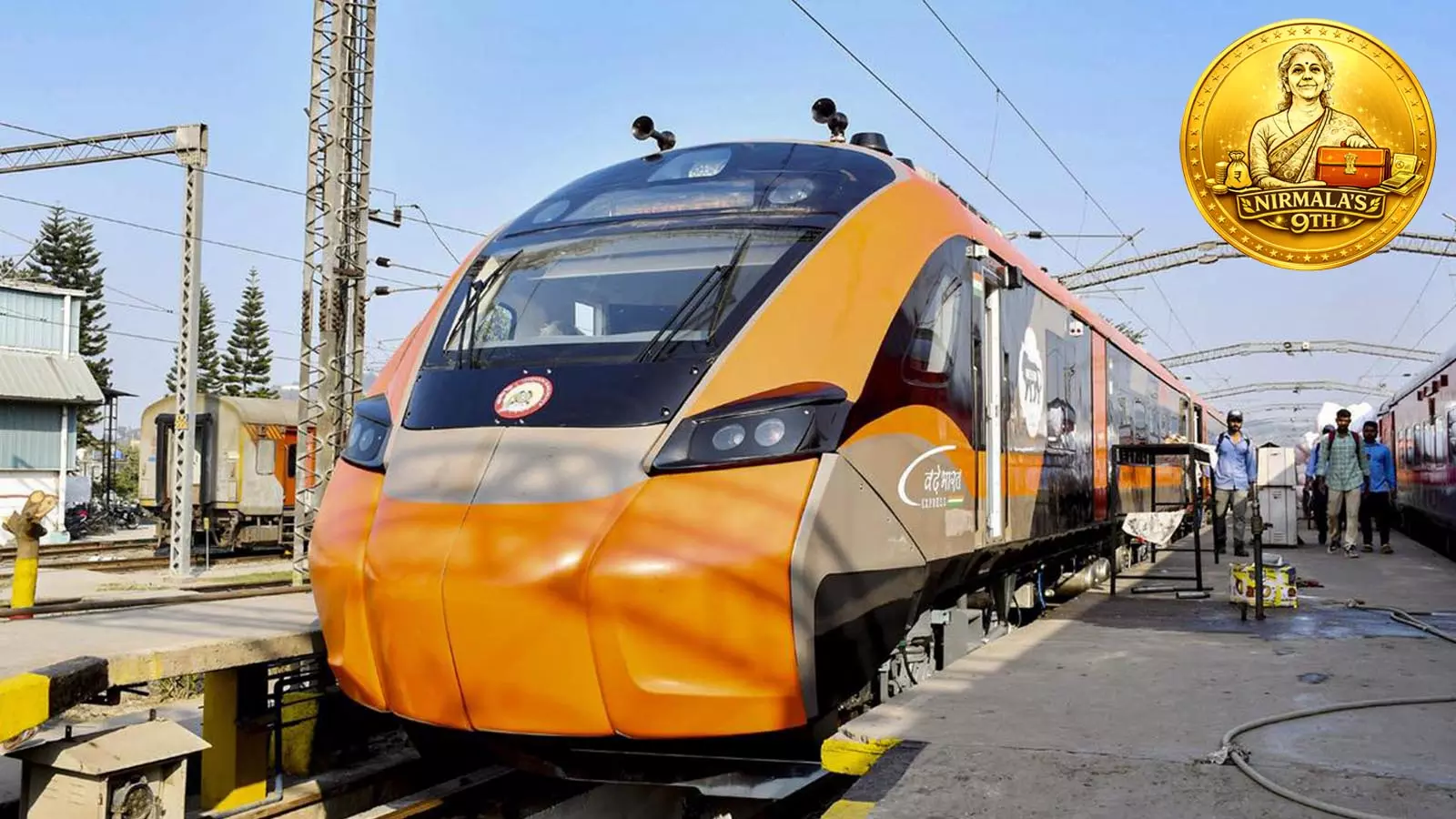
Vande Bharat as a problem
If anything, the proliferation of Vande Bharat trains — now with a freshly-minted sleeper version — has only added to the confusion. A significant expansion of the number of Vande Bharat trains happened just before the 2024 general elections, from 35 operational train sets in the previous year to more than 80. By 2025, the number of “services” had increased to more than 160.
There is a general consensus that the expansion of the services, without an expansion in track capacity, has resulted in sub-optimal utilisation and patronage. With the Prime Minister himself taking an avid interest in flagging off the Vande Bharat trains, the decline in the quality of services on the Shatabdis that run on the same routes is palpable.
But most importantly, the congestion on tracks means that the slower freight train services (which are earn a profit for the railways) and other passenger trains are sidelined in order to accommodate these new trains. Moreover, the congestion on the tracks is what results in the average speed of the Vande Bharat trains ranging from about 58 kmph (the Coimbatore-Bengaluru Cantonment service) to 95 kmph (the one running from Modi’s constituency Varanasi to New Delhi.
Incidentally, these trains are designed to run at a top speed of 180 kmph and an operational speed of 160 kmph. There is little doubt that the Vande Bharat is itself now a constraint on capacity utilisation.
Surge in costs
Although the allocations for crucial segments of the “hardware” component – track renewal (a euphemism for replacement of overaged tracks) and new lines have increased in the last few years, the costs also appear to have escalated sharply.
For instance, the per km cost of for track renewals has increased from Rs 4.66 crore in 2022-23 to Rs 6.45 crores, an increase of almost 40 per cent. The cost of new lines has increased from Rs 13 crore per km to Rs 46 crore per km, an increase of a whopping 250 per cent in just three years.
The figures in Graph 2 demonstrate the sidelining of the railways in national budgetary priorities. Gross budgetary support for the railways accounts for just 5.29 per cent of the overall Union Budget in the current year, significantly lower than its share in the first year the railway budget was abandoned.
Nirmala Sitharaman’s stoic refusal to utter the ‘R’ word in her last two budget speeches reflects scornful apathy. If, a decade ago the abandonment of the Railway Budget appeared whimsically ill-thought, today it reflects the total marginalisation of the Indian Railways in national priorities.
That was the original sin, the rest has only followed that script.