Why CJI’s dismissal of CJP protest crackdown plea exposes gaps in suo motu rules
While past instances show SC taking suo motu cognisance of similar cases, the lack of uniform rules often leaves it to the CJI’s discretion whether to act or look the other way

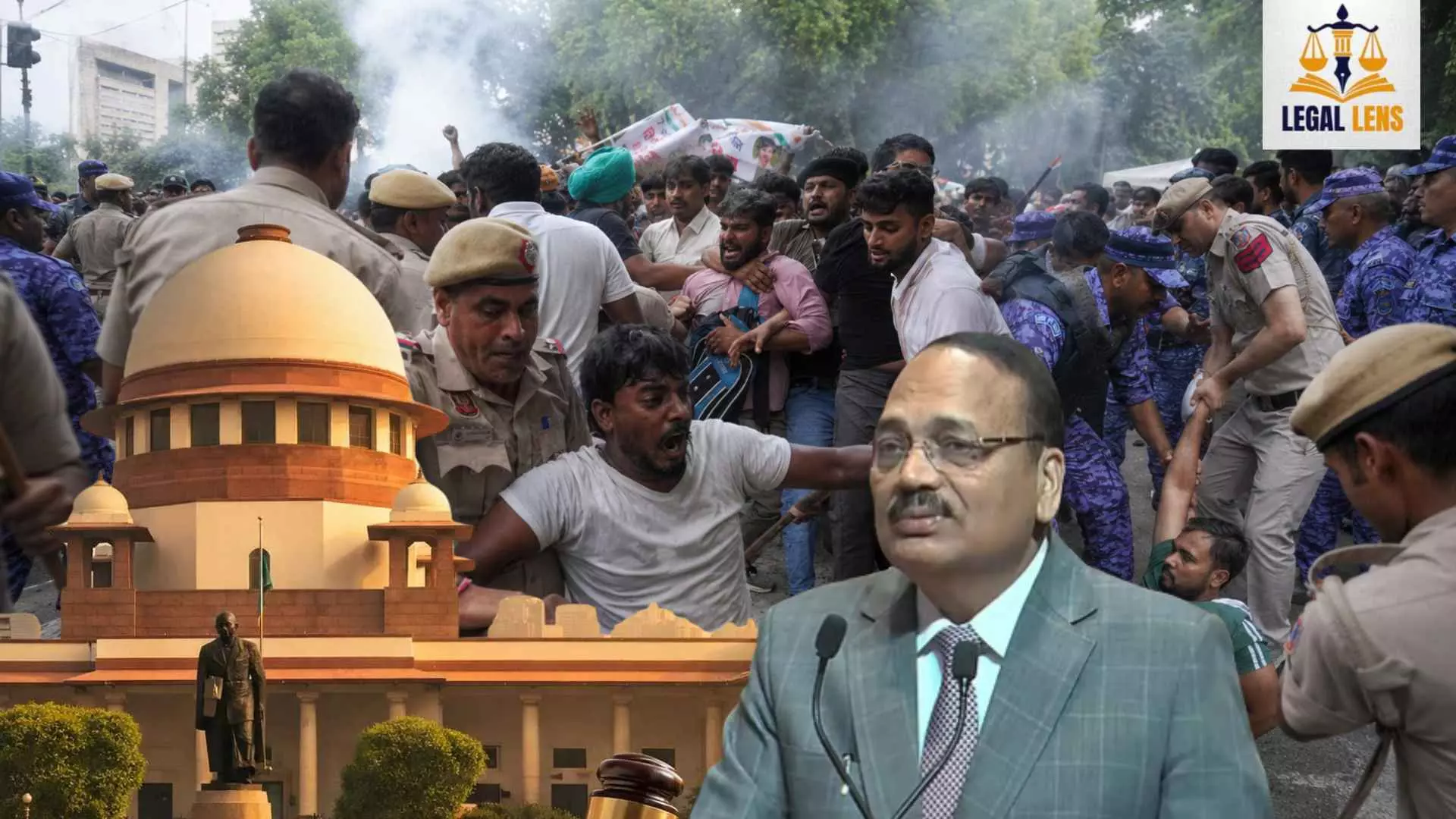
The Supreme Court opened on Wednesday (July 22) with a mention, the brief oral plea by which lawyers seek an urgent hearing. Advocate Narendra Mishra rose before the Bench of Chief Justice of India (CJI) Surya Kant and Justices Joymalya Bagchi and V Mohana. His petition concerned the Delhi Police action against students who marched towards Parliament on July 20 as part of their protest against the exam paper leaks.
Violence at ‘Sansad Chalo’ march
“Don’t waste our time, and don’t waste your time,” the CJI had curtly told the advocate. Mishra offered the bench videos purportedly showing policemen assaulting unarmed protesters. The reply was still blunt: “We are not interested in videos; we don’t have time to watch.”
The ‘Sansad Chalo’ march spearheaded by the Cockroach Janta Party (CJP) coincided with the opening day of Parliament’s Monsoon Session. Thousands of protesters from different walks of life walked towards Parliament from Jantar Mantar, in demand for Union Education Minister Dharmendra Pradhan’s resignation over the alleged NEET paper leak. They also demanded accountability for student suicides and reform of the National Testing Agency (NTA).
Also read/watch: Has CJP protest revealed a chink in BJP’s armour? | Talking Sense With Srini
The CJP had given the call after a hunger strike at Jantar Mantar by students and climate activist Sonam Wangchuk, stretching for over three weeks, elicited no response from the government. Police halted the marchers with layered barricades. What followed after that is what the courts have now been asked to examine. The petitioners allege excessive force. The police allege rioting and stone pelting by the protesters, and have registered at least nine FIRs in central Delhi.
Suo motu cognisance not rare
Mishra had asked the court to act suo motu, on its own motion, without the listing of a formal petition. Nothing in the Constitution bars such action, and the court has used it recently. In August 2024, it took suo motu cognisance of the rape and murder of a doctor at Kolkata’s RG Kar hospital. The court reasoned then that the case raised systemic issues beyond one crime. A police crackdown on thousands of citizens outside Parliament would seem to raise questions no less systemic. The CJI, however, thought otherwise, telling Mishra to take proper recourse in law. Read strictly, the CJI refused nothing but haste. His advice to take proper recourse in law leaves room for a regularly filed petition to be heard in due course.
In June 2011, the Delhi Police descended at midnight on protesters sleeping at Ramlila Maidan. The SC acted suo motu on news reports. In their order in February 2012, Justices Swatanter Kumar and BS Chauhan found the eviction unjustified.
That defence collapses on the court’s own record. Since the early 1980s, the court has treated letters, telegrams and even postcards as writ petitions. That epistolary jurisdiction was invented precisely for those who could not afford proper recourse. In October 2021, a letter from two Uttar Pradesh lawyers on the Lakhimpur Kheri killings was taken up within days. The bench comprised then chief justice NV Ramana, and Justices Surya Kant and Hima Kohli. The court has never insisted on form when it wished to act; form appears when it does not. What the country heard on Wednesday, therefore, was not procedure. It was tone.
SC refuses, HC tunes in
Proper recourse was already underway, and had met the same wall. On Tuesday (July 21), a Delhi High Court bench of Chief Justice Devendra Kumar Upadhyaya and Justice Tejas Karia declined an urgent hearing. “Don’t drag the court into all this,” the chief justice had remarked.
By Wednesday (July 22), the high court had changed the register entirely. After allowing an urgent mention, the same bench issued notice on a batch of public interest petitions. Senior advocates N Hariharan, Gopal Sankaranarayanan and Vikas Singh appeared for the petitioners. One petition submitted that the incident had shocked the conscience of the entire nation. The bench directed the Delhi Police and the Union government to answer within four weeks. It ordered preservation of all records, including CCTV footage and videography. It observed that these were not isolated incidents for which victims could be told to file individual complaints.
Also read: Blood on Capital streets as doctors, students unite in CJP protests
And where the Supreme Court had no time to watch, the high court watched. When the police counsel alleged stone pelting, the bench viewed videos of the incident furnished by the lawyers. The hearing of the matter resumes on September 11.
When SC set course without hearing
The obvious defence of the Supreme Court’s refusal is judicial hierarchy. The high court was seized of the matter, and the top court is no forum for disputed facts. That was the logic in December 2019, when the police stormed Jamia Millia Islamia and Aligarh Muslim University. “We are not trial courts,” a bench headed by then chief justice SA Bobde said, remitting petitioners to the high courts.
The court’s own Bar saw the incident differently. The Supreme Court Bar Association condemned the “brutal lathi charge on innocent students” and demanded an independent inquiry.
Two details complicate the comfort of that precedent. The Bobde bench at least heard senior advocates Indira Jaising and Colin Gonsalves for over two days before remitting. And sitting beside former chief justice Bobde and Justice BR Gavai was a puisne judge named Surya Kant. The aftermath tested the remedy the court prescribed. Nearly three years later, Gonsalves told the Supreme Court that not a single FIR had been registered against any of the policemen. The top court merely requested the high court to decide early, declining to fix a time. Proper recourse, on that occasion, was a road without a destination.
When SC stood by Ramlila Maidan protesters
The stronger counter-precedent is older. In June 2011, the Delhi Police descended at midnight on protesters sleeping at Ramlila Maidan. The Supreme Court did not wait for a petition; it acted suo motu on news reports. In the Ramlila Maidan incident, decided in February 2012, Justices Swatanter Kumar and BS Chauhan found the eviction unjustified.
Also read: 'Too much support': CJP urges well-wishers to stop sending food to protest site
The top court faulted the hasty invocation of Section 144 of the Code of Criminal Procedure and ordered compensation for the affected protesters. It were sleeping citizens then, and marching students now. No doctrine explains the distance between the two responses. No judgment tells a chief justice when to act on his own motion and when to look away.
No uniform rule
That vacuum is precisely what troubles lawyers. Scholars have long observed that, absent criteria, the court’s suo motu interventions have not been uniform. Selectivity invites the charge of arbitrariness. Within hours of Wednesday’s exchange, lawyers were privately trading lists of matters the court had heard without any formal filing. The deeper complaint at the Bar concerns judicial speech itself: remarks that decide nothing, yet damage much. To know whether a mentioning succeeds depends on the chief justice of the day; there is no published standard, no reasoned order and no appeal. A refusal at mentioning leaves no trace on the record. It survives only as a dismissive sentence, and as that sentence’s afterlife on social media.
Also read: Congress says PM ‘rattled’, ‘shaken’ after Modi’s X post on exam paper leak
The court’s own Bar saw the incident differently. The Supreme Court Bar Association condemned the “brutal lathi charge on innocent students” and demanded an independent inquiry. Its resolution recorded that members of the legal fraternity were among the injured. The Advocates-on-Record Association joined the condemnation. Not every voice at the Bar agreed.
Has top court chosen a side?
On July 21, Supreme Court Advocate-on-Record Pragya Paarijat Singh posted that government panel lawyers “cheering or aiding rioters” must be identified and immediately removed. Sonam Wangchuk, whose fast preceded the march, wrote to Union ministers JP Nadda and Jitendra Singh on July 22. He sought an assurance that no protester would face punitive or retaliatory legal action. The FIRs already registered suggest the assurance is not on offer. A court that declines even to watch the video decides, in effect, who gets believed first.
There is one more thing the court had no time to notice. The videos it declined to watch may soon be scarcer. Mobile internet was suspended in parts of central Delhi through the day of the march, and was restored only by evening. Telecom operators confirmed receiving government instructions; subscribers received texts citing them. No suspension order has been published.
Also read: NEET protests: Delhi lit the spark, and small towns, cities are keeping it burning
On Wednesday night, digital rights groups reported a fresh shutdown around Jantar Mantar. Parts of Delhi were also placed under Section 163 of the Bharatiya Nagarik Suraksha Sanhita, successor to the Section 144 invoked at Ramlila Maidan. In Anuradha Bhasin v. Union of India (2020), the Supreme Court held that every suspension order must be published and justified. The Telecommunications Act, 2023 and its 2024 suspension rules now write that duty into law. SFLC.in has demanded restoration, publication and review of the orders within five days. The high court has directed that footage of the crackdown be preserved. The state has been narrowing the means of creating it.
All eyes on Delhi HC
The Delhi High Court will now do the work: notice, affidavits, preserved footage, a September hearing. That is the system functioning, and it may yet vindicate the hierarchy argument. But satire has already filed its judgment. Digital rights researcher Srinivas Kodali shared a video from the protest site with a caption. “Courts don’t have time to hear people’s issues. People are starting their own courts.” A court that once rose for citizens asleep in a maidan had no time for those who say they were beaten outside Parliament. The difference between those two mornings is the question the institution must now answer.