SC labour verdict: Old cases protected under 1978 test, ‘industry’ definition still unsettled
In nine-judge verdict, four judges float narrower test for word ‘industry’, five disagree; real fight now shifts to new Industrial Relations Code which must be interpreted independently

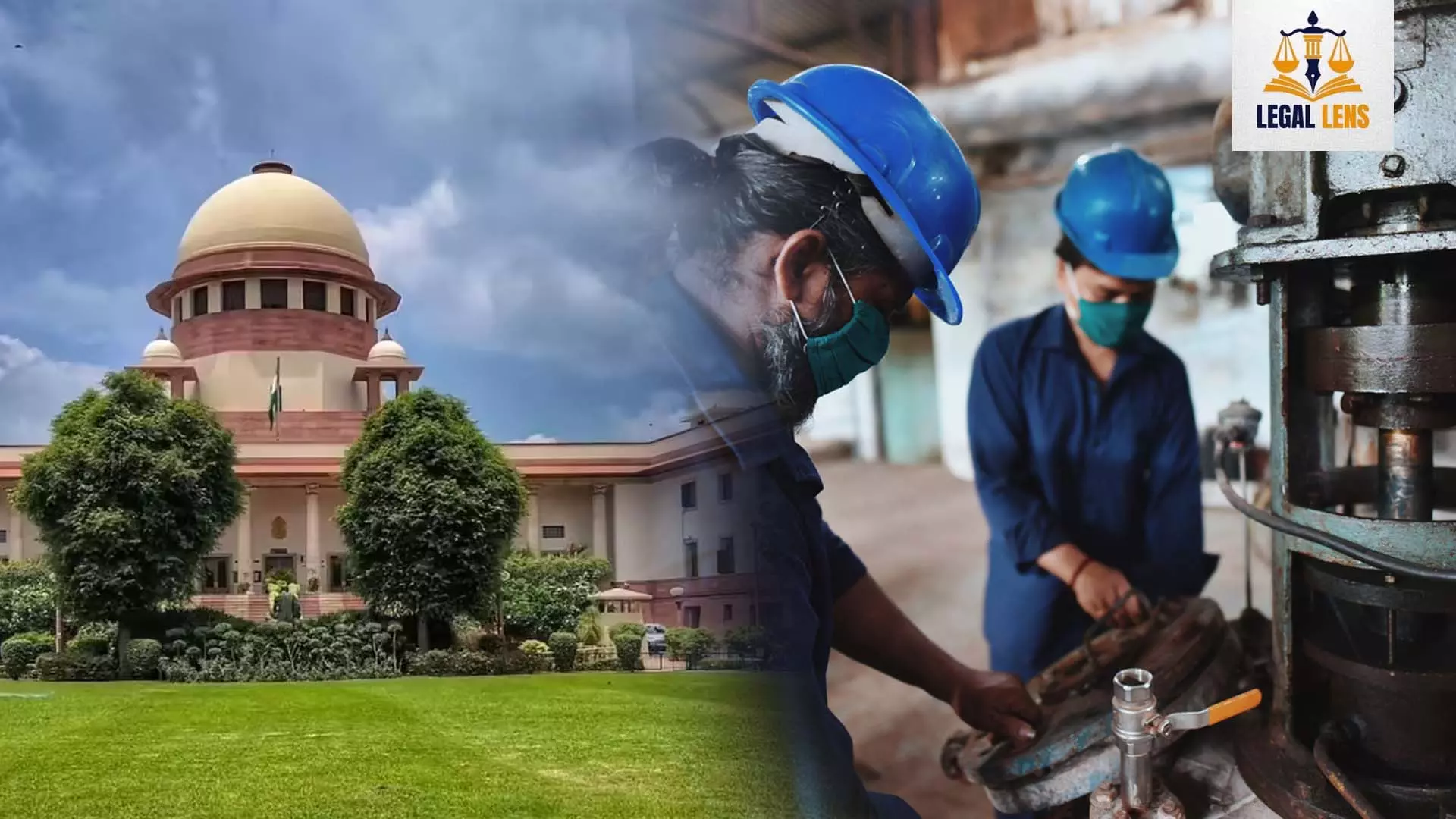
On August 20, nine judges of the Supreme Court answered the oldest labour law question on their docket – What is an "industry”? The question had waited 21 years for an answer.
The answer runs to 489 pages and five separate opinions.
For the millions of workers whose cases are stuck in labour courts and tribunals, the practical outcome is simple. Nothing changes. Every dispute pending under the old law will be decided under the worker-friendly test laid down in 1978.
The longer answer is more complicated, and more consequential. Four judges sketched a narrower test for the word "industry". Five judges refused to join them. And all nine agreed that the new Labour Code, which now governs fresh disputes, must be read on its own terms. Here is what it all means.
What was the case about?
The story begins with daily wagers working in a tree-planting welfare scheme in Uttar Pradesh's Social Forestry Department. They raised disputes under the Industrial Disputes Act, 1947. The state argued that a welfare scheme is not an "industry", so the Act did not apply to them at all.
Also read: Draft labour rules not only weaken worker protections but also hurt economy
In May 2005, a five-judge bench hearing their appeals, in State of UP v Jai Bir Singh, went further. It doubted the correctness of the Supreme Court's own 1978 ruling on the meaning of “industry”. It asked the Chief Justice to place that ruling before a larger bench.
The larger bench took its time. In January 2017, seven judges directed that nine judges hear the matter. The hearing itself came only in March 2026. Nine judges heard arguments over three days. The verdict came on August 20.
Significance of the word ‘industry’
Because it is the key that opens the door to labour law. The 1947 Act gave a workman real remedies. She could raise a dispute over dismissal or wages. She could go to a labour court or tribunal. She could win reinstatement with back wages, or compensation for retrenchment.
But every one of those remedies had a precondition. The workplace had to be an "industry". The Act defined that word in Section 2(j), its definition clause. If the employer fell outside the definition, the labour court's door stayed shut. The worker was left to an ordinary civil suit, which was slower and costlier.
Think of a ward attendant in a charitable hospital. A lab assistant in a university. A sweeper engaged by a municipal board. Whether each of them could knock on a labour court's door depended entirely on whether their employer counted as an "industry".
What did the 1978 ruling say?
The dispute in Bangalore Water Supply v A Rajappa began with fines imposed on workmen of a water board. The board argued it was a statutory body, not an "industry", so the labour court had no jurisdiction. The question reached a seven-judge bench.
Justice VR Krishna Iyer's majority opinion answered it with a three-part test, remembered ever since as the triple test. Is there systematic activity? Is it carried on through cooperation between employer and employee? Does it produce or distribute goods or services that satisfy human wants? If yes to all three, the establishment is an industry.
Also read: New labour codes: From gratuity after 1 year to equal pay, all you need to know
Crucially, profit did not matter. A charitable hospital, a university, a municipal board and a club all came within the Act. Only the core sovereign functions of the State, such as defence and law making, stayed outside.
The judges knew the definition needed legislative repair. Parliament passed an amendment in 1982 to narrow it, but never brought that amendment into force. So the 1978 test governed Indian workplaces for the next 48 years.
What does the latest judgment say?
Three things command the agreement of all nine, and these are the operative parts of the verdict.
First, every dispute pending under the 1947 Act will be decided under the 1978 triple test. Second, cases already decided will not be reopened. Third, the Industrial Relations Code, 2020, which replaced the Act, must be interpreted independently. Neither the 1978 ruling nor this new judgment will serve as its guide.
The part that made headlines is different. Chief Justice Surya Kant, writing for himself and Justices Satish Chandra Sharma, Alok Aradhe and Vipul M Pancholi, proposed a change to the third limb of the triple test. The goods or services, on his reformulation, must have a "discernible commercial character", something resembling trade or business.
Also read: Govt ushers in major reforms, notifies 4 labour Codes; mandates social security for gig workers
Profit would still be irrelevant. But purely spiritual or religious activity, and activity with no resemblance to economic enterprise, would fall outside.
Then came the twist. The Chief Justice framed his new test "hypothetically speaking". It will not decide any pending case. It will not govern the new Code. It decides, in the here and now, nothing at all.
Opinion of other five judges
Justice P.S. Narasimha declined to rewrite the test. He agreed the reference was validly made. But the provision being interpreted had been repealed, he pointed out, so a fresh authoritative definition had become pointless. Rewriting the rules only for pending cases, he warned, would create confusion and push old disputes into civil courts.
Justice Joymalya Bagchi went further in the opposite direction. He praised the 1978 test and said the changes in the economy since then had strengthened the case for keeping it, not revisiting it. Justice BV Nagarathna held the reference should never have been made and listed 10 reasons for leaving the old ruling alone. Justices Dipankar Datta and Ujjal Bhuyan, writing jointly, agreed the reference deserved rejection. Courts, Justice Datta observed, protect their credibility by respecting the finality of settled decisions.
Also read: Take-home pay shrinks despite salary hikes, thanks to new labour codes
Count the positions and the arithmetic is plain. Six judges upheld the making of the reference. Four proposed a new test. Five refused to disturb the 1978 ruling. Nine protected pending cases and left the Code alone.
Is verdict anti-worker?
The criticism writes itself. The country's highest court, at its largest strength in years, has floated a narrower meaning of "industry". A narrower definition means fewer protected workers. Hence the charge that the verdict weakens labour safeguards.
Test that charge against what the verdict actually does, and it lands somewhere unexpected.
For today, it misses. No pending dispute will be decided on the narrower test. No concluded award will be reopened. A worker whose case has waited 15 years before a tribunal loses nothing. The decision will come under the same generous test that applied when the case was filed.
Also read: New labour codes a boost or blow to workers? Expert KE Raghunathan weighs in
For tomorrow, the charge has force, but at a different address. Judgments are remembered for their reasoning, not their disclaimers. Four judges have reasoned, at length, that an industry should bear some commercial character. That reasoning sits on the record, waiting for the day the new Code's definition is tested. And Parliament, as it happens, has already written some of that narrowing into the Code itself.
The worry, in short, is real. But it attaches less to what the court decided than to what future courts, and Parliament, may do with it.
Where does new Labour Code fit in?
The Industrial Relations Code, 2020 came into force on November 21, 2025 and repealed the 1947 Act. Every dispute arising after that date falls under the Code, not the Act.
The Code carries its own definition of "industry", in Section 2(p). Its opening words copy the triple test almost exactly. But Parliament then added written exclusions that the old Act never had. Institutions run by charitable organisations are out. Domestic service is out. Activities connected to the government's sovereign functions are out. And the Central government can notify further exclusions.
Also read: Will new labour codes bring transformative changes? Answer is not clear yet
In other words, the narrowing that four judges could only describe hypothetically has, in part, already been enacted by Parliament. The battles the 1978 test settled will now be fought afresh, clause by clause, under Section 2(p).
What happens next?
The pending cases will be listed before regular benches on the Chief Justice's orders, and tribunals will dispose of them under the 1978 test. That is real relief for litigants who have waited a generation.
The first big test of the Code's definition is only a matter of time. Is a private hospital an "industry" under Section 2(p)? A university? A government welfare scheme? When that case comes, one side will cite the four judges on commercial character. The other side will cite the same judgment's insistence that the exercise was hypothetical. The Supreme Court has guaranteed itself a return visit.
In March, when the hearing opened, the question before the court was who counts as a worker. Five months and 489 pages later, that question is still open. It has only moved from a 1947 Act to a 2020 Code.