In Assam's Citizenship cases, SC draws a line between proof and process
Detention and statelessness cannot follow a hearing that never happened, the Supreme Court tells tribunals

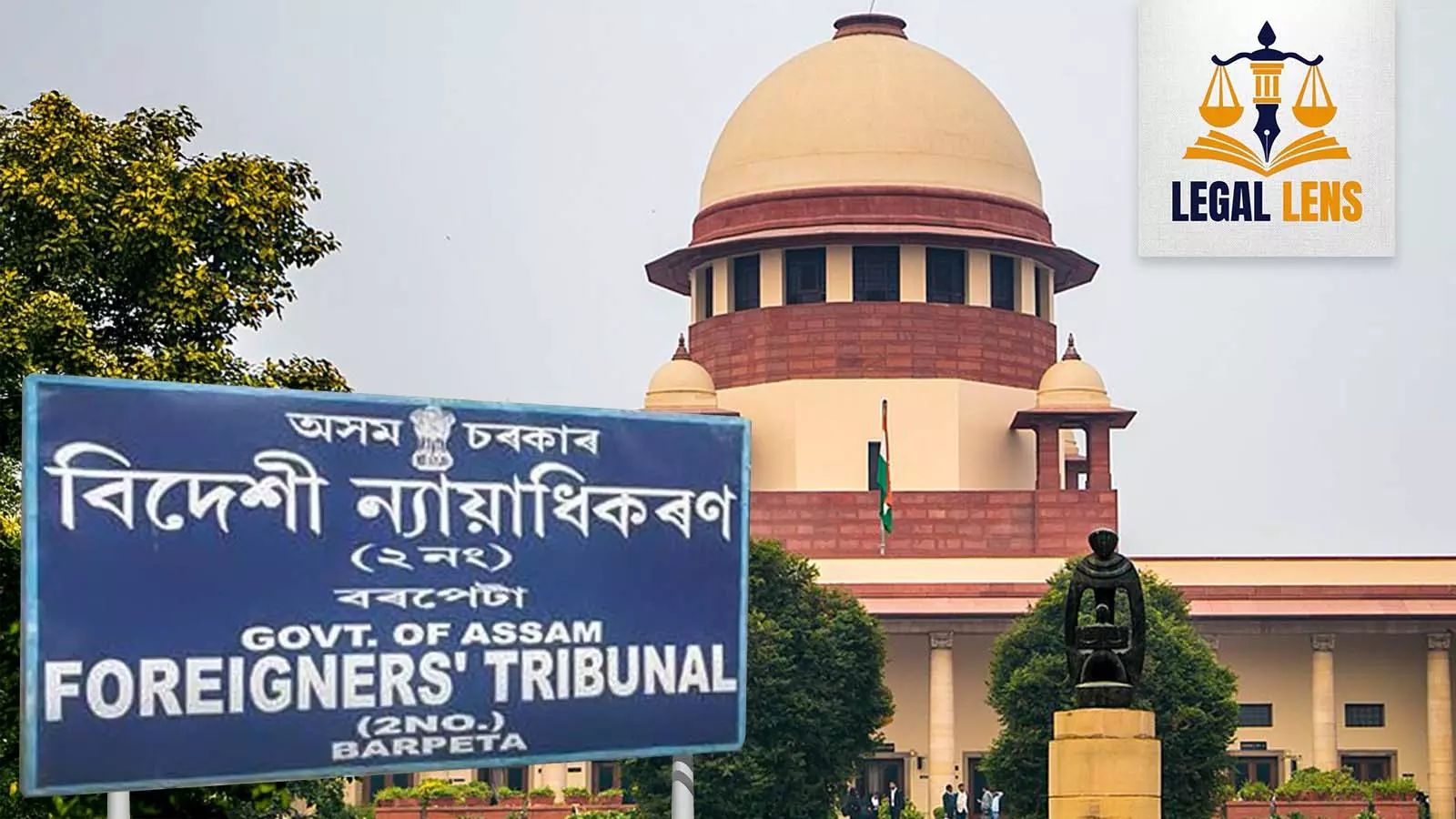
Supreme Court held that an absent person can be declared a foreigner only after a real adjudication.
If a party fails to appear before a court for a hearing, it may reasonably be inferred that the result could go against them. It is quite another thing for that absence, on its own, to mark someone as a foreigner in the land they call home. Yet in Assam, that is often how it has worked. People have been declared foreigners in hearings they never attended, and sometimes never knew about.
The Supreme Court has now drawn the line afresh. On July 13, a Bench of Justices Vikram Nath and Sandeep Mehta decided a batch of citizenship appeals from Assam. It held that an absent person can be declared a foreigner only after a real adjudication. The tribunal must weigh the State's evidence and give reasons.
Reinforce on procedure
In these cases, the law puts the onus on the person to prove they are not a foreigner. But that onus, the Court said, has limits. “The burden … operates within a legal process. It does not replace the legal process itself.” That line captures the message of the Court's judgment in Sabitri Dey alias Swasthi Dey v Union of India.
Also read: SC says citizenship must be determined fairly, sets aside Assam Foreigner Tribunal orders
The appeals came from people whom Foreigners Tribunals in Assam had declared to be foreigners. Some cases arose before the former Illegal Migrants (Determination) Tribunals. The Gauhati High Court had upheld those findings. The Supreme Court set aside both the tribunal opinions and the High Court judgments, and remitted the cases.
The ruling does not hold that the appellants are Indian citizens. Nor does it accept their documents as genuine or sufficient. It lays down the minimum procedure the State must follow before fixing the gravest of labels: that a resident of India is a foreigner.
Case of absent person
A case begins when a person is named as a suspected foreigner and sent to a tribunal. They must then prove that they are not a foreigner. An absent person here is simply one who does not appear. Some never come. Others appear once, then drop out.
Absence is often not defiance. Notices are frequently affixed at a house or served before a village headman. Many never reach the person. In one appeal here, the notice was pasted up after the person refused it. The poor, the migrant and the illiterate may learn of a case only once they are declared foreigners.
Foreigners Tribunals exist under a national law. In practice, they work at scale almost only in Assam. The State's history explains this. The Assam Accord of 1985 fixed 24 March 1971 as the cut-off for detecting foreigners. Suspected cases reach the tribunals from the Border Police and from “doubtful voters” flagged by the Election Commission.
Also read: Assam citizenship verdict shows one missing link can cost you your nationality
The scale is vast. The updated National Register of Citizens, published in 2019, left out about 19 lakh people. Each must satisfy a tribunal. With thin documentation and scattered, marginalised populations, ex parte findings became common. A 2019 study of 500 tribunal orders by journalist Rohini Mohan found that about 78 per cent were passed without hearing the accused.
A heavy burden
This burden is an unusual one. In an ordinary case, the party making an allegation must prove it. Section 9 of the Foreigners Act, 1946 reverses the rule. It requires the person to disprove the charge, once a question about their status is raised. The reason is practical. Facts about birth, parents, lineage, residence and migration usually lie within the person's own knowledge.
The Court did not dilute this rule. But the reverse burden does not let a tribunal treat the police reference as automatically correct. It does not let absence stand in for proof. The tribunal must first conduct a lawful adjudication. Section 9, the Court said, does not authorise a “mechanical declaration”.
The procedure sits in the Foreigners (Tribunals) Order, 1964. The tribunal must serve the “main grounds” on which the person is alleged to be a foreigner. This means more than a bare assertion or a vague suspicion. The Court drew the point from its 2024 ruling in Md. Rahim Ali alias Abdur Rahim v State of Assam. A bare suspicion cannot start the machinery. The authority must hold some material, and must tell the person the substance of the case. No one can disprove an accusation they have never seen.
Also read: 15 documents not enough to prove citizenship: Assam man declared foreigner by HC
The person must then get a real chance to reply, produce documents and lead evidence. The Superintendent of Police may also produce evidence for the reference. The tribunal must then give an opinion with a concise statement of facts and a conclusion. These duties survive the person's absence. A tribunal may proceed ex parte after valid service. It need not adjourn a case forever for someone who stays away. But it must still verify service, confirm that the grounds were communicated, and test whether the State's material supports the allegation. It must apply its mind and record reasons. A tribunal cannot reason that a person failed to appear and must therefore be a foreigner.
Rights that do not turn on citizenship
The Court rested its conclusion on the Constitution as well. Article 14 guarantees equality before the law to “any person”. Article 21 says “no person” shall be deprived of life or personal liberty except by lawful procedure. Neither protection is confined to citizens.
A foreign national has no fundamental right to reside and settle in India. The State may regulate the entry, stay and removal of foreigners. Yet even a person finally found to be a foreigner is entitled to fair procedure while that status is decided. Earlier rulings had settled this. In Louis De Raedt v Union of India (1991), the Court held that foreigners enjoy the protection of Article 21. It affirmed the same in National Human Rights Commission v State of Arunachal Pradesh (1996) (the Chakma refugees case).
The consequences are severe. A declaration can lead to detention, deportation, separation from family, and even statelessness. A formal notice followed by a formal order is therefore not enough. Citing Maneka Gandhi v Union of India (1978), the Court repeated that procedure must be fair, just and reasonable, and never arbitrary.
Three groups, one standard
The Court sorted the appeals into three groups.
The first held six people who never appeared, despite a finding that notice was served. The tribunal could proceed in their absence. But their cases still needed reconsideration, since status cannot be declared by default alone.
The second, two cases, covered the High Court examining the documents itself while hearing a challenge to an ex parte order. The Court held that the High Court should not ordinarily be the first forum to assess such evidence. Ancestry, family links, electoral records and residence may need proof, explanation and rebuttal. That task belongs to the tribunal. A fresh look by the High Court cannot cure the tribunal's failure.
Also read: Interview: Can Assam ‘push back’ people without proof? Ex-BJP MP slams 1950 law
The third group, 20 matters, held people who took part and then defaulted. The Court was critical of their conduct. A person who appears cannot treat the proceeding casually or vanish when evidence is due. Even so, their default did not free the tribunal from weighing the record and giving reasons. They too received one final opportunity, on strict conditions.
Limits of the ruling
The Court was careful about the limits of its ruling. It did not examine the merits of any citizenship claim. It made no finding on whether the documents were genuine, admissible, relevant or sufficient. Those questions now return to the tribunals. The judgment lifts the existing declarations. It does not replace them with declarations of citizenship.
The terms of the remand are strict. The appellants must appear before their tribunals within four weeks. They may file written statements, documents and affidavits. The State and the reference authorities may also lead evidence. Extensions come only for sufficient reasons recorded in writing, and the appellants must not seek needless adjournments. No coercive action may be taken on the basis of the opinions now set aside, provided the appellants appear and cooperate. The tribunals should decide, preferably, within six months of first appearance. If a person fails to appear or cooperate, the tribunal may proceed in law.
Proving citizenship
The judgment is at once modest and far-reaching. It draws a clean line between the burden of proof and the duty to adjudicate. The person still bears the hard burden of proving citizenship. The ruling neither shifts that burden to the State nor presumes citizenship. What it forbids is turning a reverse burden into an automatic finding against an absent person.
The State's interest in identifying those not entitled to citizenship remains legitimate. It may guard against false claims and against delay. The Court has asked only that the label “foreigner” follow evidence and a reasoned decision. It cannot follow from silence, absence or default.
That distinction carries weight because the stakes are rarely higher. A wrong finding can cost a person their home, their family and their place in the only country they know. For such a decision, a hearing cannot be a formality. The Court has asked Assam's tribunals to give a hearing worth the name.