Vijay govt's balancing act: Allies with one foot in, one foot out
Legal Lens |Four parties from DMK alliance are sustaining Vijay's government; while the arrangement is legal, it's politically explosive, and brand new in India

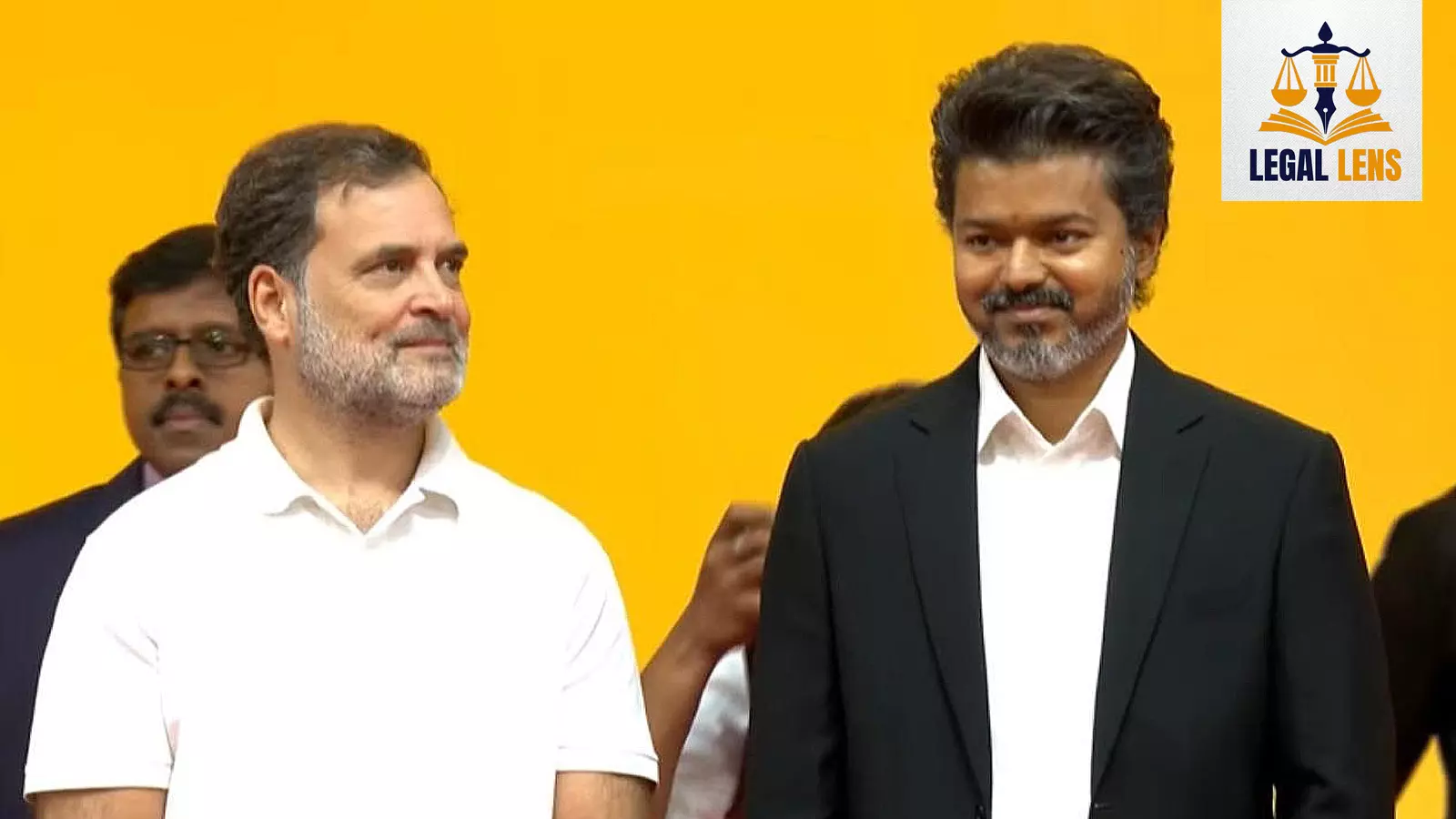
When C Joseph Vijay was sworn in as Tamil Nadu's Chief Minister at 10 am today, the ceremony at the Nehru Indoor Stadium, Chennai concluded a week of frantic arithmetic. What it has not concluded is the question of what kind of government Tamil Nadu now has.
The form of support that put the Tamilaga Vettri Kazhagam (TVK) in office is, in its precise structure, without parallel in Indian politics. Neither the Centre nor any state has seen the like of it.
Not really a coalition
The descriptive label most reporters have reached for is "coalition." It is not quite that. Of the parties supporting Vijay, only the Congress walked out of the Secular Progressive Alliance (SPA) led by the DMK.
The CPI, CPI(M) and the Viduthalai Chiruthaigal Katchi (VCK) have formally stated they will continue inside the SPA. They will continue with the DMK on broader political questions. They are supporting from outside without any cabinet berth. The Indian Union Muslim League (IUML) has joined them in extending support.
Also read | Suvendu vs Vijay: Two first-time CMs take oath, reflecting two Indias
This is the structural feature that has no Indian precedent.
Outside support of minority governments is familiar in Indian history. What is not familiar is outside support extended by parties that remain, at that moment, members of the parent alliance of the principal opposition.
A pattern overturned
In every comparable instance at the Centre or in the states, the supporting parties were unaligned outsiders. They sat in no rival front; their backing carried no contradiction with the formal architecture of opposition.
The supporting parties have chosen to keep one foot in the parent alliance and the other in a government they are sustaining.
The Tamil Nadu case overturns that pattern. The CPI, the CPI(M) and the VCK will vote to install Vijay on the floor of the Assembly. They will do so while remaining constituents of the alliance led by the chief opposition party. Tamil Nadu's own history offers no parallel either.
The first reaction of those trained in the Tenth Schedule is to ask whether this produces a contradiction for the supporting MLAs. The answer is that it does not. The Tenth Schedule disqualifies a member only for voting against a direction issued by the political party to which they belong. The political party for a CPI MLA is the CPI, for a VCK MLA the VCK.
Pre-poll alliances are not political parties for that purpose. They issue no whips that the Constitution recognises. The SPA's preference, even if expressed, has no legal weight. There is no legal contradiction to resolve.
Legal vs political contradiction
The political contradiction, however, is acute. The supporting parties have chosen to keep one foot in the parent alliance and the other in a government they are sustaining. That posture is sustainable for as long as the parent alliance accepts the arrangement. The DMK's tolerance once its own opposition role hardens will determine the shelf-life of the Vijay government.
Political scientist E Sridharan has catalogued the typology of Indian coalitions. He identifies four types:
a) Minimal winning, where there are only enough parties to get a majority
b) Surplus majority, where, like the present NDA coalition at the Centre, some of its partners are redundant
c) Minority coalition
d) Single-party minority government with external support
The TVK government is the last, but with a wrinkle Sridharan's typology does not capture. The external supporters are not unattached. They have a parent home, and that home is in the rival camp.
In surplus majority coalitions, as Sridharan points out, no party is pivotal, and one party can’t pull out and threaten the ruling party. The redundant partners in a surplus coalition are like an insurance policy, Sridharan suggests.
The DMK's tolerance once its own opposition role hardens will determine the shelf-life of the Vijay government.
The longevity of theTVK government depends on whether Vijay is able to draw lessons from the NDA experiment at the Centre and aim at securing a few redundant partners to claim support over and above the majority mark.
Global parallels
The closest international parallel is what political scientists Tim Bale and Torbjörn Bergman, writing in 2006, called contract parliamentarism. In Sweden in 2014, the Social Democrats and Greens governed in a minority with written confidence-and-supply support from the Centre and Liberal parties.
Watch/Read: 'CM Vijay's promise to release white paper on TN affairs critical' | Interview
Similar arrangements have sustained New Zealand's minority governments since the late 1990s. The defining feature is not outside support as such. It is a written agreement that fixes what the supporting parties will get in policy terms in exchange for guaranteed votes on confidence and supply.
The agreement creates an inside and an outside. It lists the issues on which the support holds, with a residual category on which it does not.
Tamil Nadu has the support without the contract. The letters submitted to the Governor speak the language of preventing President's Rule and of secularism. They do not specify a programme. There is no Common Minimum Programme, no allocation of policy turf, no agreed mechanism for resolving disputes between TVK and its supporters when they arise. Each occasion of disagreement, when it comes, will be negotiated from a standing start.
Absence of written pact
The absence of a written agreement matters less for the immediate floor test than for what comes after. A budget will have to be moved.
Bills will have to be steered through the Assembly on subjects the supporting parties may not agree on. Federal disputes with the Centre will continue and the supporters' positions may diverge from TVK's.
The formative weeks of Vijay's administration will be spent inventing conventions other states have refined, with little precedence in Tamil Nadu.
In Sweden, even with a written agreement in force, the Centre Party walked out of the January Agreement when housing-rent deregulation came up. The agreement at least delineated what was inside it; everything outside was openly negotiable. Tamil Nadu's arrangement has no inside and no outside. Every issue is, in principle, open.
TN's own experiences
There is a second feature of the experiment that compounds this. The state has no muscle memory of coalition cabinet practice. Tamil Nadu has been governed by a single party in continuous succession since 1967, when CN Annadurai's DMK came to power and ended Congress rule.
Watch/Read | Beaten, yet Congress could see green shoots in Mamata-less Bengal
Fifty-nine years of single-party rule have shaped the secretariat's file practices. They have shaped how cabinet committees are constituted. They have shaped how the Speaker's office relates to the leader of the House. They have shaped how anti-defection administration operates within a chief minister's party.
None of that has been built for a government in which the chief minister leads one party while four others hold the casting numbers.
State of other governments
Other states have decades of coalition cabinet experience to draw on. Kerala has practised front-based governance since 1957, with cabinet conventions, dispute-resolution forums and seat-sharing arithmetic refined over generations.
Maharashtra ran formal coalitions from 1999 to 2014. West Bengal sustained the Left Front for thirty-four years.
Tamil Nadu is starting from a standing position with an additional handicap: in those states, allied parties were inside the cabinet. In Tamil Nadu, indications are that while the Congress may join Vijay’s cabinet, other post-poll allies may keep out.
For Vijay, this means the formative weeks of his administration will be spent inventing conventions other states have refined. The allocation of portfolios may appear to be the easy part because most of the supporting parties have said they will not enter the cabinet.
Speaker role is critical
The harder work concerns the Speaker's office. The Speaker is elected by the House and adjudicates defection petitions. With no allied legislators in cabinet, the Speaker becomes the principal point of contact between TVK and its outside supporters.
How that role is performed will set the tone for the administration. A Speaker drawn from TVK ranks will face an immediate test. The question will be whether the office's adjudicatory function can survive the holder's partisan affiliation.
What the experiment has on its side is the deadlock that any withdrawal would trigger. Neither Dravidian party emerged with the numbers to assemble an alternative. Pulling down the TVK government would invite President's Rule.
The Left has stated it does not want that outcome, viewing Central rule as a proxy BJP regime. That cost discipline may hold the arrangement together longer than the absence of a written agreement suggests.
A five-year test
Tamil Nadu will discover the conventions it needs as it goes. India's constitutional and statutory framework is robust enough to accommodate the arrangement. The political framework supporting it has never been tested before.
The next five years are the test. As Sridharan observed on the basis of coalition experiments by different parties at the Centre and in the States, coalition politics does not have to be unstable or incompetent.